In August 2025, a man called Mark opened apps and composed text on an iPad without using his hands. Mark lives with ALS and participates in Synchron’s COMMAND study. In the company’s demonstration, an implanted sensor and Apple’s accessibility software turned his intention to move into a way to operate the screen. The destination was familiar. The route there was decidedly unusual.
- Stentrode records motor intent from inside a brain blood vessel.
- A catheter delivers it through the jugular vein, avoiding open-brain surgery.
- Digital control has been demonstrated in trials; the system remains investigational.
For someone whose hands no longer cooperate, a screen can become a window with no handle. News, shopping, messages, the minor pleasures and obligations of a day: all remain visible. Synchron is trying to supply another handle. Its ambition begins with the small, consequential freedom to make a selection yourself.
A very useful detour
The company’s founding insight concerns anatomy as much as computing. Traditional implanted interfaces can require opening the skull to place electrodes. Synchron asked whether the brain’s blood vessels could provide an alternative route. Its own account credits cardiology’s catheter-delivered stents and pacemakers as inspiration. There was already a medical vocabulary for reaching difficult places through the circulation.
Thomas Oxley, a physician specializing in neurointervention, and Nicholas Opie, a biomedical engineer, brought complementary expertise to that question. The University of Melbourne dates their company’s establishment to 2012. University researchers, the Royal Melbourne Hospital and the Florey Institute helped build the research ecosystem around it. The collaboration mattered: this problem needed knowledge of vessels, materials, electrical signals and patients.
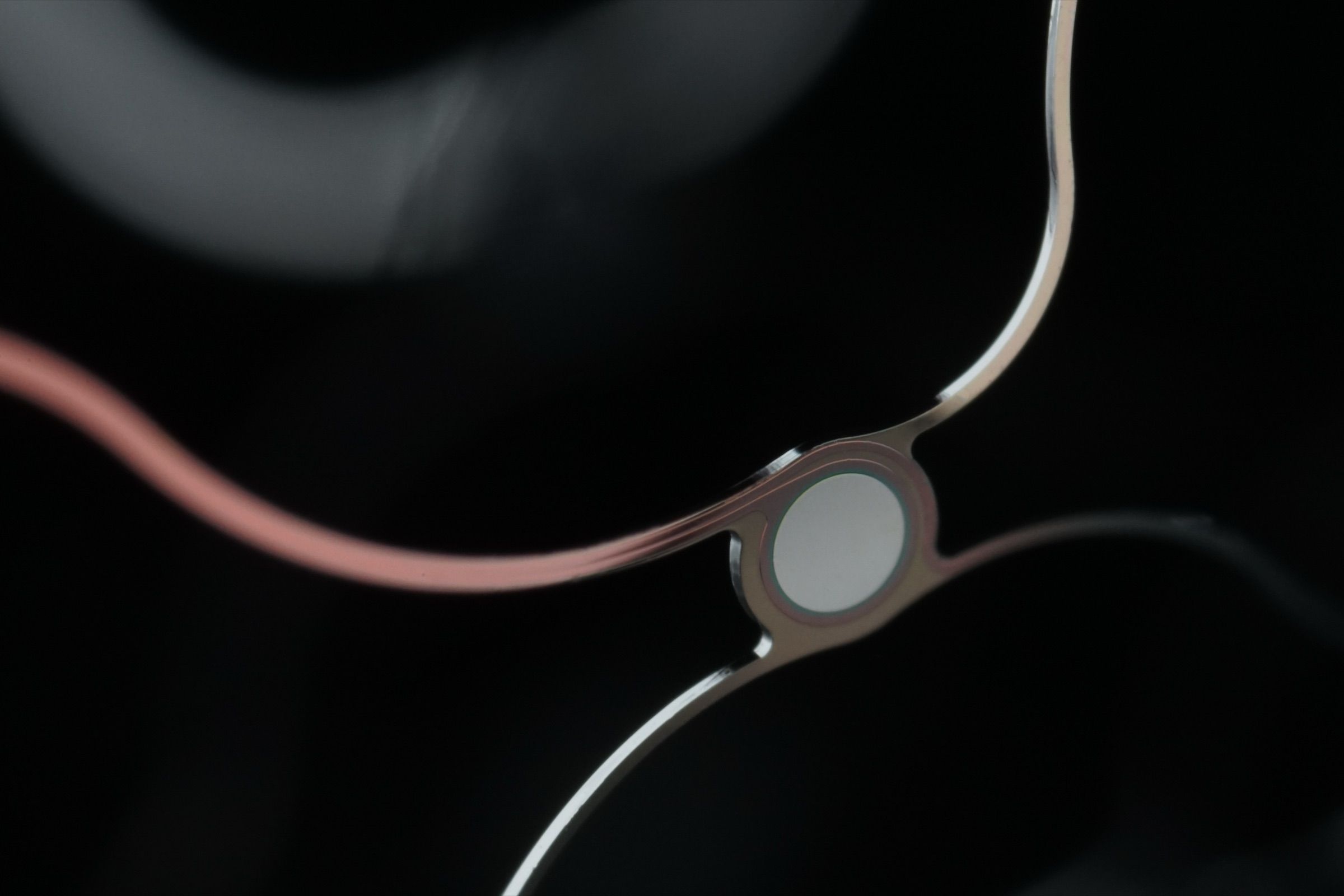
Stentrode combines electrodes with a stent-like scaffold. A clinician guides it through the jugular vein into a vessel near the motor cortex. A lead connects it to a telemetry component beneath the skin of the chest; signals travel wirelessly to external equipment. The system records activity associated with attempted movement and translates it into digital input.
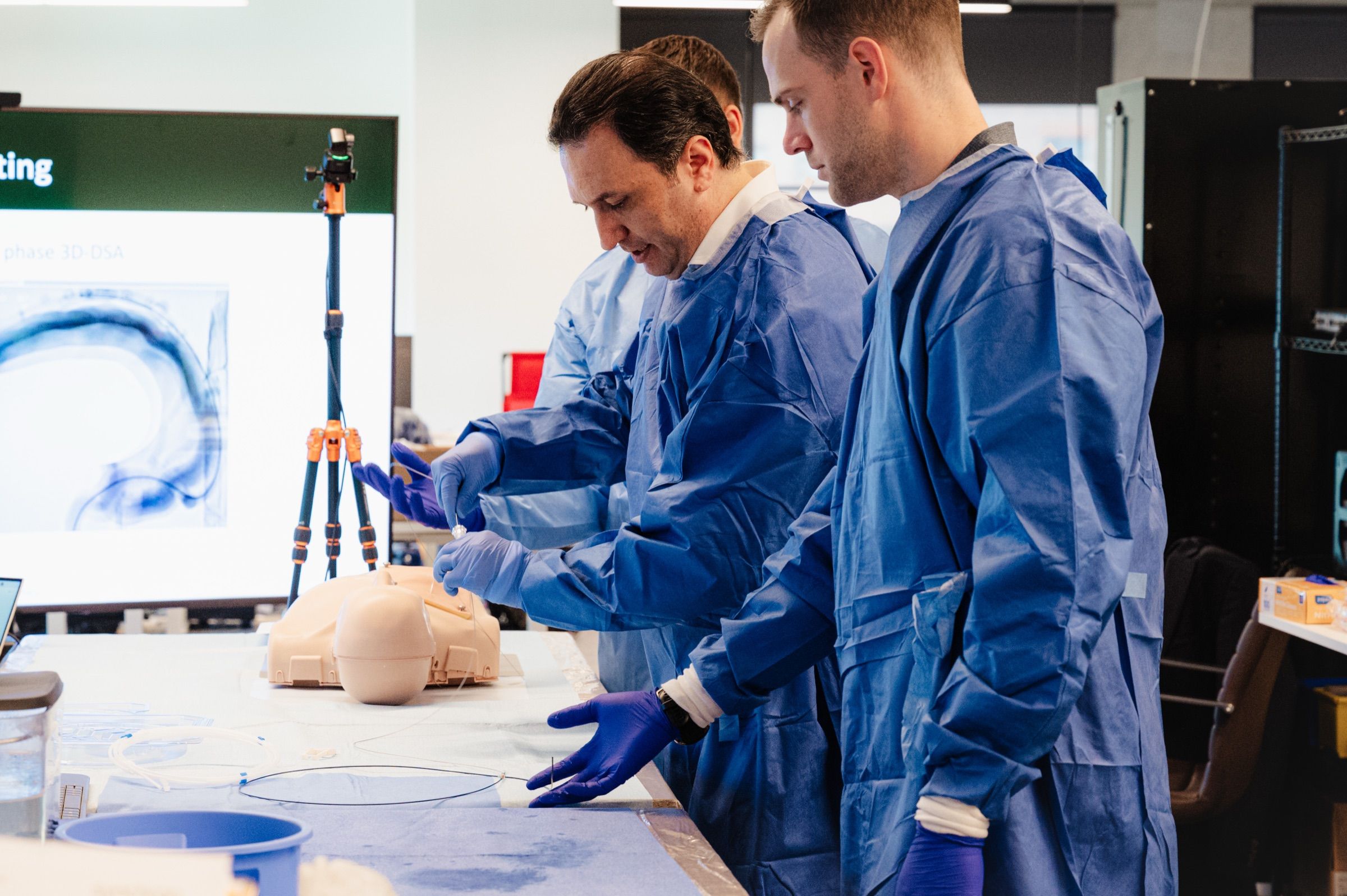
Avoiding open-brain surgery changes the procedure. It does not abolish medicine. There is still an implantation, an anatomical target, an implanted lead and hardware that must remain compatible with the body. The commercial bet is that a catheter route could make delivery more repeatable within existing healthcare practice. That prospect has to survive clinical testing.
- 01Motor
intention - 02Vessel
electrodes - 03Telemetry
+ decoder - 04Digital
selection
The remarkable part is the ordinary task
In the early Australian work, a BCI-controlled switch worked alongside eye tracking to enable computer use. That detail deserves attention. A useful assistive system can combine inputs rather than demand that one sensor do everything. Decoding a command, moving around a screen and composing language are different jobs. The interface must make them cooperate.
Apple’s involvement addresses the software end of that chain. In May 2025, Apple announced a BCI input protocol for Switch Control across iOS, iPadOS and visionOS. Synchron’s subsequent iPad demonstration used this native accessibility route. A device designed for a clinical population could interact with software people already knew, rather than confining them to a bespoke demonstration environment.
“It’s given me part of my life back.”Mark, COMMAND participant, on his iPad experience
A separate March 2025 demonstration showed Rodney, another participant living with ALS, using a Vision Pro setup to adjust his home environment and activate a dog feeder. That system included eye navigation and BCI selections. The dog supplies an excellent audience: a meal is a meal, regardless of the sophistication of the input method.
In the implanted BCI market, Neuralink uses electrode threads, while Paradromics is developing Connexus for communication and computer control. Synchron’s defining choice is its endovascular route. Its immediate users are research participants with substantial motor impairment. Eye tracking, voice control and assistive switches already serve some of their needs. An implant introduces burdens those options do not, so the benefit must justify them. The relevant comparison begins with what a particular person can reliably do.
Six people are evidence, with limits
The Australian SWITCH study published in JAMA Neurology in 2023 assessed four participants. In September 2024, Synchron reported one-year results from six US COMMAND participants: all met the primary endpoint of no device-related serious adverse event causing death or permanent increased disability. The company also reported sustained recording of motor-intent signals that could produce digital actions.
participants met the primary safety endpoint at one year.
Early feasibility study. A small cohort cannot establish every long-term risk or broad clinical benefit.Those are meaningful steps, and small samples. They support further investigation rather than settle the question for every future user. Anatomy, implantation, signal quality and the demands of daily use all matter. Synchron’s current website states that clinical benefit has not been validated and the system has no commercial approval in any geography.
The expensive distance to everyday use
In November 2025, Synchron announced a $200 million Series D led by Double Point Ventures, bringing stated total funding to $345 million. The money supports pivotal trials, commercial preparation and next-generation development. It is development capital, not a treatment price. Today the company is a venture-funded medical-device developer with a prospective business in implants and decoding software.
Its expanding ambitions include Chiral, a neural-data foundation-model roadmap announced in 2025, and collaboration with NVIDIA on real-time processing. The ambition is to make decoding more adaptable and responsive to context. These plans extend beyond the demonstrated digital switch; their eventual clinical usefulness requires its own evidence.
The lesson a reader can borrow is practical: find the bottleneck outside the most glamorous component. Synchron’s founders identified surgical access as an obstacle to wider use. Its Apple work tackles another obstacle, software compatibility. A clever sensor needs both a way into the body and a useful place for its output to go.
Synchron’s most persuasive argument remains Mark’s ordinary screen. An implant earns its place when the person using it can finish a task that matters, safely and repeatedly. Sending a message may look modest beside the grand language of brain computing. For the person who gets to choose its words, modest is a curious description.