The familiar route begins at the skull. A surgeon places a catheter into a brain ventricle, then tunnels tubing beneath the skin toward the abdomen, where excess cerebrospinal fluid can drain. CereVasc begins somewhere rather less theatrical: a vein in the leg. The destination is still the brain’s fluid spaces. The wager is that changing the journey can change the treatment.
- The device: an investigational shunt delivered through the veins.
- The patient: someone with communicating hydrocephalus who meets clinical and anatomical criteria.
- The test: STRIDE compares eShunt directly with conventional VP shunting.
A plumbing problem with a neurological disguise
Cerebrospinal fluid cushions the brain and spinal cord. In communicating hydrocephalus, its absorption into the venous system is impaired. Fluid accumulates. The consequences depend on the patient and the condition, but the company’s current pivotal focus is normal pressure hydrocephalus, or NPH, which can disturb walking, cognition and bladder control.
That combination makes NPH an awkward guest in the clinic. Its symptoms can be mistaken for Alzheimer’s disease, Parkinson’s disease or ordinary aging. The Hydrocephalus Association estimates that roughly 800,000 older Americans may have NPH. Recognition matters because, unlike many conditions it resembles, NPH can respond to treatment. An ingenious implant cannot help a patient whose condition has never been identified.
The trouble with the established route
The conventional ventriculoperitoneal, or VP, shunt already solves the drainage problem for many patients. Its burdens are familiar too: infection, obstruction, disconnected components and over-drainage can lead to another operation. CereVasc’s own overview puts the average US placement procedure at approximately $35,000. That is a company-cited estimate for conventional treatment, not an eShunt price or a demonstrated saving.
Carl Heilman and Adel Malek, neurosurgeons at Tufts Medical Center, developed the idea behind eShunt. Tufts and investment firm ATON Partners announced CereVasc’s formation in August 2014. Their proposed answer borrowed from the body: arachnoid granulations normally transfer cerebrospinal fluid into the venous circulation. Could a miniature valve reproduce that function?
A shorter drain, reached by a longer journey
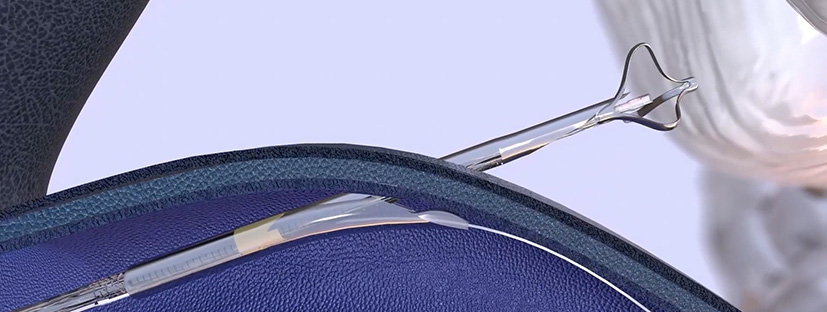
The eShunt System combines an implant with the equipment needed to deliver it. A specialist advances the delivery system from the femoral vein under X-ray guidance. Near the skull base, the device crosses the dura, the tough membrane surrounding the central nervous system, to connect a cerebrospinal-fluid space with venous drainage. Its one-way valve is intended to keep that traffic moving correctly.
This removes the need for the conventional ventricular catheter and its long tunnel to the abdomen. It also moves the procedure into the world of neurovascular intervention. The intended operators include appropriately trained neurosurgeons, interventional neuroradiologists and neurologists. Hospitals need imaging, specialist expertise and a suitable patient, not merely a box containing a clever valve.
Read the small print beside the big number
The first published human case involved an octogenarian with hydrocephalus after a subarachnoid hemorrhage. Intracranial pressure fell from 38 to below 20 centimetres of water within 90 minutes. That established an encouraging possibility. It did not establish how the approach would perform across a population, or against an existing treatment.
A subsequent 66-patient paper reported improvement in at least one NPH symptom in 95% of evaluable participants at 90 days. It recorded no device-related serious adverse events, but two procedure-related serious adverse events. The procedures used general anesthesia. Follow-up was short, and the study lacked a randomized comparator. Anatomy can also rule out implantation.
Early, single-arm evidence. Not a head-to-head verdict.
This is where STRIDE enters. Enrollment closed in June 2026 at 32 sites across the United States, Canada and Argentina. The randomized pivotal study compares eShunt with VP shunting and is intended to support an FDA premarket approval submission. Breakthrough Device designations, including one for pediatric patients aged 12 and older, help the development process; they do not authorize commercial sale. The published study and STRIDE overview explain the distinction.
The expensive business of making it ordinary
CereVasc announced a $43.9 million expanded Series A in 2020, a $70 million Series B initial closing in 2024 and an $85 million Series C initial closing in June 2026. The latest round brought in Piper Sandler Merchant Banking, Johnson & Johnson’s JJDC and Medtronic alongside existing investors. Medtronic’s presence makes for an interesting dinner conversation: an established shunt-market participant backing a proposed alternative.
“This facility is an investment in CereVasc’s future.”Dan Levangie, July 2026
The money supports trials, regulatory work, operations and preparations for commercialization. A Wilmington facility opened in July with an ISO Class 7 clean room for assembly, inspection, testing and manufacturing. In September, Tony Kingsley became CEO and Dan Levangie moved to Chairman. CereVasc also reported more than 200 patients treated worldwide. These are preparations for a business serving healthcare providers; eShunt remains investigational.
Copy the question before copying the device
The transferable lesson is a design question: does the established access route create avoidable burdens? CereVasc’s engineering partner, Sage, describes working with clinicians, testing materials and building fixtures that mimic conditions inside the body. The company also holds an exclusive Tufts patent license and has a LianMedical partnership targeting Asian markets. Technical insight needs an organization around it.
The limits are equally concrete. Unsuitable anatomy can close the route. A hospital without neurovascular expertise cannot simply adopt it. Durable benefits, comparative safety and lower costs require evidence. CereVasc’s interesting achievement is making another entrance plausible. Its next task is persuading clinicians, regulators and hospitals that patients should pass through it.