There is a peculiar amount of waiting inside Magnus Medical’s fast treatment for depression. A session of magnetic brain stimulation lasts about ten minutes. Then comes a fifty-minute break. Repeat ten times a day, for five days. The pauses occupy far more of the calendar than the pulses. Even a treatment built for speed has to know when to sit still.
- The product: SAINT, a prescription brain stimulation system personalized with MRI data.
- The patient: an adult with major depression who has not improved sufficiently with antidepressant medication.
- The commitment: five treatment days, each roughly ten hours long.
- The catch: remission is possible, but trial percentages depend on when and how researchers count it.
That timetable is the doorway into Magnus. The company commercializes a therapy developed at Stanford, combining brain imaging, targeting software, and transcranial magnetic stimulation, or TMS. Its subject is serious; its engineering is unusually specific. Instead of asking only whether magnetic stimulation can help, SAINT asks where to aim, how much to deliver, and how long to leave between sessions.
01 A map before a magnet
TMS uses magnetic pulses delivered through a coil near the scalp to stimulate brain tissue. SAINT belongs to that family. The distinction lies in its recipe. Structural and functional MRI scans inform a proprietary algorithm that identifies an individual stimulation target. Neuronavigation then helps the clinician put the coil where the plan says it belongs.
The target is in the left dorsolateral prefrontal cortex, a region involved in executive functions. Researchers look for a location with a particular relationship to the deeper subgenual anterior cingulate, a region implicated in depression. The aim is to influence a network through an accessible part of it. A brain scan here has a practical job: it changes the coordinates of treatment.
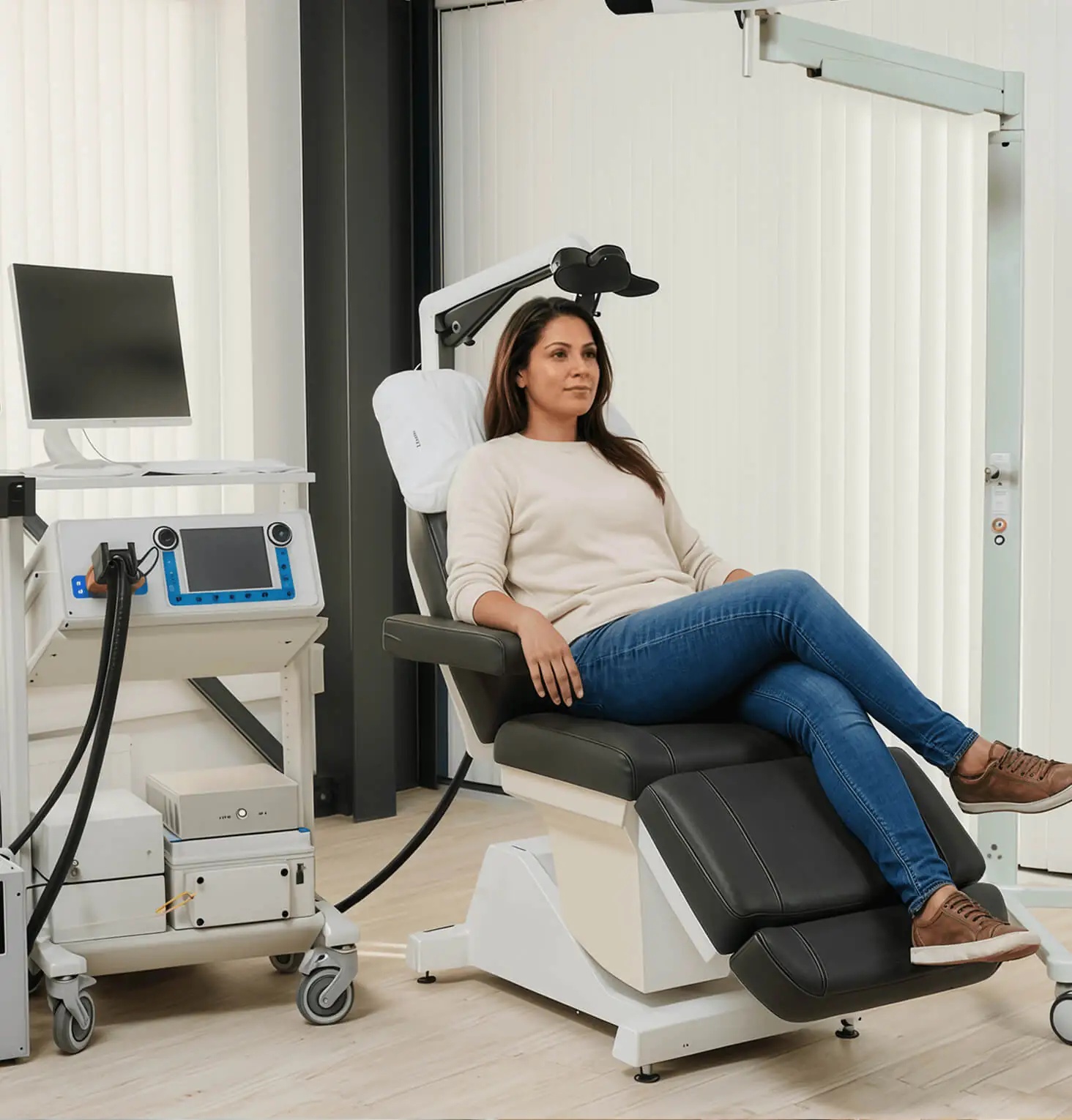
Magnus calls its software platform SNT. The commercial SAINT system combines that software with neurostimulation and navigation hardware. A 2025 study poster identifies MagVenture stimulation equipment and Localite neuronavigation alongside Magnus’s target-generation cloud. This is an integrated medical system, with several pieces working together. You encounter it in a clinic, with trained people around it.
The protocol also changes dose and timing. Stanford’s researchers used 1,800 pulses per session, compared with 600 in the theta-burst protocol they described as their reference. Multiple sessions are spaced through the day. Magnus connects those rest intervals to the neuroscience of spaced learning. The pauses are part of the treatment design, rather than merely an unfortunate queue.
stimulation
rest interval
Assessment and MRI mapping are additional steps. The compressed calendar still means long clinic days.
02 The percentage needs a clock
The early controlled study was small: 14 people received active treatment and 15 received sham treatment. Eleven in the active group reached remission at some point during the four-week follow-up, compared with two in the sham group. Rounded, those are the familiar 79% and 13% figures. They helped put SAINT on the map. “It works well, it works quickly and it’s noninvasive,” Stanford researcher Nolan Williams said when those results were announced.
But “at some point” is doing work. At the exact four-week assessment, the original paper reported active-group remission of 46.2%. A person can meet a remission threshold during follow-up and later fall outside it. Counting everyone who ever crossed the line answers a different question from counting who stands beyond it on a particular day.
A remission percentage without a time point is a clock with the hands missing.
An editorial reading of the clinical evidence
A replication trial published in World Psychiatry in 2026 randomized 48 participants, 24 to each group. Its primary outcome was remission one month after treatment. The result was 50.0% with active SNT and 20.8% with sham. Active treatment performed significantly better. Half the active group, however, did not meet that remission threshold at that visit.
Same clock. Different treatment.
This supports a more useful conversation than a contest between impressive percentages. Response means symptoms improved enough to meet a specified threshold; remission sets a different bar. Neither word promises a permanent cure. Magnus’s research library includes repeated-treatment and continuation studies, reflecting the question that follows a rapid improvement: how do you help someone stay well?
03 The invention had to become an appointment
Magnus was founded in 2020 by Brett Wingeier and Brandon Bentzley. The earlier 2017 date in its history belongs to SAINT’s development at Stanford. Bentzley brought clinical training and research experience in treatment-resistant depression; Wingeier was the founding chief executive. Stanford licensed the technology exclusively to the company for commercialization.
The FDA granted 510(k) clearance in September 2022. Commercial launch followed in April 2024, with early customer sites including the University of Arkansas for Medical Sciences, MUSC Health, Acacia Clinics, and Kaizen Brain Center. That interval captures the difference between permission to market a system and having a service patients can book.
Hospitals and specialist psychiatric clinics are Magnus’s business customers. Patients receive treatment from those providers. The provider needs access to imaging, a stimulation setup, navigation, staff, and a schedule that accommodates repeated sessions. The commercial proposition therefore depends on the choreography around the device as well as the device itself.
Its position in the market is interventional psychiatry: a technology option when previous antidepressant treatment has proved inadequate. Conventional TMS, ECT, and ketamine or esketamine are among the clinical alternatives. Different studies enroll different patients and measure different outcomes; a row of percentages from separate papers cannot establish which treatment wins a direct comparison.
04 The other circuit runs through Medicare
Magnus announced a $25 million Series A in October 2021, co-led by JAZZ Venture Partners and Red Tree Venture Capital. Its company history records a Series B in 2025; the current press-kit background names Khosla Ventures as lead. Financing supports the journey from research protocol to commercial delivery. Payment for the treatment itself has required another kind of work.
For 2025, Magnus announced a national hospital outpatient payment framework of $3,750.50 per treatment day, plus $950 for targeting. Five days and targeting total $19,703. Hospitals could finally plan around a defined reimbursement pathway. The company subsequently announced that the relevant outpatient payment assignments would remain in place for 2026.
5 × $3,750.50 treatment days + $950 targeting
Published rounded total. Patient charges, coverage, and personal costs vary.For patients, the practical questions remain local: which provider, which plan, which authorization, and which personal cost? Magnus’s FAQ says self-pay pricing varies by site and that Medicare Advantage, commercial, and Medicaid coverage is handled case by case. Five days also means arranging work, transport, and care responsibilities around unusually long appointments.
There are medical boundaries too. Certain metal near the coil and implanted devices are among the system’s contraindications. Headache and treatment-site discomfort can occur; TMS carries risks including seizure. A provider’s assessment matters. SAINT is cleared for a defined adult MDD population, and it does not help every treated patient.
05 Fourteen states, and the next question
In May 2026, Magnus reported availability across 14 states, naming systems including Cleveland Clinic, UPMC, HCA Healthcare, and Sutter Health. It also reported payer access encompassing more than 80 million covered lives. Those are measures of distribution and potential access, rather than a count of people treated or people recovered.
Meanwhile, an approximately $11.6 million Department of Defense-supported randomized trial is examining postpartum depression. Magnus announced the first UMass Chan enrollment in February 2026. The planned study spans four institutions and up to 192 women. Unlike previous SAINT studies, it does not require an earlier antidepressant or psychotherapy failure. Postpartum depression remains an investigational indication for the system.
For a reader outside medicine, the transferable lesson is a design question. When a tool disappoints, inspect its target, its dose, and its intervals. Then inspect the institutions needed to deliver it. That is an inference from Magnus’s work, not a treatment recipe. Here, the magnet gets attention, the software supplies coordinates, and the fifty-minute pause reminds us that acceleration can be carefully paced.