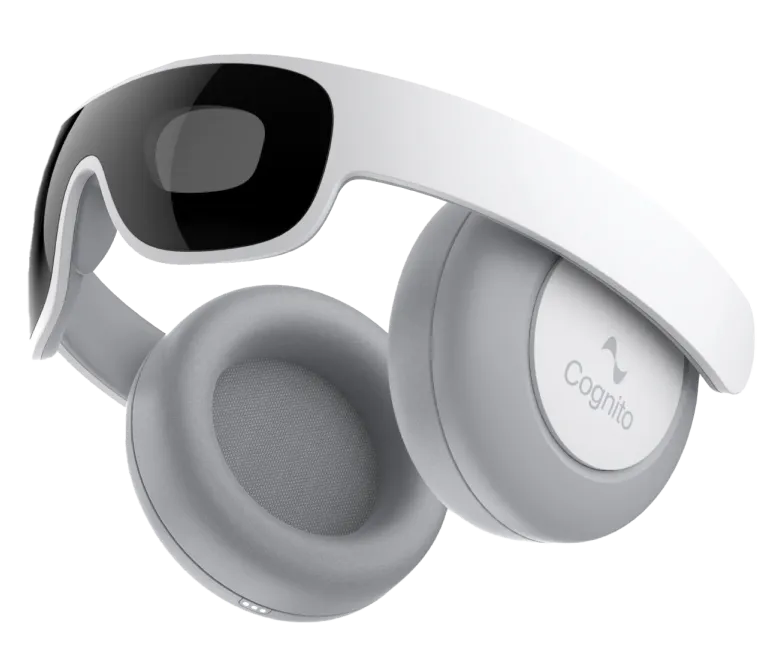
Turning the brain's own rhythm into medicine - no drugs, no needles, just gamma waves of light and sound.
Alzheimer's care has long been a story told in molecules - amyloid plaques, tau tangles, monoclonal antibodies delivered by infusion. Cognito Therapeutics is testing a different sentence entirely. Its bet is that the brain speaks in rhythm, and that a missing rhythm can be restored from the outside using nothing more than precisely timed light and sound.
The company, spun out of MIT in 2016, builds Spectris: a non-invasive, wearable device that delivers proprietary gamma-frequency stimulation to evoke EEG-confirmed gamma oscillations in the brain. The goal is not to sedate symptoms but to slow the underlying decline in cognition and daily function that defines the disease.
The science traces back to a striking laboratory observation: gamma-frequency activity - roughly 40 cycles per second - is diminished in the Alzheimer's brain, and restoring it appeared to change disease biology in preclinical models. Co-founders Li-Huei Tsai and Ed Boyden, both MIT professors, turned that observation into a company.
A decade later, that idea is no longer a slide in a seminar. It is a 670-patient pivotal trial, an FDA Breakthrough Device Designation, and a $105 million Series C closed in March 2026.
The therapy is deliberately simple to use and precisely engineered underneath. Here is the path a session takes.
The patient puts on connected glasses and headphones at home - no clinic visit required.
The device emits gamma-frequency light and sound tuned to roughly 40 cycles per second.
The sensory input evokes matching gamma oscillations across brain networks, confirmed by EEG.
Sustained daily use aims to slow cognitive and functional decline and preserve brain structure.
“One of the largest and most advanced device studies in the history of Alzheimer's disease.”
In the OVERTURE feasibility study, participants using Spectris held onto their functional and cognitive abilities meaningfully longer than those on sham treatment over six months. The company reported patients gained roughly 60% to 84% more time maintaining daily function and cognition.
A separate readout reported that gamma sensory stimulation preserved the corpus callosum - the white-matter bridge connecting the brain's hemispheres - suggesting an effect on brain structure, not just symptoms. Those findings set up the far larger HOPE pivotal study, whose topline data is expected in 2026.
NOTE. Figures reflect the company's reported feasibility-stage results and are approximate; Spectris remains investigational pending pivotal data and FDA review.
A wearable that delivers gamma-frequency light and sound through connected glasses and headphones. Designed for daily at-home use in mild-to-moderate Alzheimer's. Holds FDA Breakthrough Device Designation (2021).
A therapeutic platform delivering personalized, non-invasive neuromodulation to evoke gamma oscillations - engineered to extend beyond Alzheimer's toward a range of neurodegenerative diseases.
A randomized, double-blind, sham-controlled trial across 70 U.S. sites with 670 participants, a 12-month treatment phase and a 12-month open-label extension. Data expected in 2026.
The Alzheimer's landscape now includes anti-amyloid drugs such as Leqembi (Eisai/Biogen) and Kisunla (Eli Lilly) - infusion therapies that require clinic visits and carry monitoring burdens. Cognito is not trying to be a better antibody. It is building an adjacent category: a non-invasive device that a patient can use on their own couch.
That format choice is the strategic core. In chronic neurodegenerative care, adherence collapses in the friction of injections, side effects and travel. A therapy delivered through the senses lowers that friction toward zero - a design decision as much as a scientific one.
Cognito's closest conceptual peers are other neuromodulation players such as Sinaptica Therapeutics, alongside the broader digital-therapeutics field targeting cognitive decline. But few match its combination of MIT-rooted science, Breakthrough Device status and a pivotal trial at this scale.
The business model is still pre-commercial: venture-funded today, aimed at a prescribed, home-based, potentially payer-reimbursed therapy tomorrow. The 2026 HOPE readout is the hinge on which that future turns.
MIT labs show gamma-frequency sensory stimulation affects Alzheimer's pathology in preclinical models.
Spun out of MIT to translate gamma sensory stimulation into a human therapy.
Spectris AD is designated for cognitive and functional symptoms of Alzheimer's disease.
Data show slowed decline and preserved brain structure versus sham treatment.
670 participants enrolled across 70 U.S. sites in the pivotal device trial.
Round led by Morningside funds the pivotal readout and next steps.
MIT professor of neuroscience whose research linked gamma oscillations to Alzheimer's progression - the intellectual seed of the company.
MIT professor and optogenetics pioneer who co-developed the neuroscience underpinning gamma sensory stimulation.
Leads Cognito through its pivotal moment, framing the HOPE Study as one of the largest device studies in Alzheimer's history.
It develops Spectris, a non-invasive wearable that delivers gamma-frequency light and sound to evoke gamma brain oscillations, aiming to slow cognitive and functional decline in Alzheimer's disease.
Not yet. Spectris AD is investigational and holds FDA Breakthrough Device Designation; it is being evaluated in the pivotal HOPE Study, with data expected in 2026.
It was founded in 2016 as an MIT spinout based on gamma-oscillation research by professors Li-Huei Tsai and Ed Boyden. Christian Howell serves as CEO.
Instead of targeting amyloid through infusions or injections, Spectris uses non-invasive sensory stimulation delivered through glasses and headphones for daily at-home use.
The company has raised over $273 million in total, including a $105 million Series C closed in March 2026.
Cognito Therapeutics, Inc. · 1218 Massachusetts Ave, Cambridge, MA 02138 · info@cognitotx.com