In an operating room, the patient's body becomes a busy dashboard. Oxygen. Blood pressure. Heart rhythm. Temperature. The brain, meanwhile, can be compressed into a single score that appears to say, more or less, asleep enough. Lantern Laboratory was built around an awkward question: what if that tidy number is hiding the information the anesthesiologist actually needs?
The New York company is developing an EEG-based monitor that aims to distinguish three related but stubbornly different things: how sedated a patient is, how the brain is reacting to painful stimulation, and how old or vulnerable that brain appears physiologically. The intended payoff is not a prettier waveform. It is a more specific drug decision - whether to change the sedative, change the analgesic, or leave both alone.
That sounds obvious only after someone says it. General anesthesia is not one drug doing one job. It is a managed state involving unconsciousness, amnesia, immobility and pain control. Clinicians already combine vital signs, experience and existing brain monitors to steer the case. Lantern's argument is that the brain signal can be made more useful by refusing to blend those jobs into a single composite answer.
A monitor with an opinion
Lantern's platform analyzes electroencephalogram signals in real time. Creative Destruction Lab, which selected the company for its 2024/25 Neuro stream, describes two proposed capabilities that sharpen the pitch: estimating cognitive age and tracking nociception, the nervous system's processing of harmful stimulation, independently of sedation. Columbia's surgery innovation program describes the same basic wedge - separate analgesia from sedation, adjust for cognitive age, then guide precise titration.
One brain / three questions
That makes Lantern different from broad hospital software and consumer neurotech. It is narrow by design: a decision-support instrument for anesthesiologists and critical-care clinicians at the moment they titrate drugs. Existing systems such as Medtronic's BIS and Masimo's SedLine already process or display EEG for brain-function monitoring. Lantern is not entering an empty room. Its claim is that cognitive-age calibration and a nociception signal independent of sedation could make the output more patient-specific.
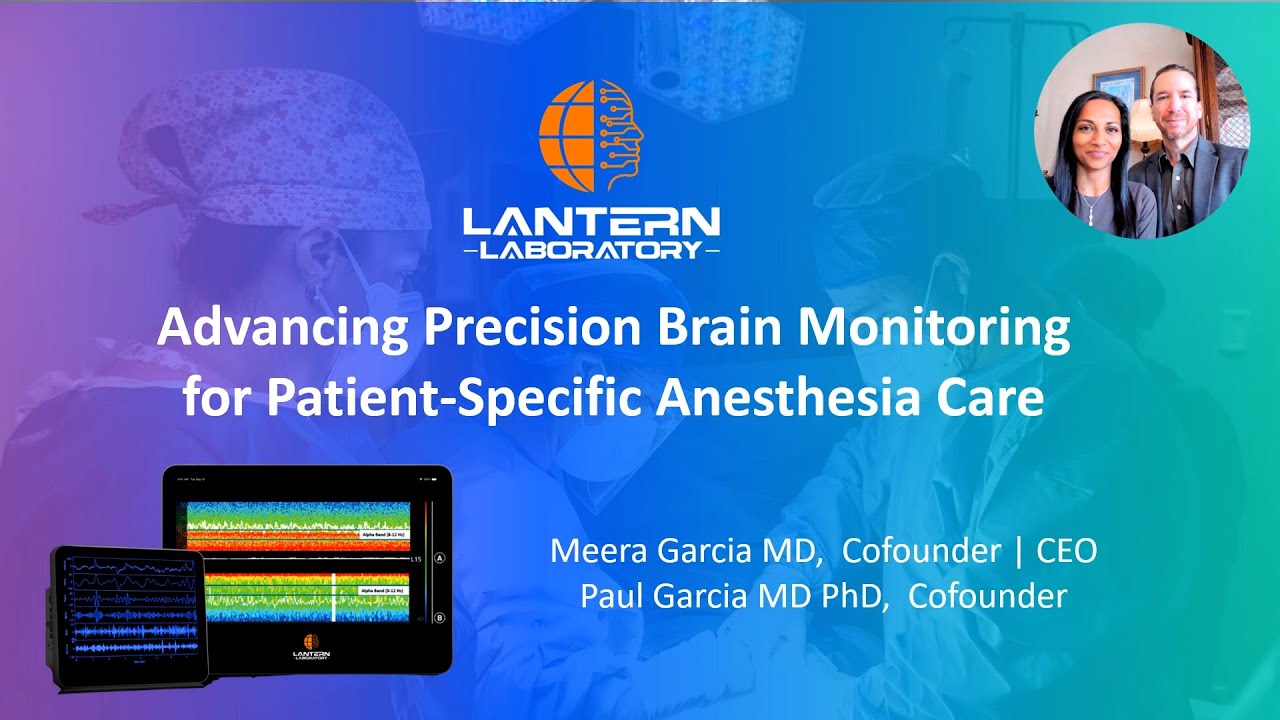
Two doctors, one translation problem
Lantern was incorporated in 2022, but its scientific roots run through Paul Garcia's neuroanesthesia research at Columbia University. His lab studies EEG signatures during anesthesia and their association with pain, emergence and postoperative delirium. Patent work involving alpha-band oscillations describes systems that can provide an indication to titrate anesthetic medication after detecting changes in EEG power. Lantern has an exclusive Columbia license to develop technology related to that work.
Meera Garcia, an obstetrician-gynecologist and physician executive, became CEO and commercial translator. She and Paul are married, an unusually literal form of founder alignment. Her background includes clinical leadership and chief medical officer roles; his includes neurophysiology, anesthesiology and computational research. One understands health systems and executive rooms. The other has spent years asking what the sedated brain is doing.
“I don't have a lot of business experience or management experience.”Meera Garcia, in Lantern's NIA winner video
It is the sort of sentence startup profiles usually edit out. Garcia followed it with the useful part: she realized the scientific and technical arm needed much more insight into strategy and business development. The NIA Start-Up Challenge supplied that missing curriculum through mentorship, commercialization coaching and a final pitch. Lantern won a $60,000 award in 2023. Later that year, an SEC filing disclosed $500,000 sold to nine investors in a planned $2.5 million debt-and-warrant offering.
So what changed their minds? Not the clinical problem. The founders' public language stays consistent: use real-time EEG to improve medication decisions and awakening. What changed was their understanding of what a product requires. Good science was the beginning. Company strategy, regulatory planning, hospital workflow, financing and evidence had to become part of the same instrument.
Then the trial argued back
The first thing to fail was not the company. It was the clean version of the story. In the randomized AlphaMax trial, researchers tested EEG-guided titration of fentanyl and desflurane in older adults. The intervention produced a limited early enhancement in oscillatory alpha power, but that effect did not persist as surgery progressed. Delirium in the post-anesthesia care unit was similar between groups: 37 percent in the intervention arm and 33 percent in the control arm.
Early alpha power was 0.8 dB higher in the titration group after incision.
PACU delirium was 37% versus 33%, a non-significant difference.
The published conclusion was plain: limited effect on alpha power and no appreciable difference in clinical outcomes. This does not validate Lantern's commercial device, nor does it dispose of the broader platform. It shows the distance between finding a biomarker and building a reliable dosing loop around it. A signal must survive different drugs, ages, procedures, artifacts and baseline cognitive states. Then acting on it must improve something patients and hospitals care about.
For Lantern, that result is a product brief in disguise. The dosing protocol may need refinement. The signal may need to be combined with other features. The most responsive patient group may be narrower. The trial's timing, endpoints or intervention may need to change. Any next claim should be smaller and more testable than “better anesthesia.”
Where the business has to land
Lantern has not published pricing, revenue or commercial customers. Its natural buyer is a hospital or health system, while daily users would be anesthesiologists and intensive-care clinicians. The likely economic argument is reduced complications, smoother recovery and more efficient drug use. But likely is not the same as proven. Hospitals will want regulatory clearance, integration with existing monitors, a manageable sensor workflow, staff training and outcome data strong enough to survive a value-analysis committee.
What it replaces
Not the clinician. It competes with a mix of composite depth scores, conventional vital signs and judgment under pressure.
What it sells
A more specific cue about which pharmacological lever to pull, if its biomarkers hold up in practice.
Who benefits
Older and cognitively vulnerable patients are the clearest initial population, with operating rooms and ICUs as the setting.
What can break
Noisy EEG, workflow friction, weak outcome evidence, unclear reimbursement or a signal that does not generalize.
The competitive distinction is easy to sketch and difficult to defend. BIS processes EEG into an index associated with level of consciousness. SedLine presents brain-function information alongside its Patient State Index and other measures. Lantern says its monitor adds patient-specific cognitive age and a read on nociception that is independent of sedation. If those features help a clinician choose between fentanyl and desflurane at the right moment, the difference is consequential. If they merely add two more uncertain numbers, incumbents have the advantages that matter: installed hardware, familiar workflows, regulatory history and trained users.
What half a million dollars buys
Lantern's publicly disclosed financing is modest by medical-device standards. The October 2023 Form D recorded $500,000 sold in debt and warrants, from a total offering target of $2.5 million. Nine investors participated, with a listed minimum investment of $25,000. The filing estimated that $100,000 of proceeds could cover initial salaries and founder advances until sufficient revenue arrived. No sales commissions or finder's fees were reported.
That is the precise answer to what the effort cost publicly: $500,000 of investor capital had been sold, plus a $60,000 federal challenge award. It is not a complete development budget. Patent licenses, engineering, quality systems, regulatory work and multi-site trials can consume far more than an early financing. The unfilled $2 million portion of the offering also shows the intended runway was larger than the amount reported as sold.
A small company in a regulated lane
With roughly three employees in the supplied company data and a public LinkedIn range of two to 10, Lantern is still a compact team. That explains the heavy use of institutional leverage. Columbia contributes the research lineage, patents and clinical environment. The National Institute on Aging contributed cash, mentors and commercialization training. Creative Destruction Lab contributed a milestone-driven neurotechnology network. Columbia's Department of Surgery Innovation Fund lists the platform among its selected projects. None is a disclosed commercial customer, but together they provide the infrastructure a three-person company cannot build alone.
The business model remains unpublished. The category usually supports several shapes: capital equipment with disposable electrodes, software licensed onto compatible hardware, or a subscription tied to monitored beds or procedures. Lantern has not said which it will use, so any revenue forecast would be theater. What is observable is the intended route: business-to-business sales into hospitals, with clinicians as users and vulnerable surgical patients as beneficiaries. That makes adoption slower than an app download and potentially stickier once a product is embedded in protocol.
Its expertise is similarly concentrated. Paul Garcia's group has published on alpha oscillations, noxious stimulation, emergence trajectories and postoperative delirium. Meera Garcia brings physician-executive experience and the willingness to say where the team needed help. That mix matters because perioperative monitoring is a translation business. The company must convert neurophysiology into software, software into a regulated instrument, the instrument into a changed dose, and the dose into a better recovery. Every arrow is a separate failure point.
The company is now carrying a name for the product, too. In April 2026 Lantern filed a trademark application for ALPHAMAX covering software as a medical device for diagnosing electrical activity of the brain. A trademark is not a clearance or a launch. It is, however, a sign that an academic program is being packaged into something that can be named, evaluated and eventually bought.
The part worth copying
Lantern's most reusable lesson has little to do with EEG. It began with a decision already made badly or inconsistently, not with a technology looking for a home. It licensed university IP instead of pretending the research appeared inside a startup. It used a large clinical dataset as a starting advantage, then sought non-dilutive support and structured mentorship before attempting a full commercial build.
The Lantern playbook
- Find one high-stakes decision that still relies heavily on judgment.
- Separate the variables that existing tools blur together.
- Start with real clinical data and defensible IP.
- Use accelerators to fill founder skill gaps, not merely decorate the pitch deck.
- Treat an inconclusive trial as a constraint for the next product, not a marketing inconvenience.
The approach will not work everywhere. EEG can be contaminated by muscle activity, electrical equipment and poor electrode contact. A model trained on one institution's cases may not transfer cleanly to another hospital's patients, drugs and practices. A monitor that adds setup time without changing treatment becomes expensive wallpaper. And if the company cannot show that acting on its signals improves a clinical or economic endpoint, the distinction between three clever measures and one familiar number will not matter to a buyer.
That is Lantern Laboratory's real tension. The team has assembled the ingredients early medtech investors ask for: clinician founders, licensed IP, a sizable dataset, institutional programs, initial capital and a defined user. Now it has to turn brainwaves into a repeatable action and that action into an outcome. The operating room does not need another oracle. It needs an instrument that knows the difference between being interesting and being useful.