The troublesome thing about a seizure is that it need not look like one. A patient in an intensive care unit can lie still while abnormal electrical activity continues in the brain. The bedside team needs an electroencephalogram, or EEG, to see what the body is declining to announce. Yet ordering the test and getting the test are two different events.
In the DECIDE study, conducted at five academic hospitals with around-the-clock EEG access, conventional EEG took a median 239 minutes to arrive and be set up. Ceribell’s rapid EEG took five. The study was published in 2020. Its enduring interest is the inconvenience it exposes: even a well-equipped hospital can own the answer and spend hours getting it to the patient.
- The problem: silent seizures require EEG, but access can be slow.
- The intervention: a trained bedside provider starts monitoring with a wearable and portable recorder.
- The business: disposable wearables plus monthly hospital subscriptions.
- The boundary: AI supports clinical decisions; a reading still needs clinical judgment.
The clock was the first problem
DECIDE enrolled 181 patients and involved 37 bedside physicians. These were patients suspected of having non-convulsive seizures, not a general sample of everyone admitted to hospital. Many were already receiving antiseizure medication. Clinicians were making consequential decisions before the conventional recording could begin.
Rapid EEG gave them evidence earlier. The study assessed physicians before and after they reviewed it, documenting changes in their judgments and confidence. It was prospective and observational, so the timing result should not be inflated into a guarantee of shorter admissions or better outcomes for every patient. Five minutes describes a measured median, not a stopwatch attached to every sale.
Five academic centers · Prospective observational study · Published 2020
Bar lengths share the same scale. Timing records were incomplete for some encounters.
This is Ceribell’s useful provocation. The equipment must produce a good signal, of course. But the design also has to survive the practical question of who is standing beside the bed when the signal is needed. A specialist who is somewhere else is a difficult component to miniaturize.
An unlikely duet
The company’s origin has rather more music in it than one expects from a medical-device business. Stanford neurologist Josef Parvizi was listening to the Kronos Quartet perform a piece based on radio signals from space. He wondered what brain activity might sound like. He approached Chris Chafe, a Stanford music researcher with experience turning unusual data into sound.
They converted EEG recordings into audio. Chafe later told Stanford: “My initial interest was an artistic one at heart”. Listening suggested a medical use: patterns associated with seizures could be audibly distinguished from other activity. The collaborators called the idea a brain stethoscope. It is a pleasingly literal name for a device that makes an otherwise hidden process available to the ear.
A subsequent Stanford experiment played converted EEG samples to medical students and nurses with no epilepsy diagnostic training. Participants detected seizure samples more than 95% of the time, though their performance on other patterns was less accurate. That result belonged to a controlled listening experiment. It was an invitation to investigate bedside usefulness, rather than permission to diagnose by ear alone.
“My initial interest was an artistic one at heart”Chris Chafe · Stanford Medicine, 2013
Ceribell was founded in 2014. Its founders brought together Parvizi’s neurology, Chafe’s work on sound and Jane Chao’s scientific and commercial background. Chao, now president and CEO, had worked at McKinsey, Novartis and Genentech. The combination matters: an interesting signal-processing experiment still needs a product, regulatory clearance and someone willing to persuade hospitals to change a routine.

Give the bedside team a way to begin
The Ceribell System joins disposable EEG wearables to a portable recorder and a cloud review portal. A trained healthcare provider can apply the wearable and start recording without waiting for an EEG technologist to perform the setup. Neurologists can review the waveforms remotely. The Brain Stethoscope audio function preserves a trace of the company’s musical beginnings.
Clarity, its machine-learning software, analyzes EEG every ten seconds and estimates seizure burden over a rolling five-minute window. Think of the percentage as time occupied by detected seizure activity, rather than a probability that the patient has epilepsy. The recorder can alert staff to suspected continuous seizures; the portal supplies waveforms, trends and annotations for review.
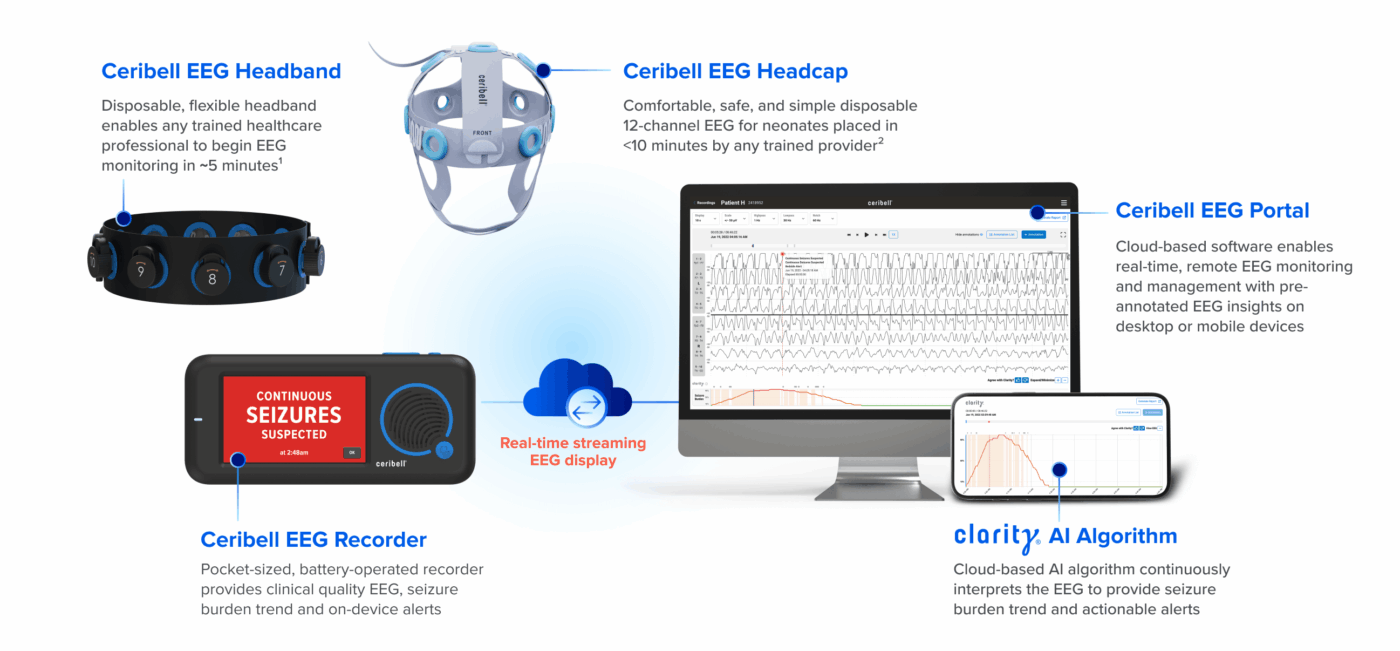
The benefits depend on using those pieces together. Faster recording helps a team investigate suspected seizures, follow changes over time and review what happens after medication. It does not turn every member of that team into an epileptologist. Ceribell itself describes EEG as one component of diagnosis and acknowledges that expert readers can disagree.
Its acute-care seizure-burden tool also has a different purpose from meticulously labeling every epileptiform event. That distinction gives buyers a sensible question: which clinical decisions will this help us make sooner, and which still require conventional full-montage EEG or specialist review? Convenience earns its keep when the information answers the actual bedside question.
A headband with recurring revenue
The paying customer is the hospital. Users include nurses, emergency physicians, intensivists and neurologists, with pediatric and neonatal teams joining the audience. In 2021, Inspira Health publicly described introducing the system at its Mullica Hill and Vineland medical centers in New Jersey. It wanted rapid assessment of suspected non-convulsive seizures in critically ill patients.
Ceribell charges for single-patient-use wearables and monthly subscriptions covering Clarity, recorders and the portal. The economics tie revenue to continued use. A recorder left in a cupboard does little for either the patient or the supplier. Training and support therefore belong to the commercial proposition as much as the circuitry does.
June 30, 2026
33% annual growth
Growth is real, and expensive. In 2025, Ceribell reported $89.1 million in revenue and a $53.4 million net loss. Sales and marketing cost $73.1 million; research and development cost $19.1 million. Those figures are a reminder that a hospital product must be sold, taught, supported and studied. An attractive gross margin does not settle the company’s bills.
Investors financed the expansion: a $35 million Series B announced in 2018, a $53 million Series C in 2021 and a $50 million extension led by Ally Bridge Group in 2022. The October 2024 IPO brought $207.3 million in gross proceeds after the underwriters exercised their full option. Ceribell trades on Nasdaq as CBLL.
The market offers alternatives. Conventional EEG suppliers include Natus and Nihon Kohden; rapid systems include Zeto and Natus’s BrainWatch. BrainWatch advertises setup in under five minutes and combines Persyst AI with NeuroWorks. Speed alone is becoming a crowded claim. Ceribell’s case must also rest on its evidence, monitoring features, age coverage, support and fit with hospital practice.
The smallest patients, the next signals
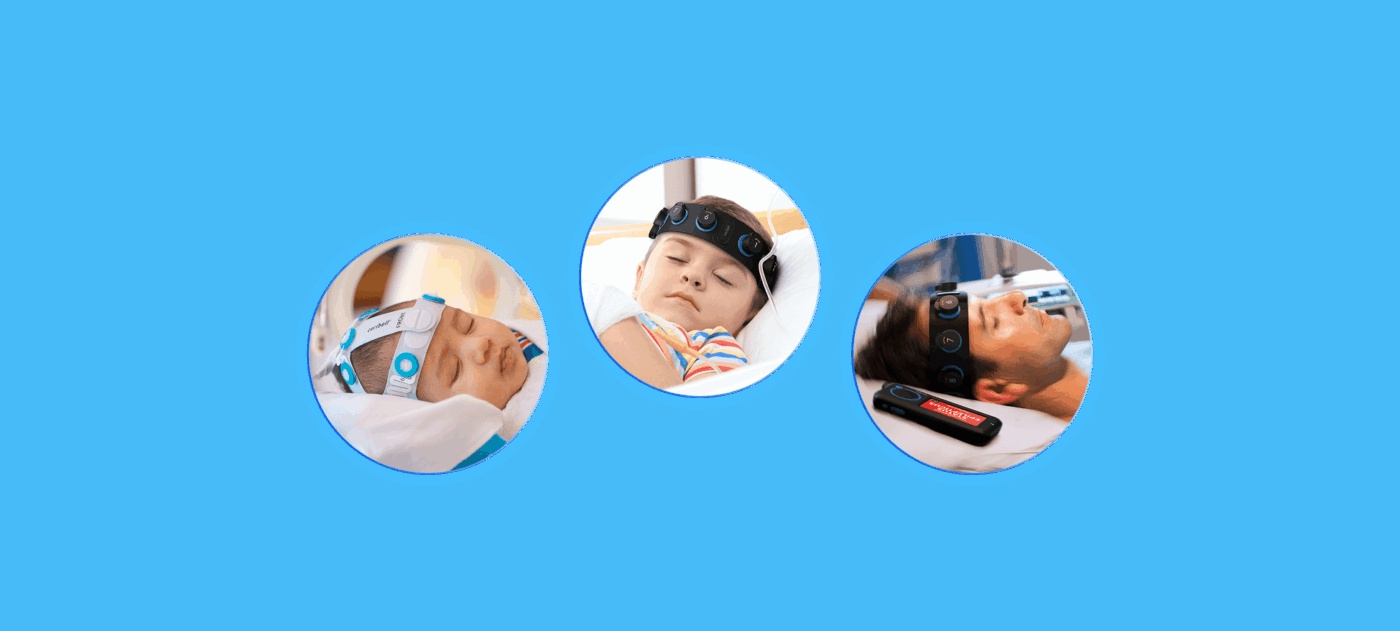
Ceribell initiated commercial launch of neonatal and pediatric products in 2026 following a pilot. The neonatal system uses a headcap, a useful reminder that extending a medical device to a newborn involves more than shrinking the adult accessory. Different anatomy and brain activity demand their own hardware and validation.
Its ambitions now reach beyond seizures. Clarity’s cleared delirium feature tracks EEG biomarkers associated with delirium and updates a score every ten seconds. CMS granted a New Technology Add-On Payment for the delirium system, effective October 1, 2026. Eligible Medicare inpatient cases can receive up to $2,171 in additional reimbursement. That ceiling is conditional reimbursement to hospitals, not a retail price for the device.
On September 30, 2026, the company announced clearance for quantitative EEG trends and amplitude-integrated EEG, including alpha-delta ratio, relative alpha and burst suppression monitoring. The clearance has no age restriction. Ceribell expects to deliver those features through a software update in the first half of 2027. A clearance is a milestone; a deployed update is another.
Copy the handoff, then measure it
For anyone outside neurodiagnostics, the portable lesson is a service-design one. Find the handoff where work stops. Ask what the people already present could safely begin. Preserve access to the expert, and measure the delay under ordinary operating conditions. A small, well-chosen redistribution of work can be more useful than adding another sophisticated machine to a distant department.
In a hospital, that requires trained staff, dependable electrode contact, a workable review process and someone ready to respond to the result. Cloud access adds its own connectivity requirements. If interpretation and treatment remain slow, a quick setup only moves the queue further along. Ceribell’s larger ambition, in Chao’s phrase, is to “make EEG a new vital sign”. The practical test is whether brain monitoring becomes something the team can start when it matters.
Company website ↗ · The system ↗ · Industry perspectives ↗ · Latest company news ↗
LinkedIn · X · Instagram · Facebook
Watch the setupSystem setup demonstration ↗
Ceribell Easy Set Up video ↗
Ceribell’s YouTube channel ↗