The brain can be generous with information and miserly with explanations. An electroencephalogram records its electrical activity. It does not conveniently attach a note saying which event deserves attention, where it began, or what the physician should do next. Someone has to read the recording. Someone has to get access to it first. Between those two requirements sits a surprisingly large opportunity for a software company.
LVIS has chosen that territory. Its flagship platform, NeuroMatch, puts EEG review and analysis in a browser, adds tools for identifying events and visualizing their possible origins, and brings reporting into the same working environment. The customer is a hospital or neurological practice. The scarce resource is the clinician’s attention. The product’s appeal becomes clearer when you stop admiring the brain picture and follow the file.
The story in four beats
- The job: help medical teams review EEG recordings, collaborate and produce reports.
- The approach: cloud access, AI-assisted event detection and brain-source visualizations, with clinician review.
- The foothold: LVIS reported installations in 10 South Korean hospitals in 2024.
- The useful lesson: make expertise easier to reach, then train the people who will use the tools.
01 / A change of subjectThe engineer who followed a stroke
Jin Hyung Lee’s academic starting point was electrical engineering: a bachelor’s degree at Seoul National University, followed by graduate study at Stanford and a PhD in 2004. Her Stanford profile now spans neurology, bioengineering and neurosurgery. The Lee Lab describes its work with an engineer’s verbs: analyze, debug and manipulate brain circuits.
The change of subject had a personal force behind it. Lee has described her grandmother’s stroke as a reason she turned toward brain research. In a 2019 interview with DongA Science, she recalled the long disability that followed and the frustration of seeing scientific progress coexist with so little restoration of function. That experience gives the company’s interest in brain circuits a human scale. A malfunctioning network was also a member of the family.
LVIS was founded in 2013, according to its investor SK Networks. Its ambition reaches beyond sorting recordings: Lee speaks about understanding how circuit elements communicate and eventually restoring brain function. The commercial foothold is more specific. A medical team already has EEG data. NeuroMatch helps that team work with it.
02 / Follow the recordingA browser tab with clinical consequences
The simplest way into NeuroMatch is through its published workflow. Upload a recording. Let the platform scan for event annotations. Review the signals and detected events. Review, share or print the report. Add later studies to follow the patient over time. This sequence sounds almost offensively ordinary beside the phrase “neural information analysis.” Ordinary is useful when the day’s work is complicated.
From recording to report / tap a stage
An existing EEG recording enters the cloud platform. Authorized clinicians can access the study through a browser, bringing the review environment to the reader.
Workflow schematic. No patient data or measured time savings are shown.
LVIS’s June 2025 ambulatory update makes the point particularly well. Ambulatory EEG follows a patient through daily life over several days, leaving a long record for specialists to examine. The update brings event flagging, annotations, customizable reports, daily summaries and digital signatures into the browser workflow. A physician can continue a review from another location without changing the underlying working environment.
Think about the handoffs this arrangement addresses: the recording, the reader, the colleague offering a second view, and the completed report. Each handoff can demand another application or another exchange of files. Bringing them together gives the software a reason to exist even before anyone debates the cleverness of its algorithms.
03 / Useful boundariesThe doctor keeps the last word
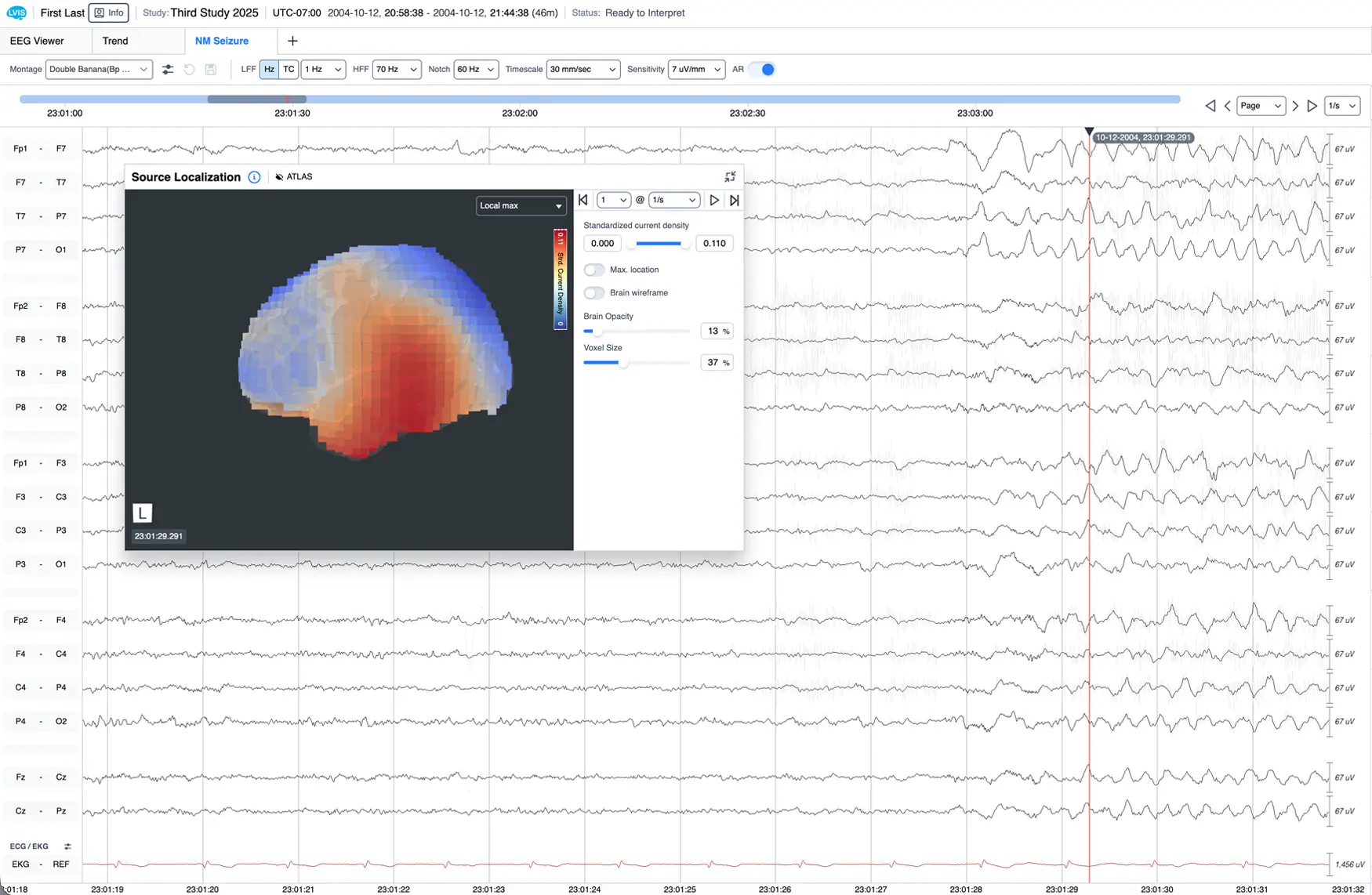
Artifact reduction helps reduce distracting signals in an EEG. Seizure and spike detection draw attention to events that warrant review. In its February 2025 launch announcement, LVIS said physicians could validate or adjust the detected events. That detail matters: a flag is an invitation to examine something, with clinical judgment still required.
The US regulatory history is a series of additions. The first FDA clearance came in June 2023. A November 2024 clearance added seizure and spike detection. A May 2025 clearance added source localization and source-localization trends. The sequence tells a more grounded story than treating every capability as if it arrived in one grand unveiling.
The FDA documentation describes use with adults aged 18 and older and explicitly says the device does not substitute for real-time EEG monitoring. A cloud platform still needs its clinical context. Hospitals evaluating it should match the cleared functions to the intended patients and workflow, rather than treating the word “AI” as an all-purpose permission slip.
Source localization adds a spatial view to the signal. The 2025 submission reports a validation comparison involving 43 patients: NeuroMatch’s localization results were concordant with the determined resection region in 39 cases. The submission established non-inferiority to the reference CURRY device. That is a specific comparison with a defined endpoint, rather than a universal score for diagnosing brain disease.
04 / The crowded software shelfCompeting for the working day
LVIS enters an existing market. Persyst is an alternative for EEG review and analysis; Epilog PreOp and Neurosoft CURRY appear in the source-localization regulatory comparison. These names locate NeuroMatch in a specialist software landscape where buyers already have tools, established habits and equipment that must keep working.
LVIS’s positioning combines that specialist analysis with browser access and the surrounding workflow. Its June 2026 article on vendor lock-in argues that proprietary formats, machine-bound licensing and locally installed applications can complicate sharing and maintenance. This is the company’s sales argument, and a sensible buyer would test it against the hospital’s own recordings and systems.
The operational question is wonderfully unglamorous: can a physician open the right study, review it with a colleague, and finish the report without asking IT to stage a small rescue? Compatibility, permissions and data handling belong in the demonstration. A beautiful visualization earns its place by helping someone do a clinical job.
05 / Software needs peopleWhy the lecture hall belongs in the story
In September 2024, LVIS reported NeuroMatch installations in 10 South Korean hospitals. The named institutions included Samsung Medical Center, Seoul National University Hospital and Asan Medical Center. Those are concrete deployments, reported by the company, and a useful foothold for understanding its market.
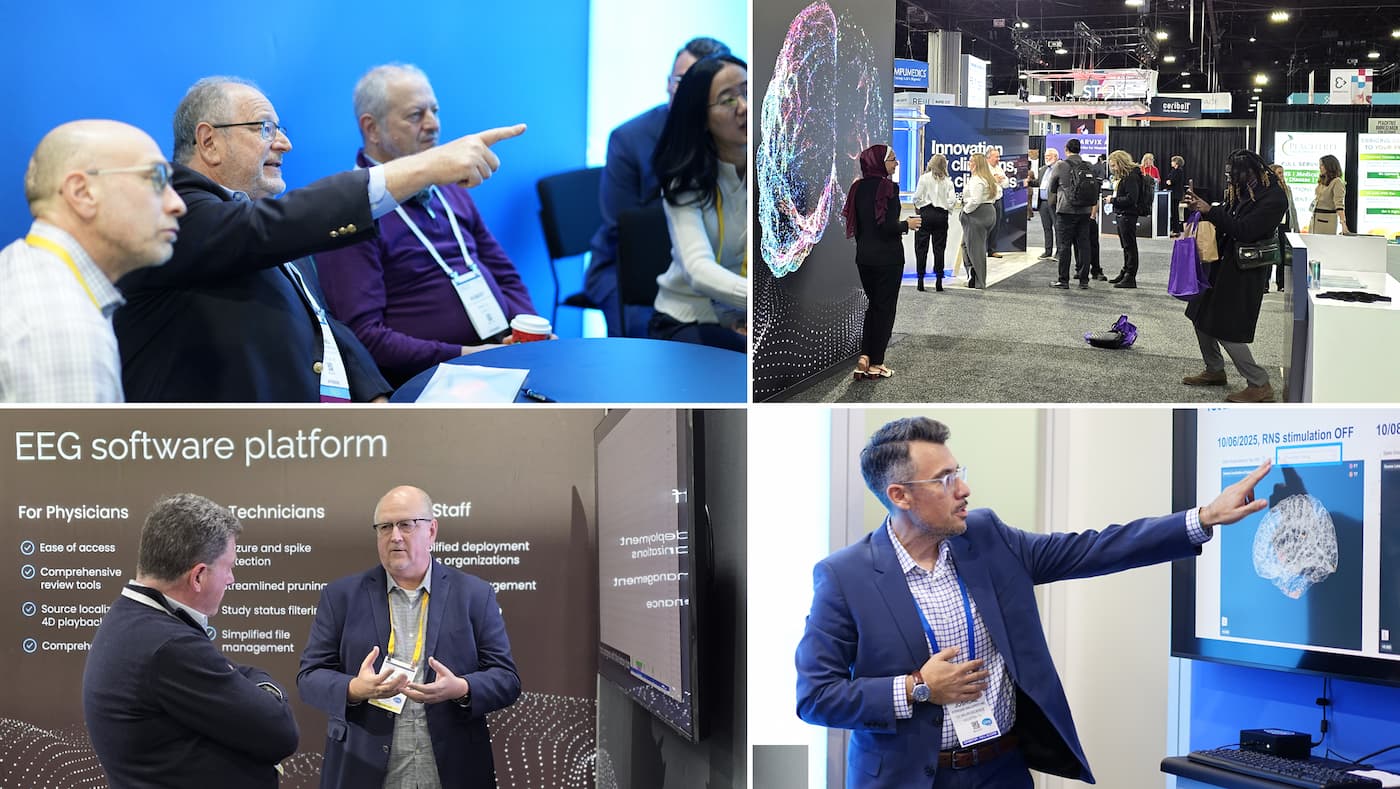
Alongside the hospital rollout came a NeuroMatch Center in Daegu, with monitoring rooms and a lecture hall. Then, in November 2024, LVIS signed a training memorandum with Daegu Health College. The announced plan, involving two additional colleges, targeted 500 clinical pathologists and technicians annually beginning in March 2025.
The adoption problem, expressed in people
Clinical pathologists and technicians per year: the announced training target for the college collaboration. A target, rather than a count of completed trainees.
This is a detail worth borrowing. A company can supply a new interface more quickly than a healthcare system can absorb a new routine. Training makes that routine teachable. Technologists prepare the work, physicians interpret it, and someone must understand how the platform fits the department. The lecture hall addresses a different constraint from the algorithm.
06 / The bill and the betCapital is easier to count than attention
The financing has at least one firm public marker: on January 11, 2022, SK Networks announced participation in a $15 million Series B-2 round. It also recorded an earlier investment by SK Inc. in 2018. The $15 million describes the round, rather than SK Networks’ individual cheque or the total cost of building NeuroMatch.
The commercial model is enterprise SaaS, with a demonstration-led sales process. LVIS also advertises advanced source-localization trend options on a pay-per-use basis. For a buyer, the relevant calculation extends beyond a software fee: local maintenance, storage, training and the time spent moving studies through review all affect the value of a change.
The team’s own recruiting language puts scientists and engineers at the center and advertises opportunities across the US and Korea. The company announced ISO 13485 certification in April 2025. In April 2026 it reported Edison Awards silver recognition and an Artificial Intelligence Excellence Award in Digital Twin Technology.
“developing AI technologies that work alongside physicians to improve diagnostic confidence and expand access to neurological care”JIN HYUNG LEE / LVIS’S APRIL 2026 EDISON AWARDS ANNOUNCEMENT
The awards add a public milestone. The more interesting proposition remains the one a hospital can examine on an ordinary working day. Take an existing recording, put it within reach of the right specialist, assist the review, and keep the report attached to the process. LVIS’s broad ambition is to understand the brain’s circuitry. Its immediate business is to make the journey from that circuitry to a clinician a little less cumbersome.