The first thing to know about MAUI Imaging is that the name has nothing to do with an island. It stands for Multiple Aperture Ultrasound Insonification, a phrase with the easy charm of an engineering grant application. The second thing is more interesting: the Tucson company has spent most of its life trying to make ultrasound stop behaving like ultrasound.
Conventional systems send focused beams along lines and assemble the returning echoes into an image. They work beautifully when the path is cooperative. Bone, gas, metal and ribs are not cooperative. A sonographer searches for an acoustic window, angles between obstacles and accepts that some anatomy belongs to CT or MRI. MAUI's K3900 takes another route. Its concave probe sends unfocused acoustic pings from groups of elements, listens across the array and reconstructs each pixel from many paths. The obstacle becomes part of the calculation.
The company that waited for its own computer
Don Specht had an unusual résumé for this problem. He worked at an early medical-ultrasound company, co-founded R2 Technology to use neural networks in mammography, then spent two decades at Lockheed Martin working on space telescopes. Multiple apertures can combine partial views into something sharper. Don wondered whether the same family of ideas could improve medical ultrasound. In 2006 he and his son David started MAUI in a Silicon Valley garage, joined early by expertise from sonar and radar.
The physics arrived before the practical machine. MAUI's approach requires trillions of calculations per second. A portable, cost-conscious device could not do that in 2006. David Specht's compact explanation for the long road is: “We had to wait for Moore's Law to catch up.” What failed first was not the ambition or even the signal. It was the compute budget.
That distinction matters. Deep-tech companies are often told to move faster, but some clocks are set by semiconductor density, component cost and regulation. MAUI kept developing algorithms and intellectual property while processors improved. The company now reports more than 160 granted U.S. and international patents, with dozens pending. Don died in 2019. David continued the work, carrying a family experiment into the far less romantic chores of regulatory clearance, manufacturing and sales.
“We had to wait for Moore's Law to catch up.”David Specht, co-founder and CEO
What the K3900 actually sells
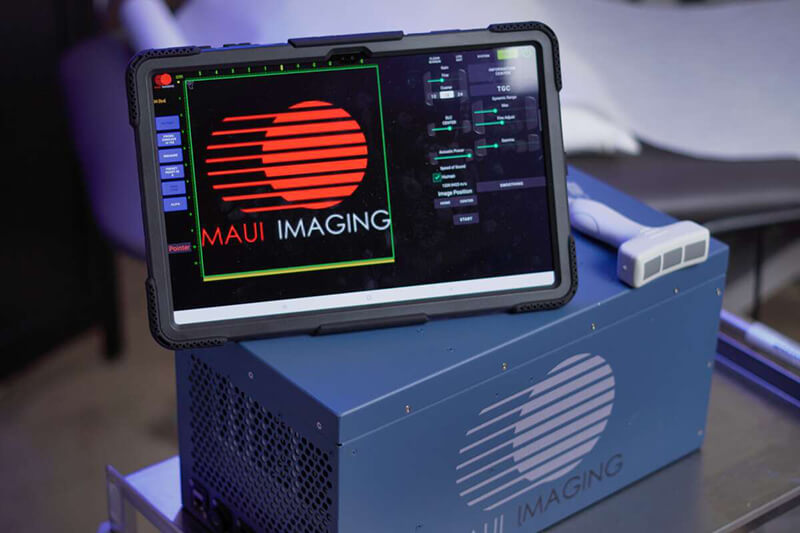
The K3900 is a Class II general-purpose ultrasound system: a transducer, a processing unit and a tablet interface. The FDA found it substantially equivalent in October 2023 under the 510(k) pathway, using GE's LOGIQ E9 as the predicate. Its cleared B-mode uses span fetal, abdominal, cardiac, adult and neonatal cephalic, musculoskeletal, urology, small-organ, vascular and certain intraoperative examinations for adult and pediatric patients.
That sentence is deliberately less exciting than “ultrasound through the skull.” The FDA clearance covers listed ultrasound uses. MAUI's more differentiating claims about imaging through or around obstructions are being investigated in clinical programs. Acertara, the ultrasound engineering company that now distributes the K3900 to many U.S. hospitals, explicitly says it is not a replacement for CT or MRI. This is the correct frame: a cleared platform with a provocative technical advantage still accumulating evidence for its most unusual applications.
Business Insider reported an average selling price of $85,000, plus maintenance. That makes MAUI cheaper than installing a CT suite, but much dearer than handheld point-of-care ultrasound. The customer is not shopping for a clever probe to fit in a coat pocket. MAUI is selling a device to hospitals, emergency departments, interventional teams and government programs that might place more capable imaging close to a patient, especially when moving the patient is difficult.
The battlefield is a brutally clear beachhead
MAUI emerged from stealth in August 2024 with a $4 million contract from the U.S. Army Medical Research and Development Command. The project spans interest across four military branches and is implemented with the University of Maryland's R Adams Cowley Shock Trauma Center. The settings are vivid: a naval vessel without CT, an evacuation aircraft, a field hospital, a mass-casualty scene. The closer diagnosis moves to the injury, the less a team depends on moving an unstable patient to fixed infrastructure.
“They're trying to move the decision-making point as far forward as possible because they don't have enough doctors,” David Specht told Business Insider. That is both customer discovery and product strategy in one sentence. The military is not buying novelty for its own sake. It is testing whether corpsmen, medics, nurses, technicians and physicians can acquire useful information where trained specialists and conventional scanners are scarce.
Hospitals form the commercial market. Trauma and emergency care are the wedge, followed by neurology, critical care and interventional guidance. A physician trying to target a liver or kidney lesion behind ribs may value a probe that is less fussy about its window. An emergency team may value bedside cranial or thoracic views. Every one of those applications must still be judged against the incumbent: ordinary ultrasound, X-ray, CT, MRI or simply transferring the patient.
The evidence is promising and small
MAUI's first peer-reviewed baseline paper appeared in JACEP Open in 2025. Researchers ran three whole-body imaging sessions on six normal volunteers, collecting 65 predefined views across four anatomical regions. Five experienced clinicians scored the images. Fifty-nine views, or 90.8 percent, met the threshold the team considered adequate for clinical decision-making. Cranial images showed anatomical detail; extremity views showed cortex and medullary cavity; abdominal views showed organs without the usual rib shadows.
Then come the caveats, which are more useful than another triumphant press release. Six people cannot reveal the effects of age, sex or body habitus. All were healthy, so the study says nothing about sensitivity or specificity for a particular injury. Vascular-flow measurement was not available during the study. The authors included MAUI employees and equity holders, and the work received military funding. The result is a technical feasibility signal, not a diagnostic victory lap.
One accidental detail captures both the promise and the risk of extrapolation. A volunteer had a benign cortical feature called pseudotumor deltoideus. It appeared on X-ray and the MAUI image. That suggests CET may visualize subtle long-bone findings, but “may” is doing important work. A useful picture is the beginning of a diagnostic study, not its conclusion.

Money, distribution and the change of mind
In July 2025 MAUI raised a $14 million Series D led by Acertara Acoustic Laboratories, bringing total capital reported by the company and press coverage to roughly $40 million. The money was earmarked for production, sales and marketing. Acertara also became the exclusive U.S. distributor for hospitals outside accounts MAUI serves directly, handling demonstrations, pre-orders, site readiness, training, commissioning and quality support. For a small device company, that operating machinery may be as valuable as the check.
MAUI had eight employees and eight consultants when Business Insider profiled it in 2025; LinkedIn places it in the broader 11-to-50 range. This is a narrow team attempting hardware, algorithms, regulatory work, clinical research and commercialization at once. The partnership externalizes the hospital plumbing without surrendering the technology.
What changed skeptics' minds was not a white paper. Rick Altinger, now acting COO, told an industry audience that former Siemens ultrasound president Said Bolorforosh initially thought the idea was not doable. Then the team showed him images. For companies selling a counterintuitive technical claim, the copyable move is obvious: build the artifact that makes disbelief uncomfortable.
The playbook worth stealing
The transferable idea is not “start an ultrasound company.” It is to preserve information before making decisions. Conventional systems focus and discard possibilities during acquisition. MAUI gathers a richer echo record and lets computation reconstruct the view afterward. Software teams will recognize the pattern: collect flexible raw material, postpone irreversible choices, then improve the output as algorithms and compute get better.
Four things another founder can copy
- Design around the incumbent's structural blind spot, not a cosmetic feature gap.
- Pick a first customer whose constraints make your difference economically legible.
- Use enabling technology as a clock and milestone, not an excuse for vague waiting.
- Pair proof with limits. A credible “not yet” earns more trust than a universal claim.
It will not work everywhere. The research protocol needs power. The cleared system is intended for qualified healthcare personnel. The first study does not prove performance on injured patients, and an $85,000 device still requires procurement, training, maintenance and workflow integration. If a site has immediate CT access, abundant specialists and no delay in moving patients, MAUI's portability advantage may shrink. If larger trials do not establish diagnostic performance across real pathology and varied bodies, the barrier-crossing story stays an intriguing image instead of a routine clinical decision tool.
The next experiment stretches the platform in a different direction. A $143,486 Gates Foundation grant is funding a 10-month feasibility study of the K3900 for tuberculosis triage in resource-limited settings. Battlefield trauma and global TB care are not the same market, but they share an infrastructure problem: the useful scanner is often somewhere else. MAUI's business depends on proving that its box can bring enough of the answer to where the patient already is.
After two decades, the company has finally reached the part where patience stops being the headline. Now the images, diagnoses and hospital purchases have to do the talking.