Some startup clocks count in sprints. David Specht’s counts in generations of processors. In 2006, Specht and his father, Don, started MAUI Imaging in a Silicon Valley garage around an idea that had traveled an improbable route: from medical ultrasound to space telescopes, then back toward the human body. It would take seventeen years for the company’s first system to receive clearance from the U.S. Food and Drug Administration. One year after that, MAUI announced a $4 million Department of Defense contract. The next summer brought a $14 million Series D.
That is an awkward timeline for the mythology of the overnight founder. It is a much better timeline for understanding hardware. The underlying premise required sensors, algorithms and enough computing muscle to process a very large volume of echoes in real time. Specht later compressed the whole long wait into one dry sentence: “We had to wait for Moore’s Law to catch up.”
A pilot learns to operate
Specht arrived at medical imaging from the cockpit. Beginning in 1983, he served in the U.S. Air Force as a pilot and instructor pilot on the A-10, T-37 and T-38. The list sketches a career in progressively different machines: two trainers and an attack aircraft built around direct support of people on the ground. He also spent a year directing the leadership department at the Air Force Officer Training School.
His next chapter was less noisy but still concerned with performance. Specht worked as an organizational-development consultant at Performance Point Corporation, then became Chief Learning Officer at Sedgwick. The titles may seem distant from circuit boards and ultrasound probes. They are close to the problem that consumes a chief executive: getting groups of specialists to make difficult things work together.
Deep-tech companies are choirs of mutually suspicious experts. The physicist thinks in first principles. The clinician thinks in workflow. The regulator asks what can be demonstrated. The investor asks when it can be sold. The former instructor pilot in the middle has to make sure everyone is reading the same instruments.
His father’s borrowed lens
Don Specht had lived at the intersection of several technical worlds. He worked at an early medical-ultrasound company, helped found an artificial-intelligence venture focused on mammography and spent two decades at Lockheed Martin working on space telescopes. His insight was to apply a principle used in multiple-aperture telescopes to ultrasound. Instead of relying on a single narrow viewpoint, a system could gather echoes from separate apertures and combine the data computationally.
More than one way to hear an echo
the data
The early circle around the idea made the crossover even stranger. Ken Brewer brought sonar experience from the Navy. Original chairman Joe Digiovanni brought radar expertise. Medical imaging supplied the arena; aerospace, sonar and radar supplied habits of signal processing. MAUI eventually called the method Computed Echo Tomography. The company name itself carries the older technical phrase: Multiple Aperture Ultrasound Insonification.
David’s part was to help turn the borrowed lens into an operating company. Father and son founded MAUI in 2006. They built hardware, wrote algorithms, accumulated intellectual property and kept going while processors became faster. The company now says its hardware and proprietary algorithms are protected by more than 160 U.S. and international patents, with more than 30 applications pending. David is named as an inventor across several of those patent families.
A family company can make the usual founder roles feel unusually literal. Don held the original technical connection. David carried the organizational burden of making it durable. Their surnames recur in the patent record alongside engineers and collaborators, a paper trail of how an inherited question became shared technical work. The story is warm only from a distance. Up close, it is years of deciding which experiment deserves another month and which version of the machine deserves another rebuild.
The garage origin matters because it sets the scale of the first bet. MAUI did not begin with a hospital contract, a regulatory decision or a polished category called Computed Echo Tomography. It began with a small group of people convinced that ideas proven in other sensing systems could be recombined around sound. The cleverness was interdisciplinary. The endurance was administrative. Someone still had to form a company, protect the work, recruit the next expert and explain why a slow technical program deserved one more season.
The patience was active
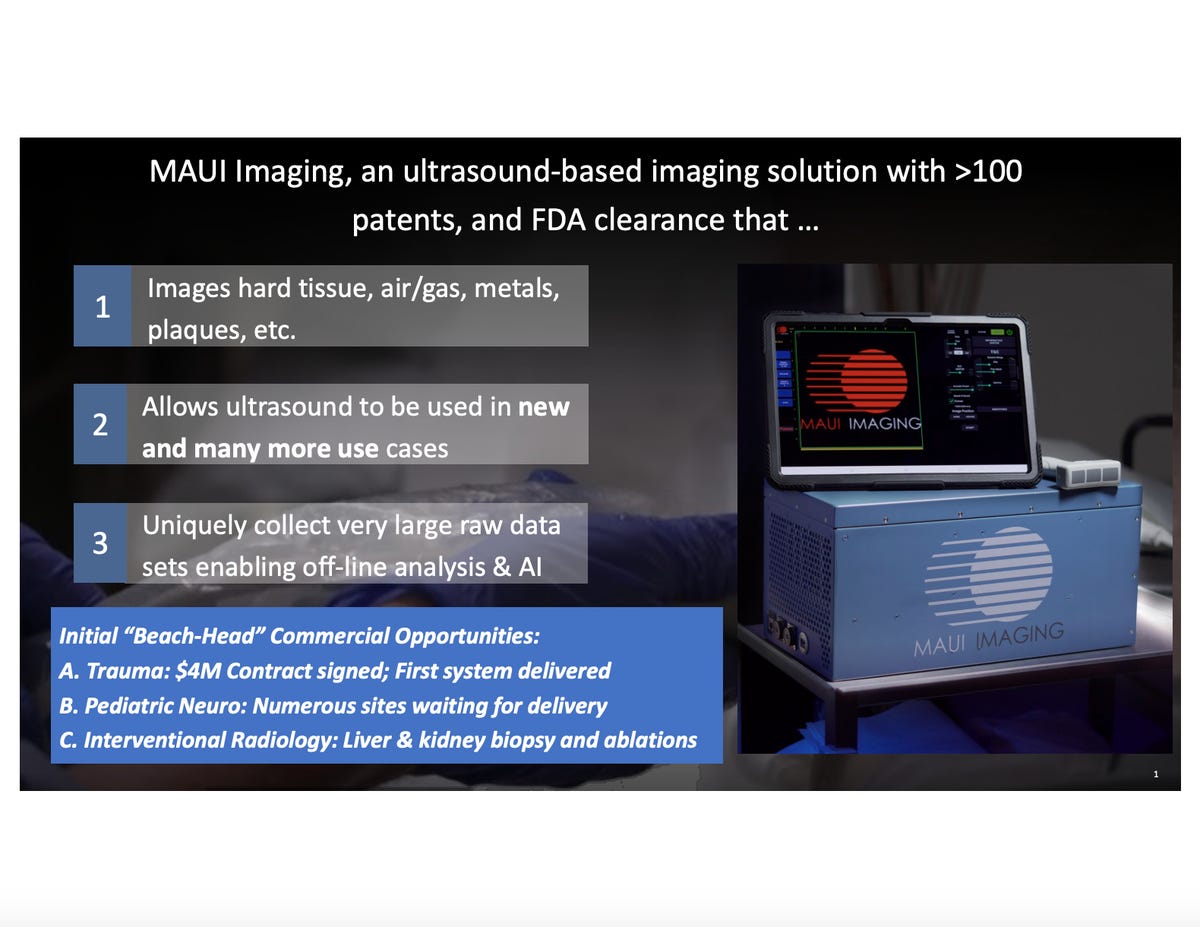
Waiting for technology to catch up sounds passive only if one ignores the paperwork, prototypes and payroll. MAUI’s K3900 is a general-purpose ultrasound imaging system with a transducer, processing unit and tablet interface. The FDA received its traditional 510(k) submission in February 2023 and issued a substantially-equivalent decision on October 25 of that year. David Specht appeared on the filing as chairman and CEO.
Clearance was a hinge, not a finish line. In August 2024, the company publicly emerged from stealth and announced that the Defense Department would evaluate its technology for use away from conventional imaging infrastructure. The interest was practical: a portable system could bring more information to personnel who otherwise have to make consequential calls with fewer tools nearby.
The phrase “emerged from stealth” sounds almost comic after eighteen years. Stealth in software often means a brief period before launch. Here it covered the better part of two decades, a time span in which phones lost their keyboards, cloud computing became normal and artificial intelligence moved from specialist conferences into everyday conversation. MAUI’s apparent stillness concealed a company advancing on a separate clock: physics first, then computation, then proof.
Specht’s biography makes that pacing easier to understand. Aviation does not reward skipping a checklist because another crew finished sooner. Training does not work because an instructor announces the outcome more enthusiastically. Regulated hardware carries the same sober bias toward sequence. It must work, its claims must be bounded by evidence and the people using it must understand what the display can tell them. Speed still matters, but it is speed inside a procedure.
Specht explained the logic from the user’s point of view. “They’re trying to move the decision-making point as far forward as possible because they don’t have enough doctors.” It is the most revealing sentence in his public comments. He describes the product not as a wondrous machine but as a way to shorten the distance between uncertainty and a decision.
The product is also the data
MAUI’s approach produces a large raw dataset. That has two consequences. First, an operator can revisit the captured information and form additional views after acquisition. Second, the dataset becomes potential material for analytical software. Specht has pointed to that trove as useful for future AI tools. The hardware gathers the echoes; the long-term value may include what software learns to extract from them.
This is where the patient founder’s job changes. Early on, scarcity meant insufficient computation. Later, it meant regulatory proof and field experience. After clearance and a government program, the bottleneck became production and distribution. MAUI’s $14 million Series D, announced in July 2025 and led by Acertara Acoustic Laboratories, was allocated to manufacturing, sales and marketing. Acertara also became an exclusive distributor to hospitals outside the accounts MAUI serves directly.
By then the company said it had raised roughly $40 million in total. The figure makes the 2006 garage feel distant. Yet the commercial argument remains close to the founding premise: gather more information with sound, process it differently and put a compact system where larger imaging infrastructure is hard to reach.
Specht has lived through every version of that pitch. First it was a technical analogy between telescopes and ultrasound. Then it became a collection of prototypes and patent diagrams. Later it had to become a regulatory submission precise enough to define the device without outrunning the evidence. Now the language includes distributors, an average sales price and maintenance. A founder’s idea becomes real by becoming less romantic and more specific. Eventually it needs a shipping schedule.
Continuing a shared idea
Don Specht died in 2019, four years before the K3900 clearance. The company’s account of its history is careful about the handoff: since Don’s death, David has continued to lead MAUI toward the mission they set together. Legacy is often discussed as reputation, a bronze noun. Here it became an operating verb. The son had to carry an idea through testing, regulation and commercialization after the father who formed it was gone.
There is no tidy moral that erases the difficulty. A nineteen-year company journey absorbs careers, capital and whole eras of technology. It also resists the founder cliché that conviction is merely loud certainty. Specht’s version looks quieter: choosing a technically demanding premise, surrounding it with people from different disciplines and staying in the work while external conditions change.
The former pilot’s product thesis is finally a form of navigation. Better information matters most before a course is fixed. MAUI wants to shift that moment outward, closer to wherever the uncertainty begins. The processors have caught up enough for the system to leave the garage. Specht’s next clock is commercial: manufacturing units, supporting customers, collecting evidence and seeing whether a long-held idea can become an ordinary tool.