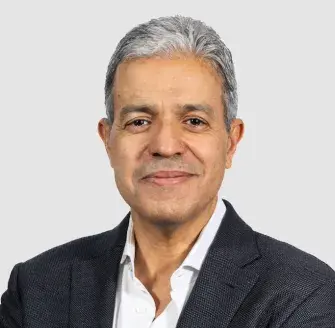
The Scan That Matters Most
Karim Karti took the CEO chair at RapidAI on January 31, 2022. The company had already built something exceptional - a deep clinical AI platform born out of Stanford research, proven in thousands of hospitals, backed by over 700 published clinical studies. His job was not to invent it. It was to make it inescapable.
He came equipped. More than 22 years at General Electric. Three continents managed. A $9 billion imaging business made profitable. A stint at iRhythm Technologies where, as Chief Operating Officer, he doubled revenues from around $105 million to $210 million in eighteen months. Karti is, by training, a builder of scale - someone who finds the distance between a good idea and a global standard and closes it.
At RapidAI, the platform he now leads handles stroke, vascular conditions, pulmonary embolism, aneurysm tracking, and an expanding suite of radiology workflows. The numbers that follow him around in investor decks - 2,500 hospitals, 100 countries, 10 million scans - are not projections. They are the present tense of a system already running.
In November 2025, RapidAI received five new FDA clearances in a single announcement: Rapid DeltaFuse, Rapid LMVO, Rapid MLS, Rapid OH, and Rapid Aortic. The pace suggests a company that has stopped asking permission and started filing paperwork on things it has already built.
The Long Way Around
Karim Karti did not start in healthcare. He started at Procter & Gamble in 1993, managing consumer brands - shampoo and detergent cycles, shelf placement, brand positioning. The toolkit he built there - reading markets, building customer relationships, understanding distribution at scale - turned out to transfer cleanly to medical technology.
In 1996 he joined GE's Corporate Audit Staff, the classic entry point for GE's leadership development pipeline. Within a few years he had moved into GE Healthcare, working across business development and M&A for GE Healthcare Systems. The path from there ran through Korea, then across a geography that most executives see only on a map: Turkey, Central Asia, Russia, the CIS states, the Middle East, Africa.
Running GE Healthcare's Growth Markets division was not a prestige post. It was a problem-solving post - getting imaging equipment and clinical software into health systems with unreliable infrastructure, patchy procurement, and extreme variation in clinical training. Karti did it anyway. The experience of building in constrained environments has a way of making expansion into developed markets feel straightforward by comparison.
By 2016, he had been handed the GE Healthcare Imaging division - a $9 billion business that had been underperforming. He turned it into one of GE's fastest-growing divisions in 2017, pushing into AI-based imaging investments and digital platforms before AI was a required talking point in every annual report. In 2018 he left for iRhythm Technologies, the cardiac monitoring company, where he served as COO. He did not stay long - eighteen months was enough time to double the revenue line. Then came RapidAI.
What RapidAI Actually Does
The company Karti leads began as a research project at Stanford University, developed by neurologist Greg Albers and radiologist Roland Bammer. Their technology - called RAPID - could analyze CT perfusion scans and identify salvageable brain tissue in stroke patients, giving clinicians a map of what could still be saved versus what was already lost. Stanford licensed the technology. The founders bought the rights. A company formed around it.
By the time Karti arrived, the company had rebranded from iSchemaView to RapidAI and expanded well beyond stroke triage. The platform now covers large vessel occlusion detection, intracranial hemorrhage, aneurysm tracking, CT perfusion, aortic analysis, and pulmonary embolism. In early 2026, the platform demonstrated 27 correct detections out of 28 clinically significant aneurysm growth cases - compared to 14 out of 28 for neuroradiologists working without AI assistance. That 27-versus-14 figure is not a marketing claim. It comes from a scientific abstract presented at the International Stroke Conference.
In a February 2026 interview with Healthcare IT Today, Karti addressed the operational reality that clinical AI companies often avoid: radiologist shortages, staff burnout, cyber incidents, connectivity failures, and tight hospital budgets. His answer was not a pitch for the technology's potential. It was a description of how RapidAI is engineering its platform to be resilient under exactly those conditions - edge-cloud architecture, offline functionality, EMR integration that works when the hospital network does not.
The April 2025 WEDI Podcast appearance (Episode 197) offered a different window into how Karti thinks about the work. He described RapidAI's AI algorithms as enabling rapid scan analysis and treatment routing to physicians - not as a replacement for clinical judgment, but as a layer that compresses the time between image acquisition and decision-making. In stroke care, that compression is measured in neurons.
November 2025: Five New FDA Clearances
The Operator's Calculus
There is a specific type of executive that large industrial companies produce: someone who has been held accountable for P&L in markets where the variables include political instability, currency fluctuation, and infrastructure that does not always cooperate. GE used to be a machine for manufacturing this type. Karti came out of it with something that is rarer in Silicon Valley than the ability to fundraise: the instinct for operational resilience.
At iRhythm, that instinct produced $210 million in annual revenue by the time he left. The company - which makes the Zio patch for cardiac monitoring - was growing fast before he arrived. He made it grow faster while simultaneously launching new AI products and building commercial partnerships. The 18-month timeline is not a typo.
At RapidAI, the operational signature is visible in two places. First, the clinical validation rigor: 700+ published studies is not a number that accumulates by accident. It is the output of a systematic effort to generate the kind of evidence that hospital procurement committees and regulatory bodies require. Second, the geographic footprint: 100+ countries means Karti's team is navigating health system procurement in Brazil, Japan, the UK, India, and dozens of other contexts simultaneously. That is the Growth Markets muscle memory from GE, applied at startup speed.
He sits on the boards of MedTech Acquisition Corp. (as Chairman), Rockley Photonics Holdings, and Braid Health - a set of affiliations that spans photonics-based health monitoring and AI-powered radiology workflow tools. The pattern suggests someone who watches the edges of the medtech landscape as carefully as he manages the center.
What He Has Built
iRhythm: Revenue Doubled
As COO, grew annual revenues from ~$105M to $210M in 18 months while launching new AI cardiac monitoring products.
GE Healthcare Imaging: $9B Turnaround
Led the division to become one of GE's fastest-growing businesses in 2017, driving AI-imaging investments and digital platform development.
RapidAI: Global Standard
Scaled the platform to 2,500+ hospitals across 100+ countries with 10M+ scans processed and $102.75M in total funding.
5 FDA Clearances in One Month
Oversaw five simultaneous FDA 510(k) clearances in November 2025, expanding into aortic, vascular, and advanced stroke imaging.
Clinical Evidence Machine
700+ published clinical studies supporting the RapidAI platform - an evidence base that rivals pharmaceutical research pipelines.
ISC 2026: 28 Abstracts
RapidAI presented 28 scientific abstracts at the International Stroke Conference 2026, including the landmark aneurysm detection data.