A needle is a simple object until it enters an ultrasound image. Tilt it a little, move it out of the imaging plane, put it behind a difficult patch of anatomy, and the clean line a clinician expects can become a guess. The anatomy is still there. The tool may be there too. But the business end of the instrument - the tip - can be the least certain point on the screen.
The short version
- DeepSight develops ultrasound systems and tiny sensors intended to locate interventional tools in real time.
- Its NeedleVue LC1 cart has U.S. FDA clearance for specified diagnostic imaging uses; its wider sensor-guided lineup is still in development.
- The company is pursuing three routes to a procedure room: a dedicated system, integration into another maker’s equipment, and an add-on for existing ultrasound.
That gap between seeing the destination and finding the instrument is where DeepSight Technology has placed its bet. The Santa Clara company proposes a sensor about 50 microns across, small enough to sit at the tip of a medical instrument. It passively detects ultrasound signals. Software then uses that signal to locate the tip against the image. The ambition is to make an instrument less dependent on the angle at which it happens to meet the ultrasound beam.
The company has not published a price for the platform. It has, however, shown the cost of attempting the idea at corporate scale: a $25 million Series A in 2021, led by Deerfield Management with Wing, Alter Venture Partners, and Time BioVentures participating. Investors bought into a broader imaging premise. The clinical pitch has since become sharper, and much easier to explain.
The invisible tip
Traditional ultrasound has a good reputation for sensible reasons. It gives live images, uses no ionizing radiation, and can sit near the patient rather than in a remote scanning suite. Yet when a physician advances a biopsy needle or guidewire, the image has a particular blind spot: visibility depends on position, angle, tissue, and acoustic conditions. A visible shaft is not proof of a visible tip. Confusing the two would make an excellent magic trick and a poor clinical workflow.
DeepSight’s NeedleVue concept tries to attach a location signal to the tool itself. Its claimed advantages include wide-angle tracking, automatic calibration, and operation in awkward conditions such as ablation clouds and ultrasound contrast media. These are design claims for a developing platform, not a blanket statement of proven clinical outcomes. If the approach performs as intended, it could help an interventionalist during a biopsy, ablation, vascular procedure, or other image-guided intervention by making the working end of the instrument less ambiguous.
A physics lab meets a procedure room
DeepSight was founded in 2019 by Nader Sadrzadeh, Lan Yang, and Anand Chandrasekher. Yang, a professor at Washington University in St. Louis, works with optical microresonators. The name for one class of them - whispering-gallery-mode resonators - sounds like a Victorian social club. The physics is practical: light circulates in a tiny structure, making it possible to detect minute disturbances. Patent filings connected to Yang and the university describe using those structures for ultrasound sensing and imaging.
Sadrzadeh brought a different résumé. Before DeepSight, he led Kionix, a MEMS sensor company, and held senior semiconductor roles. That pairing of microscopic sensing and product engineering is more revealing than a generic claim to “AI in healthcare.” DeepSight certainly mentions algorithms and software. But its distinctive wager is physical: put a sensor where the uncertainty is, then make the image respond to it.
In 2021, the public pitch emphasized an ultrasound system with greater sensitivity and reach. DeepSight said internal studies suggested up to 100 times greater sensitivity and more than double the effective range of conventional systems. Those were company claims, tied to internal work, and they are not the same as an independent clinical trial. By 2023, the company was introducing NeedleVue as a tool-guidance solution. At RSNA in 2024, it showed an investigational LiteCart. The shift in emphasis is visible in the record, though the company has not publicly described a failed product or a single moment of changed minds.
Three doors into the same room
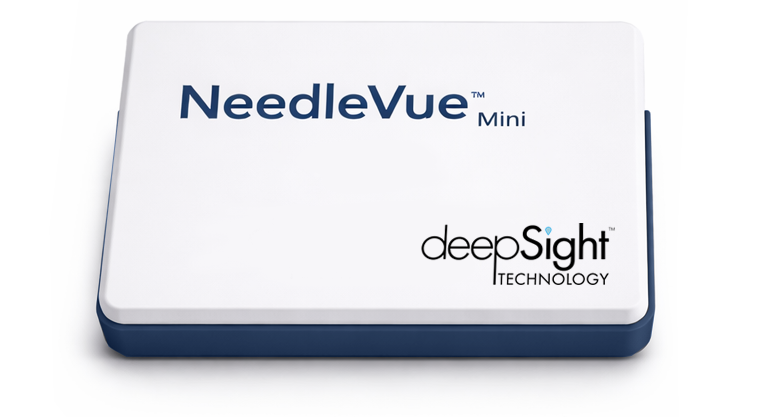
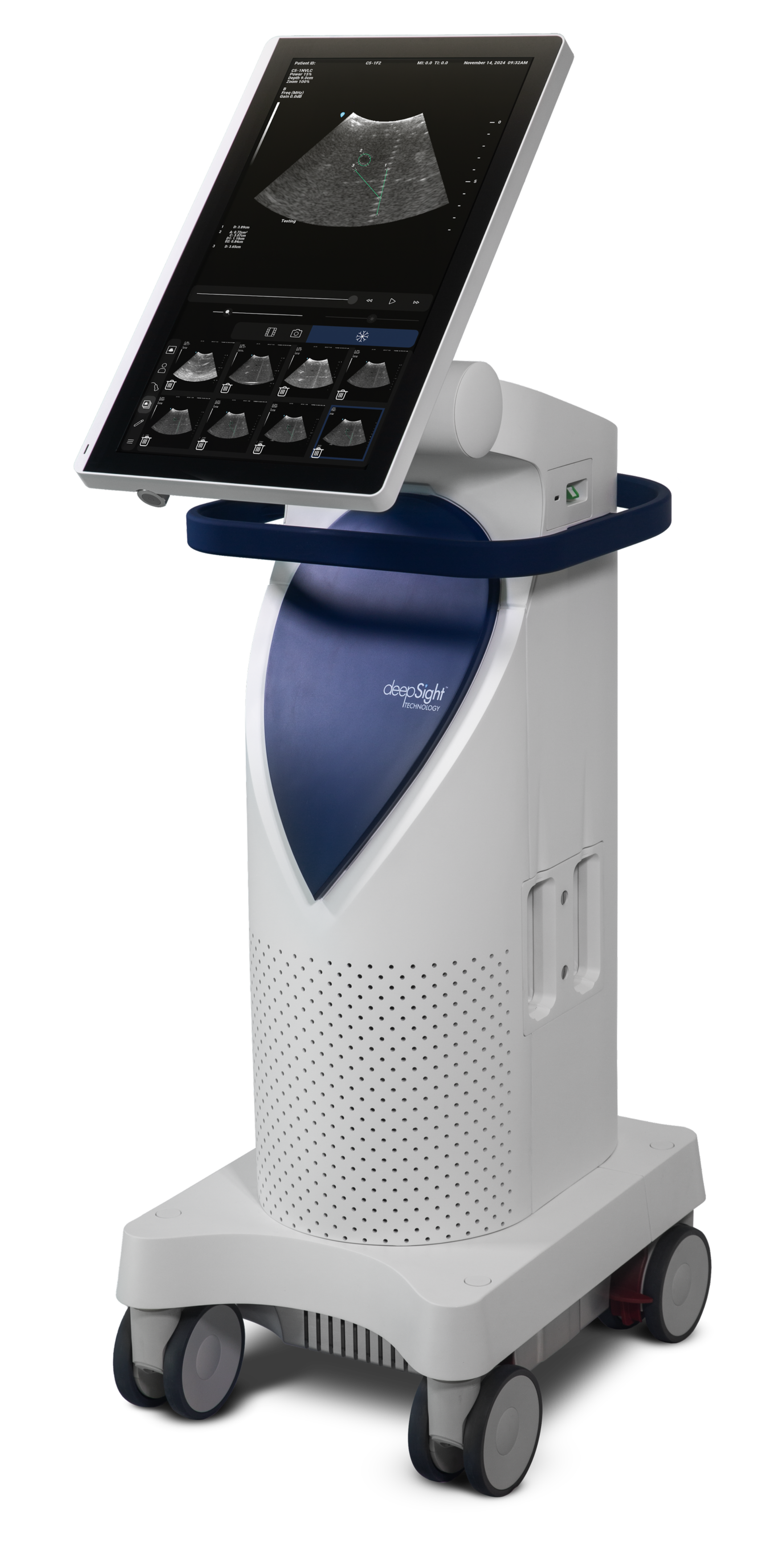
The 2026 product map shows a company thinking about adoption, not merely invention. LiteCart is a dedicated interventional ultrasound platform. NeedleVue Embedded is intended for equipment manufacturers that want to put DeepSight’s technology inside their own systems. NeedleVue Mini is proposed as a bolt-on for ultrasound machines hospitals already have. The three forms answer three different purchasing questions: buy a new cart, build with a partner, or extend installed equipment.
LiteCart
A purpose-built interventional ultrasound setup.
Embedded
A platform component for medical equipment partners.
Mini
A proposed upgrade path for an existing ultrasound fleet.
That distinction is the hinge of the story. In August 2025, the FDA cleared the NeedleVue LC1 Ultrasound System under 510(k) number K250381. The agency’s stated indications cover specified abdominal, pediatric, small-organ, peripheral vascular, fetal, urological, and musculoskeletal imaging. It is a prescription system for qualified healthcare professionals. The company’s own notice says the other DeepSight devices have not been authorized for sale. The cleared cart is an important milestone; it does not turn every sensor-guidance idea shown beside it into a cleared device.
The people who would use it
The LC1’s formal users are physicians and trained sonographers in hospitals, clinics, and medical practices. NeedleVue’s proposed guidance features speak more directly to proceduralists - interventional radiologists, oncologists, and clinicians placing instruments into hard-to-see anatomy. Equipment makers are another audience, because an embedded version only matters if someone else designs it into a platform.
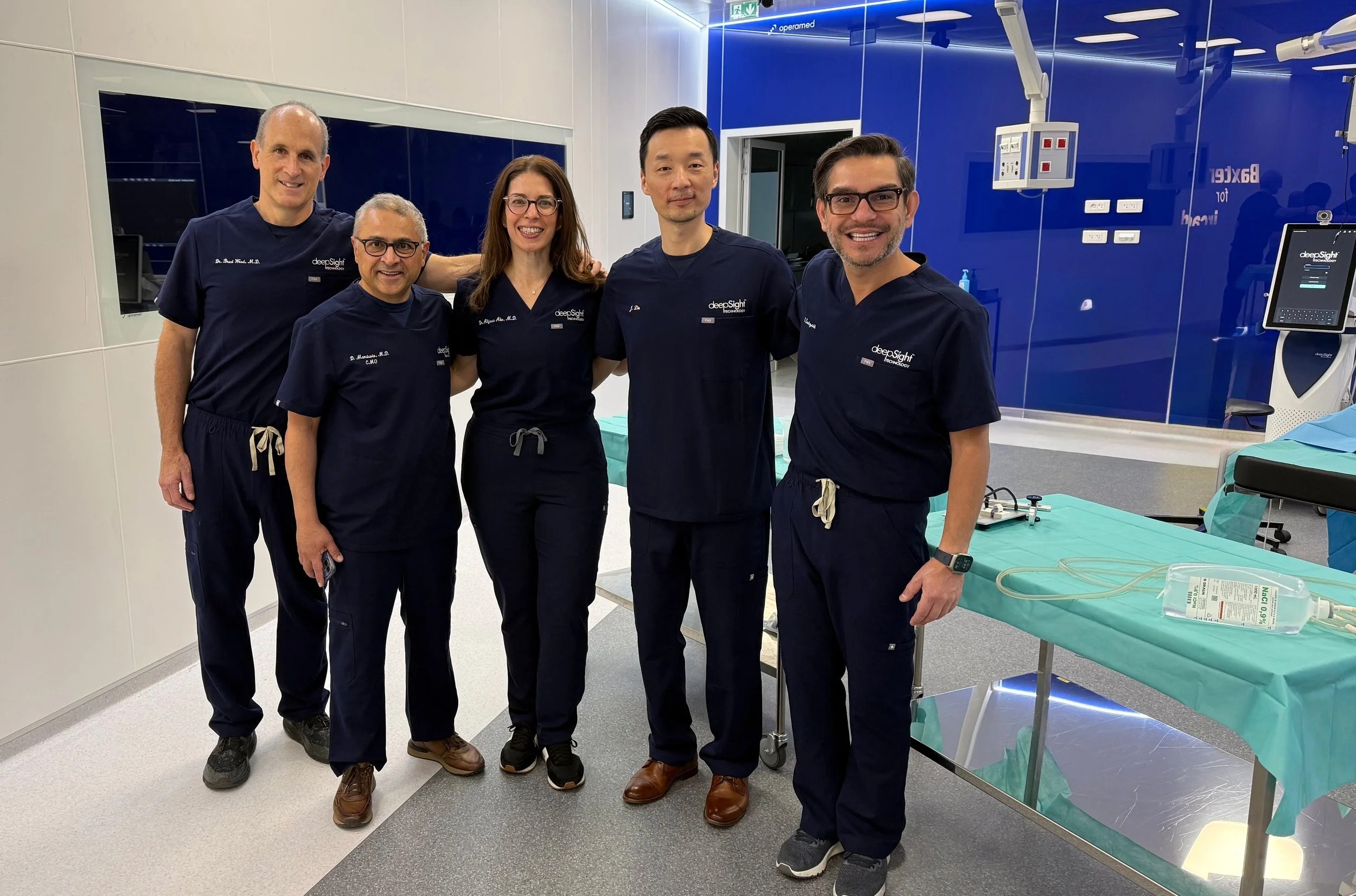
The company has recruited around that clinical problem. Diku Mandavia, a former chief medical officer at Sonosite, joined as DeepSight’s chief medical officer in 2025. Interventional radiologist Bradford Wood, formerly of the NIH Clinical Center, became vice president of strategic partnerships later that year. Their presence does not validate a device on its own. It does show the expertise DeepSight is assembling as it moves from sensor physics toward procedures, trials, integration, and sales.
For a hospital, the practical test is ordinary and severe. Does the tip stay visible in difficult anatomy? Does setup fit the pace of a real procedure? Does the new information help more than it distracts? A 50-micron sensor has to survive integration into disposable instruments, regulatory review, staff training, and the economics of purchasing. The elegant laboratory answer becomes useful only when it is dull enough to work on a busy Tuesday.
What the small sensor can teach a large company
There is a lesson here for anyone building tools for professionals. DeepSight did not stop at a stronger image. It followed a specific moment of uncertainty in the user’s work: the tool tip appears to vanish just when its position matters most. Then it designed several ways for buyers to adopt the same underlying idea. The company’s road from a physics claim to a cart, an OEM plan, and an add-on is a study in making an invention meet a workflow.
Whether that strategy succeeds depends on evidence still to be made in clinics and on regulatory decisions still to come for the wider lineup. DeepSight’s current achievement is narrower but tangible: a cleared diagnostic ultrasound system, a funded sensor program, and a sharply defined clinical problem. Sometimes the most useful innovation begins with a very small question. Where, exactly, is the tip?