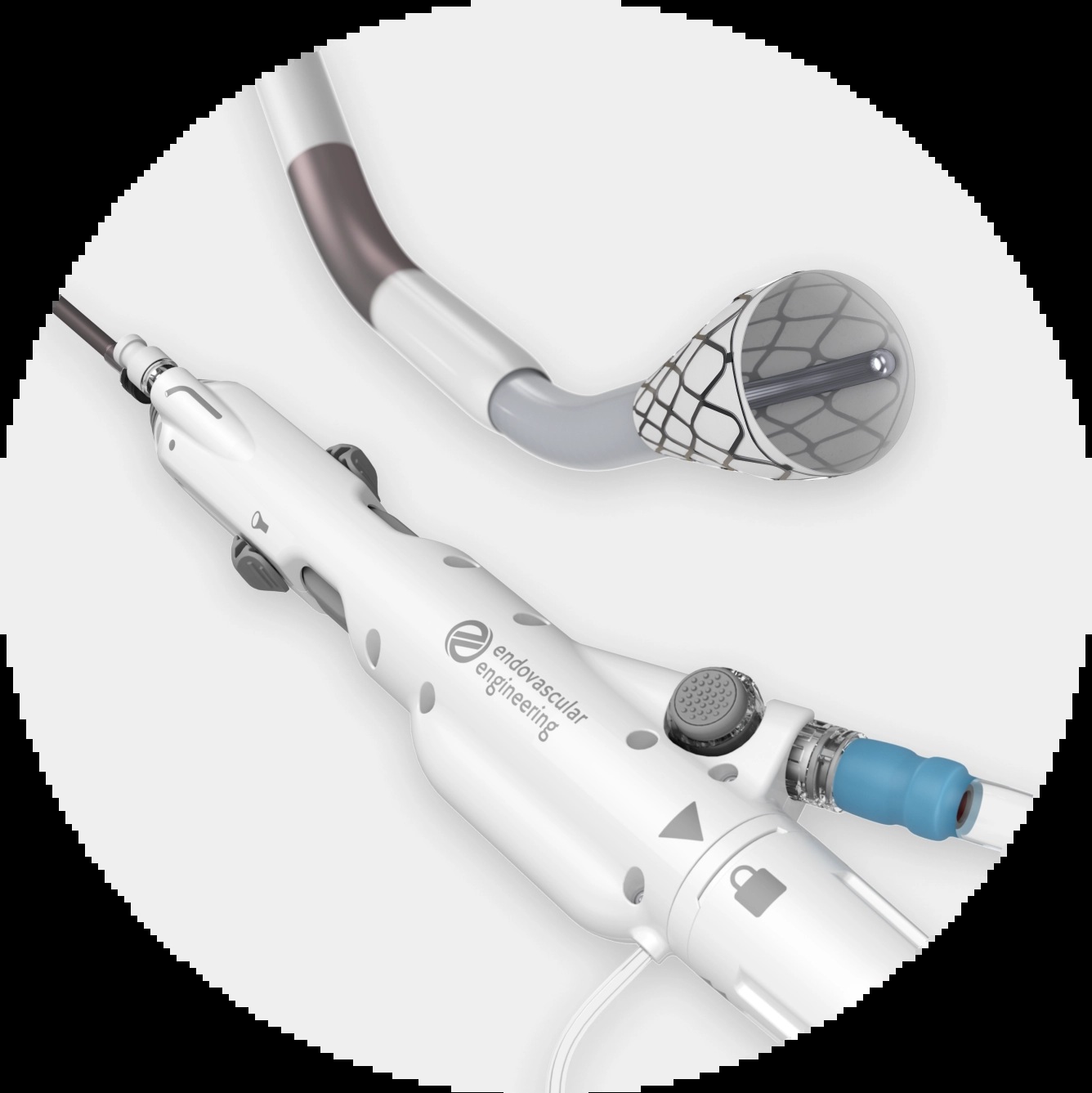
The heart is a narrow place to carry a big tool. To remove a clot from the arteries of the lung, a physician must first guide a catheter through veins and across the right side of the heart. A broad mouth can catch more clot, but getting that mouth to its destination is another matter. Endovascular Engineering, a Menlo Park company known as E2, built its Hēlo thrombectomy system around this awkward journey: cross small, open wide, pull the clot in.
The device has a funnel at its tip. An agitator inside that funnel helps break up clot while suction draws material out. It is a clinical instrument, operated by interventional specialists in a hospital, rather than a product a patient can choose from a menu. Its intended users include interventional cardiologists, radiologists and vascular surgeons treating pulmonary embolism, the dangerous blockage that occurs when a clot lodges in a lung artery.
- Hēlo travels through the heart at roughly a 15 to 16 French profile, then expands to a 24 French clot-engagement funnel.
- The FDA cleared the Hēlo catheter system for pulmonary and peripheral venous clot removal in December 2025.
- An early 25-patient study recorded two transfusions; later work examined a separate blood-return system.
- E2 has announced $137 million across three financing rounds, most recently an $80 million Series C.
A small traveler with a large appetite
Luis Savastano, a physician and scientist, invented the underlying thrombectomy approach. The first idea came from work on small vessels in the brain, according to E2's own account of its origins. The company, founded in 2019, developed it with the medical-device incubator Inventure Group and early investor Santé Ventures. E2 later shifted its first clinical focus to pulmonary embolism. That decision put the invention in a field with established aspiration systems, real hospital buyers and a very specific anatomical problem.

The competing designs show why the choice mattered. Stryker's FlowTriever, originally made by Inari Medical, uses large-bore clot extraction. Penumbra's Indigo platform is another aspiration alternative. E2's answer is an expandable distal opening with a smaller crossing profile and an agitator that works at the point of capture. The claim is mechanical and testable: a catheter can reach the lung arteries with less bulk, then present a larger target to the clot. It is not proof that Hēlo outperforms either rival in patient outcomes; that would require a different kind of comparison.
The first warning came with the blood
The first-in-human ENGULF feasibility study enrolled 25 people at eight centers. All underwent a successful thrombectomy procedure. The ratio of right-ventricular to left-ventricular size - a measure of cardiac strain in this setting - fell by an average of 23.2 percent after treatment. No patient in that small cohort had a major life-threatening bleed under the trial's prespecified definition. Yet two developed anemia that required transfusion after procedure-related blood loss. A procedure can meet its formal safety endpoint and still reveal a design problem worth taking seriously.
E2's next work paid attention to what aspiration removes alongside the clot. The company added an audible flow indicator to help operators recognize rapid flow, and studied a separate blood-return system that filters aspirated blood and returns it to the patient. In one 2026 ENGULF analysis reported by the Society for Cardiovascular Angiography & Interventions, median blood loss was 10 mL in 40 patients treated with blood return and 340 mL in 90 patients treated without it. The comparison was not randomized, so it cannot by itself establish how much of the difference the accessory caused. It does show the question E2 chose to measure.
The Hēlo thrombectomy catheter and the Hēlo Blood Return System have distinct regulatory status. The catheter has FDA 510(k) clearance; the blood-return accessory remains investigational.
“E2 took a unique approach, by innovating the catheter and introducing new elements of the Hēlo system throughout the pivotal study.”Andrew Klein, MD, ENGULF co-principal investigator
Evidence is a longer catheter
The pivotal ENGULF cohort enrolled 105 patients across 19 U.S. hospitals, with 40 operators from three specialties. In E2's presentation of the pivotal results, the average right-to-left ventricular ratio fell 25.1 percent at 48 hours. The FDA's decision summary records a 1.9 percent device-related major adverse event rate under its specified adjudication. Those figures are useful, but neither is a randomized comparison with another device or with medical management. The study was designed to test Hēlo against prespecified performance goals.
The FDA cleared the Hēlo Thrombectomy System on December 18, 2025, for non-surgical removal of emboli and thrombi from pulmonary arteries and peripheral veins. That clearance gave E2 a path to market for the catheter system. It did not answer every clinical question about which pulmonary embolism patients gain the most from intervention, or establish a price. Device purchasing happens between manufacturers and hospitals; E2 has not published a public list price.
The price of reaching that point as a company is easier to see. Santé Ventures and Cordis co-led a $15 million Series A1 in 2022 to move the platform toward initial clinical evaluation. A $42 million Series B followed in February 2025 as the pivotal trial approached completion. In April 2026, Gilde Healthcare and Norwest co-led an $80 million Series C intended to build commercialization, research and operations. The three announced rounds add to $137 million. Capital bought a long sequence of engineering, manufacturing, regulatory work and clinical evidence, not a shortcut around them.
What the company actually sells
E2 is a business-to-business medical-device maker. The FDA filing describes Hēlo as sterile and single-use, which points to the familiar hospital purchasing model for interventional tools: the institution buys devices for procedures performed by trained clinicians. The system includes the aspiration catheter, agitator, and accessories such as an optional audible flow indicator. The company's expertise sits at the intersection of catheter mechanics, clot behavior, blood handling, clinical trial design and regulatory execution.
That position is promising only under particular conditions. Hēlo must be navigable by operators across different anatomies and work within the timing and staffing of pulmonary embolism care. Blood-return benefits need to hold up beyond a nonrandomized subgroup analysis. Hospitals must find a clinical and economic reason to stock it beside existing systems. These are ordinary hurdles for a medical device, but they are where a clever drawing becomes a durable business - or does not.
The lesson another builder could copy is procedural rather than proprietary. E2 began with a physical contradiction, picked a clinical setting where it mattered, ran a small study, took the uncomfortable signal about blood loss seriously, and measured a revised approach in a larger trial. The best part of the story is not the funnel's size. It is that the company kept asking what else the funnel was taking.