The first argument over Evalve's future took place, according to Abbott's account, in a California diner. Cardiologist Fred St. Goar brought drawings of a device that might repair a leaking heart valve without opening the chest. There was a natural question around the table: could anyone actually steer such a thing through the body and make it work on a beating heart?
A leaking mitral valve fails to close cleanly. Blood moves backward when the heart contracts, adding work to a pump that may already be in trouble. Surgeons can repair the valve by bringing its two leaflets together, an edge-to-edge maneuver often associated with the Alfieri stitch. Evalve's proposal was to reach those leaflets through a catheter, then make the same essential move from inside the heart. It sounded like a small change in venue. It was an entirely different engineering problem.
- Evalve developed MitraClip, a catheter-delivered device for selected patients with mitral regurgitation.
- The team dropped an early suture approach and built a clip instead.
- Abbott bought Evalve in 2009 for $320 million upfront, with up to $90 million tied to milestones.
- In a randomized trial, the clip was safer than surgery but less effective at reducing leakage.
A sewing problem without a needle
The Foundry, a medical device incubator, and St. Goar founded Evalve in 1999. CEO Ferolyn Powell assembled clinicians, engineers, and regulatory specialists to turn the drawings into something a physician could use. Abbott's retelling has a detail that startup histories often tidy away: the engineers tried a suture-based route first. Sewing is how surgeons solve this problem in an operating room. At the end of a long catheter, though, sewing asks the instrument to do a remarkable amount of work.
The design changed. A tiny mechanical clip would grasp both leaflets and hold them together, reducing the gap through which blood could escape. The system needed a steerable guide, a delivery catheter, imaging, and a trained team. The implant itself was the memorable part, but the rest of the apparatus made the clever part reachable.
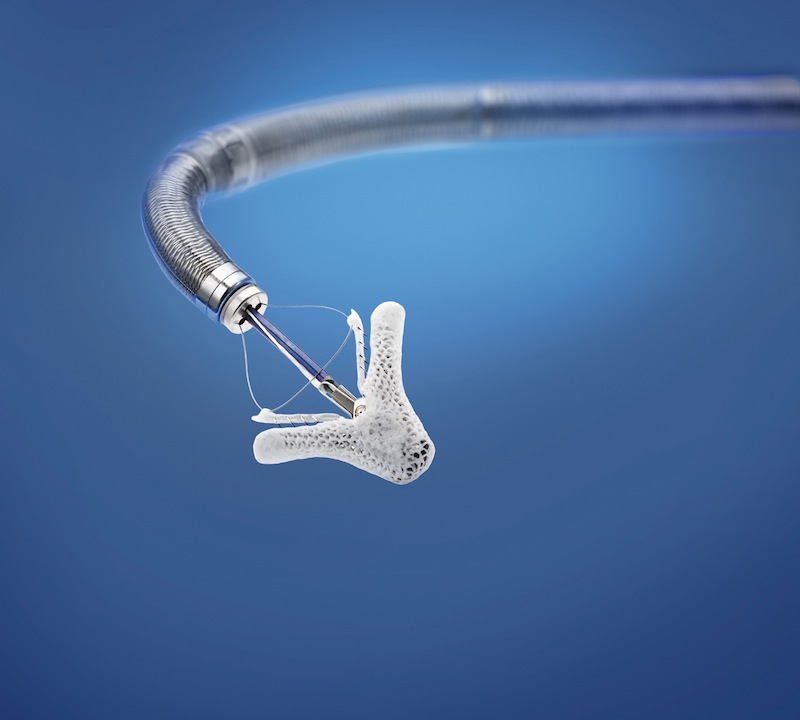
The route matters. Instead of stopping the heart and opening the chest, a physician advances the device through a vein and across the wall separating the heart's upper chambers. Imaging guides the clip onto the mitral leaflets. If its placement looks wrong, the team can adjust before releasing it. For patients facing substantial surgical risk, that difference could turn an impossible conversation into a possible procedure.
The trial refused a tidy victory
A device that avoids an incision still has to prove that it helps. Evalve's EVEREST program brought MitraClip through early feasibility work and then a randomized comparison with surgery. The first human implant came in 2003. Europe granted a CE mark in 2008, allowing commercial use there while the United States continued to demand evidence.
The pivotal EVEREST II trial enrolled 279 patients. At twelve months, 55% of the catheter-repair group and 73% of the surgical group met the study's primary effectiveness endpoint, a composite that included survival, no surgery for valve dysfunction, and no severe residual regurgitation. The published conclusion was blunt: percutaneous repair reduced leakage less effectively than conventional surgery. It also had a superior safety profile and similar improvement in clinical outcomes.
That result is the hinge of Evalve's story. A company can spend years asking whether a device works, then discover that the sharper question is for whom? For someone who can tolerate surgery and wants the most durable reduction in leakage, a less invasive route may be a poor bargain. For someone whose health makes surgery prohibitively risky, the arithmetic can look very different. The FDA's first US approval in 2013 reflected the latter group: selected patients with significant degenerative mitral regurgitation judged by a heart team to be at prohibitive risk for surgery.
“We tried lots of different things to find what the right path or the best path at the time would be.”Troy Thornton, former Evalve vice president of research and development
What the check bought
Abbott agreed to buy Evalve in September 2009. Its $320 million upfront payment bought the remaining 90% of a company in which it had already invested. Another $90 million depended on regulatory milestones. The often quoted $410 million figure was the ceiling, not a single check written on day one. Abbott's own later financial reporting described the transaction in those terms.
For Abbott, the appeal was specific. It wanted a place in nonsurgical structural heart treatment and could supply manufacturing and a global commercial network. Evalve had a working device, European access, and a demanding US evidence program. The merger paired a focused invention with the machinery needed to distribute and support it. Hospitals and structural heart teams, rather than consumers, were the buyers and operators; patients were the beneficiaries.
And what did the repair cost? There is no honest single number. One economic analysis of EVEREST II used a study device price of $18,000 and estimated a $2,200 lower cost per patient than surgery under its base assumptions. Later US economic work cited about $30,000 for the device alone, before the rest of the procedure. A study of hospital admissions found median in-hospital costs of $37,700 for MitraClip and $25,400 for surgery in its sample. These figures measure different years, populations, and slices of expense. They make a useful point: a shorter route into the heart does not automatically produce a smaller hospital bill.
The narrow door became a market
The first approval was narrow. It took another body of evidence to widen the door. Abbott's COAPT trial examined people with heart failure and secondary mitral regurgitation whose symptoms persisted despite medical treatment. Results supported a 2019 US expansion for selected patients meeting detailed clinical criteria. MitraClip later grew through several product generations; Abbott's current clinician catalogue lists a G5 system and says more than 200,000 patients worldwide have been treated with the therapy. Those patients are the legacy of Evalve's platform, not proof that every leaking valve should be clipped.
Competition also changed. Open surgery remains the relevant alternative for many patients, while other catheter-based repair systems now exist, including Edwards Lifesciences' PASCAL. The choice sits with a specialist heart team weighing valve anatomy, heart function, symptoms, medical treatment, and surgical risk. Abbott’s current labeling also rules out the G5 system for patients with active mitral-valve infection or untreatable hypersensitivity to implant materials or procedural anticoagulation. The company that began in a diner ended up inside that clinical decision tree.
The lesson worth borrowing: Evalve revised the mechanism from suture to clip, ran a comparison that exposed the product's limits, and found a patient group for whom those limits mattered less than the safety benefit. The clip succeeded because its makers could be precise about the job it did.
There is something deliciously modest about the finished object. A heart valve is a busy doorway, opening and shutting thousands of times a day. Evalve did not invent a new heart. It made a fastener, then spent years proving when that fastener deserved to be there.