The mitral valve has two leaflets and a talent for making simple choices look foolish. When it leaks, blood escapes backward into the left atrium. The heart works harder, the patient tires sooner, and a problem measured in millimetres becomes a life measured in shorter walks. The established procedural answers are consequential: stitch the leaflets together, operate on the valve, or replace it. Polares Medical looked at that menu and ordered half a replacement.
The short version
- MRace restores the posterior leaflet rather than replacing the whole mitral valve.
- The catheter-delivered implant uses five anchors and an adaptive bovine-pericardial element.
- Polares says more than 70 patients had received the device by March 2026.
- Three disclosed rounds total about $115 million, including a $50 million Series C.
- MRace remains investigational and is not approved for commercial sale.
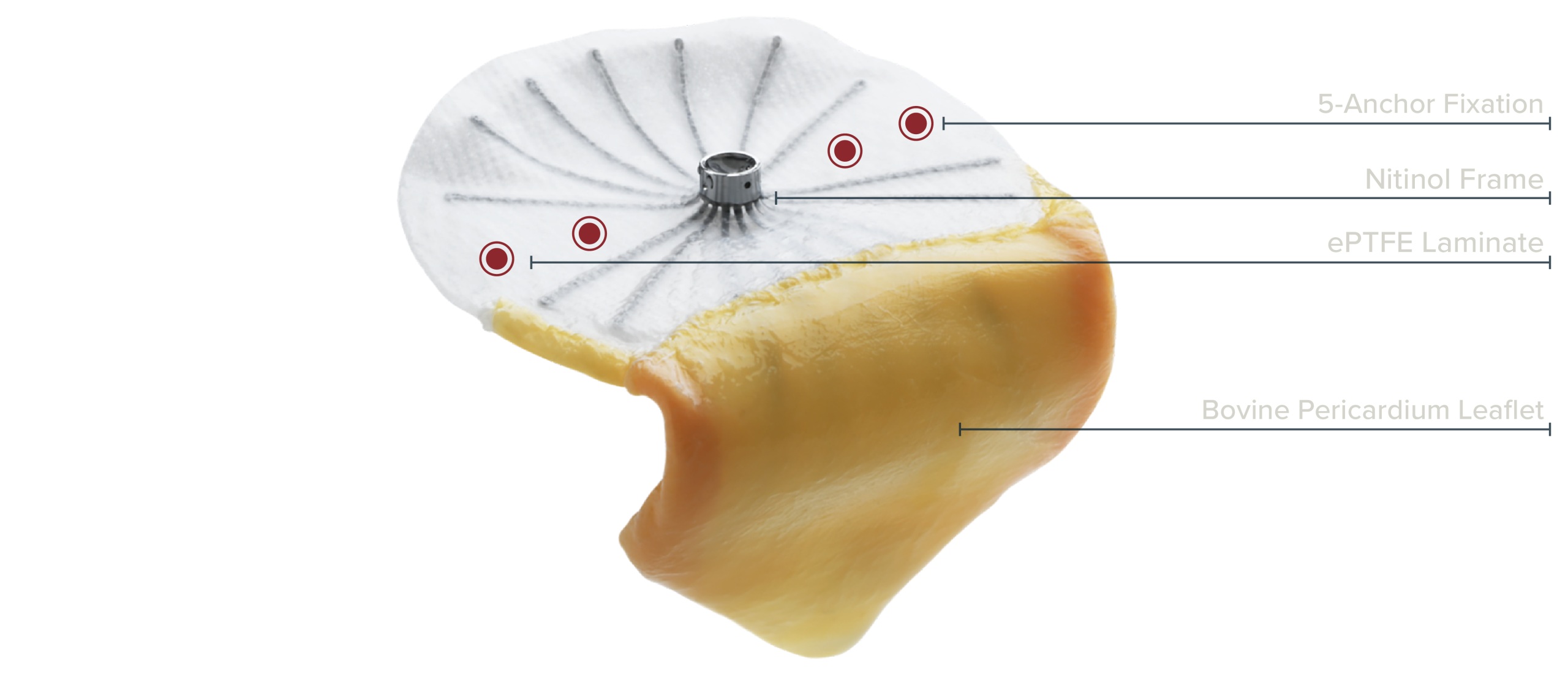
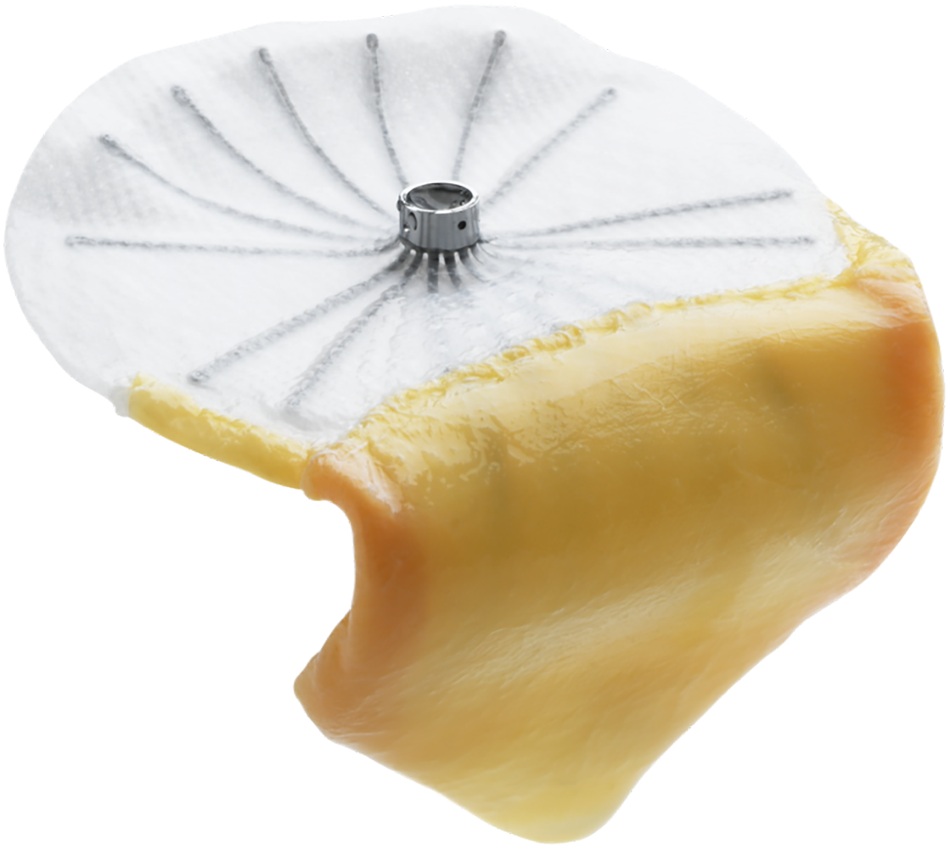
Its product is MRace, a Transcatheter Leaflet Restoration system. A doctor advances it through a catheter, crosses the wall between the heart's upper chambers, and positions an implant along the posterior side of the mitral valve. Five anchors fix a nitinol frame above the valve. Attached to it is what Polares calls the Adaptive Coaptation Element - a shaped piece of bovine pericardium intended to meet the native anterior leaflet and make the valve close again.
A category hiding between two verbs
The distinction sounds semantic until one considers what the alternatives do. Transcatheter edge-to-edge repair, best known through Abbott's MitraClip, joins the native leaflets. Full transcatheter replacement puts a new valve inside the old anatomy. MRace instead adds a new posterior surface while leaving the anterior leaflet, the route of blood through the left ventricle, and other treatment pathways largely undisturbed.
join native leaflets
add one coaptation surface
install a whole valve
This is Polares' competitive argument: difficult anatomy can limit edge-to-edge repair, while a full replacement can obstruct the left ventricular outflow tract or foreclose later options. MRace is designed for small valve areas as well as anatomy considered challenging for a clip. It remains retrievable until the final deployment step, so the physician can assess the result in real time before committing.
“We believe Posterior Leaflet Replacement represents a new chapter in transcatheter mitral therapy.”Jacques R. Essinger, co-founder and CEO
The intended customer, eventually, is not a consumer browsing a pharmacy shelf. It is the structural-heart program inside a hospital: interventional cardiologists, imaging specialists, surgeons and administrators who decide which patient can tolerate which procedure. The beneficiary is the patient with functional mitral regurgitation, where the leaflets may be healthy but an enlarged or misshapen heart has pulled them apart.
Five million patients, sixty thousand procedures
Polares presents the market as a gap. It cites an estimated two to 2.5 million Americans with moderate or severe mitral regurgitation today, rising to five million by 2030, against roughly 60,000 patients treated annually with available procedures. Those figures are not a sales forecast. They describe the distance between having a disease and being a suitable candidate for an intervention.
That gap is where Polares hopes to build a business. The company is pre-commercial; MRace is an investigational device and Polares explicitly says it is not approved for sale in the United States or elsewhere. If trials and regulators cooperate, the likely model is familiar medtech: hospitals buy single-use implants and delivery systems, clinicians receive training, and the company supports case planning and clinical evidence. Until then, the company sells a proposition to investors and trial sites, not a product to customers.
The project that survived an acquisition
Polares carries an inheritance. Jacques Essinger previously led Symetis, a Swiss transcatheter aortic-valve company. When Boston Scientific bought Symetis in 2017, the buyer's interest centered on the aortic business. The younger mitral project was spun out. Essinger became Polares' co-founder, chief executive and chairman; inventor Alex Khairkhahan became co-founder, chief operating officer and chief technology officer.
This origin explains the company's geography and its temperament. Headquarters sit in Lausanne, while an operating office in Palo Alto gives Polares a U.S. regulatory and clinical foothold. The management bench covers research, clinical affairs, regulation and operations. It is a small company doing the work of a large one because permanent implants are indifferent to headcount.
The first study did not simply march forward
Medical-device histories acquire a suspicious smoothness in retrospect. Polares' public registry record is more useful. An earlier EXPLORE MR study was terminated in 2023. The stated reason was “study device refinement.” That is the first documented failure in the program's public trail - not a verdict on the concept, but a halt serious enough to change the object being tested.
What changed the team's mind about the design is not publicly described in detail. What can be seen is the response: refinement, new early-feasibility programs, and a vocabulary that became more precise. The system once appeared in the literature as PLAR, or posterior leaflet augmentation/replacement. Today Polares calls it MRace and frames the category as Transcatheter Leaflet Restoration. That shift is not merely cosmetic. “Restoration” tells physicians that native flow and future choices are part of the product, not pleasant side effects.
By March 2026, the company said MRace had been implanted in more than 70 patients and that one-year data showed encouraging, sustained safety and efficacy. It announced a $50 million Series C, supported by DC Global Ventures, Lumination Partners, existing backers and an undisclosed strategic investor. Added to a $25 million round in 2018 and $40 million in 2020, disclosed financing totals about $115 million. The money is earmarked for clinical work in the United States, Europe and Australia.
The lesson worth copying
Polares offers a product lesson that travels beyond cardiology: design around the next decision. Permanent interventions often compete by promising finality. MRace competes by promising optionality. It attempts enough change to solve the present problem while preserving enough anatomy for a future physician to choose again. Software people call that reversibility. In a beating heart, it requires five anchors, imaging, materials science and rather more paperwork.
The operating lesson is equally plain. Pick a neglected middle, name it, and produce evidence specific to it. Polares did not call MRace a smaller replacement or an unusual repair. It named Transcatheter Leaflet Restoration, then built the product claims - native flow, retrievability, challenging anatomy, future compatibility - around that category.
That play works only if the clinical evidence proves durable reduction in regurgitation without unacceptable complications, if physicians can place the device reproducibly, and if enough patients sit in the anatomical gap Polares has identified. It also depends on regulatory clearance and on hospitals finding the added option worth its training and cost. Clever positioning cannot rescue indifferent outcomes.
For now, Polares is a clinical-stage company with a thoughtfully constrained idea. The heart does not care about categories, investment rounds or elegant names. It cares whether two surfaces meet at precisely the right moment, tens of thousands of times a day. MRace is a wager that changing one of those surfaces is enough. The next trials will decide whether restraint, in this case, is engineering wisdom.