Breaking
FDA IDE APPROVAL SECURED - US PIVOTAL TRIAL BEGINS RENALPRO CUT AKI 52% IN 220-PATIENT KIDNEY STUDY FDA BREAKTHROUGH DEVICE DESIGNATION CE MARKED IN EUROPE AS RENALGUARD ST. ELIZABETH HEALTHCARE JOINS AS STRATEGIC INVESTOR 36 EMPLOYEES - MILFORD, MASSACHUSETTS 20 PATENTS PROTECTING RENAL PROTECTION TECH FDA IDE APPROVAL SECURED - US PIVOTAL TRIAL BEGINS RENALPRO CUT AKI 52% IN 220-PATIENT KIDNEY STUDY FDA BREAKTHROUGH DEVICE DESIGNATION CE MARKED IN EUROPE AS RENALGUARD ST. ELIZABETH HEALTHCARE JOINS AS STRATEGIC INVESTOR 36 EMPLOYEES - MILFORD, MASSACHUSETTS 20 PATENTS PROTECTING RENAL PROTECTION TECH
Company Dossier · Medical Devices · Milford, MA

CardioRenal Systems

The device that taught the IV drip to think - reading urine output in real time and matching fluids by the milliliter to keep kidneys out of harm's way.

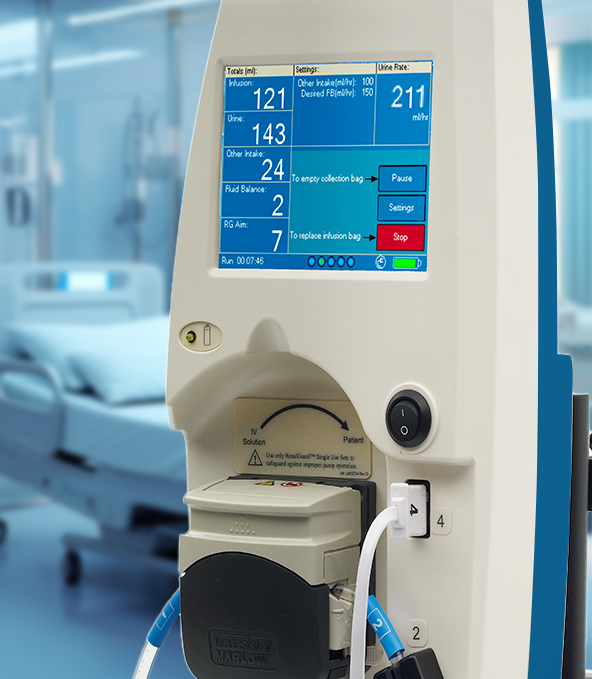
RenalPro System console by CardioRenal Systems displaying real-time infusion, urine and fluid-balance readings

THE MACHINE: The RenalPro console tracks infusion, urine output and fluid balance to the milliliter. Marketed as RenalGuard outside the US, it is the company's answer to a quiet, common complication - acute kidney injury.

52%
AKI Reduction
220
Patient RCT
20
Patents
$21.5M
Total Funding
The Story

A Solvable Problem, Hiding in Plain Sight

The kidney is a quiet organ. It does not page a surgeon or set off an alarm. So when a patient's kidneys begin to fail during or after a major procedure, the first sign often arrives a day later, in a lab result, after the damage is already done. Acute kidney injury - AKI - is one of the most common complications of cardiac surgery, contrast-based heart procedures, and intensive care, and it lengthens hospital stays, raises costs, and worsens outcomes.

CardioRenal Systems, a medical device company based in Milford, Massachusetts, built its business around a single idea: what if hydration during those high-risk moments could be automated and precise, rather than estimated by hand? Its answer is the RenalPro System, sold outside the United States as RenalGuard. The console continuously measures a patient's urine output and adjusts the intravenous fluids they receive in milliliter increments - roughly a fifth of a teaspoon at a time - keeping the patient hemodynamically stable and the kidneys protected against both over- and under-hydration.

The approach is called balanced forced diuresis. The engineering that makes it reliable is protected by a portfolio of 20 patents and pending applications. And the clinical case behind it is not theoretical: in a 220-patient randomized, controlled trial known as the KIDNEY study, RenalPro Therapy reduced AKI by 52% compared with standard care, with no reported adverse events.
How RenalPro Works

A Feedback Loop, Not a Guess

Standard hydration protocols are set in advance and adjusted by hand. RenalPro closes the loop - measuring, deciding, and dosing in a continuous cycle throughout the procedure.

01

Measure

Sensors track urine output in real time, catching minute fluctuations.

02

Decide

The system calculates exactly how much fluid the patient needs, moment to moment.

03

Dose

IV fluids are administered automatically in milliliter increments.

04

Protect

The patient stays balanced and hemodynamically stable - kidneys shielded.

The Evidence

The 52% Number

The KIDNEY study - a 220-patient randomized, controlled trial in the UK - compared RenalPro Therapy against standard of care. The relative rate of acute kidney injury is shown below (illustrative of the reported 52% reduction).

Standard of Care
Baseline AKI rate
RenalPro Therapy
-52%

Source: KIDNEY study, 220-patient randomized controlled trial. No adverse events reported. Bars illustrate the relative reduction, not absolute incidence.

Products & Customers

One Device, Two Names, Three Settings

RenalPro is the US name; RenalGuard is its CE-marked European identity. Both target the procedures where kidneys are most at risk.

Cardiac Surgery

The Operating Room

Cardiac Surgery-Associated AKI is the company's lead US indication and the focus of its pivotal trial. Roughly one in three cardiac surgery patients is at risk.

Interventional Cardiology

The Cath Lab

Contrast media used in heart catheterization can injure kidneys. RenalGuard has been studied to reduce contrast-induced nephropathy in at-risk patients.

Critical Care

The ICU

Fluid balance is precarious for the sickest patients. The system's automated matching aims to keep ICU patients stable without manual guesswork.

Who buys it: Hospitals and health systems - cardiac surgery programs, cath labs, and ICUs. The business runs on a razor-and-blade model: a durable console paired with recurring single-use disposable sets. Commercial today in Europe under CE Mark; investigational in the US pending the pivotal trial.

IDE approval is a significant milestone for CardioRenal and for the many patients who undergo cardiac surgery each year and remain at serious risk of acute kidney injury.

Ilya Budik, Chief Executive Officer

What Sets It Apart

Purpose-Built, Not Repurposed

Plenty of hospital equipment monitors fluids or hemodynamics. RenalPro is positioned differently: it is a dedicated AKI-prevention device rather than a general-purpose monitor. The distinction matters. Monitors report; RenalPro acts, closing the loop between measurement and dosing without a clinician re-calculating at the bedside.

Its competitive alternative is largely the status quo - manual hydration protocols and standard of care. That is a meaningful thing to compete against, because it is free and familiar. The company's argument is that automation delivers precision the manual approach cannot, and the KIDNEY study is the evidence it points to.

The Edge

Regulatory Momentum

FDA Breakthrough Device Designation. A CE Mark backed by European clinical evidence. And, as of July 2026, FDA IDE approval to begin the US pivotal trial. Add a strategic investment from a top-decile cardiac surgery hospital, and the validation comes from the customer as much as the regulator.

Milestones

The Long Road to a US Trial

2018

Series B Financing

The company raised roughly $7M as part of $21.5M total to advance its fluid-management platform.

2022

FDA Breakthrough Device Designation

RenalGuard Therapy earned FDA Breakthrough status for preventing Cardiac Surgery-Associated AKI.

2023

RenalPro Branding for the US

The device advanced under the RenalPro name for the US market, with RenalGuard remaining the CE-marked European brand.

2026

FDA IDE Approval & Hospital Investment

CardioRenal secured IDE approval to begin its US pivotal trial, alongside strategic investment from St. Elizabeth Healthcare and the Angel Physicians Fund.

The People

A Clinician-Heavy Bench

The 36-person team pairs operators with a deep roster of surgeons and regulatory veterans - the kind of paperwork-and-scalpel combination medtech actually needs.

Ilya BudikCEO
Ethan Benovitz, JDChairman
Heyman Luckraz, MDSVP Medical Affairs
Shmulik AdlerSVP Clinical & Regulatory
Tzvi Stern, CPACFO
Robin LuperSVP Intl. Sales
William Denman, MDSr. Medical Advisor
Janice Hogan, JDSr. Regulatory Advisor

Scientific advisors include nephrology and cardiothoracic-surgery KOLs from the University of Vermont, Baylor College of Medicine, Thomas Jefferson University Hospital, Baystate Medical Center, and St. Elizabeth Healthcare.

Questions

The Basics

What does CardioRenal Systems make?
RenalPro (RenalGuard outside the US), an automated fluid-management system that prevents acute kidney injury by matching IV hydration to real-time urine output during high-risk hospital procedures.
Is the device FDA approved?
It holds FDA Breakthrough Device Designation and, as of July 2026, IDE approval to run a US pivotal trial. It is CE-marked and commercially available in Europe, but not yet FDA-approved for US sale.
How well does it work?
In the 220-patient randomized controlled KIDNEY study, RenalPro/RenalGuard reduced AKI by 52% versus standard of care with no reported adverse events.
Where is the company based and how big is it?
It is headquartered at 459 Fortune Blvd, Milford, Massachusetts, with about 36 employees, led by CEO Ilya Budik.
Who uses RenalPro?
Hospitals - specifically cardiac surgery programs, interventional cardiology cath labs, and ICUs treating patients at high risk of acute kidney injury.
Share This Dossier

Spread the Word

Links & Resources

Where to Go Next

Sources: company website, PR Newswire, National Law Review, MassDevice, ClinicalTrials.gov, The Org. Figures are as publicly reported; regulatory status is US-investigational. Video interviews and product demos were not publicly available at time of writing.