BREAKING   Abram Scientific closes $11.75M Series A led by Octapharma AG FUNDING   ~$15.1M total raised · 17 patents granted CoagCare   Full clotting readout in under 10 minutes PROFILE   IIT Bombay → Cornell PhD → Menlo Park founder BREAKING   Abram Scientific closes $11.75M Series A led by Octapharma AG FUNDING   ~$15.1M total raised · 17 patents granted CoagCare   Full clotting readout in under 10 minutes PROFILE   IIT Bombay → Cornell PhD → Menlo Park founder
The Single-Drop Standard

Abhishek
Ramkumar

He shrank a hospital blood lab into something a medic can hold in one hand - and read in the time it takes to find a vein.
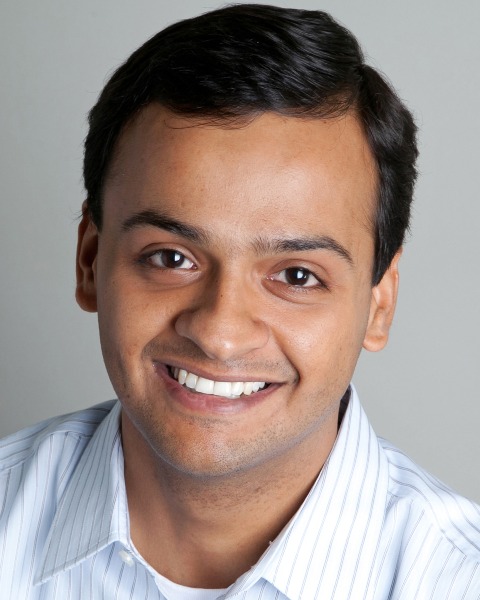
Founder & CEO, Abram Scientific Biomedical Engineer, PhD Menlo Park, California
Abhishek Ramkumar, founder and CEO of Abram Scientific

The founder who decided a drop was enough.

Dispatch / Who He Is Now

A blood test that fits in a glovebox, not a lab.

Walk into most emergency rooms and the machine that tells a surgeon whether your blood will clot is the size of a desktop printer, bolted to a bench, and slow. Thirty to sixty minutes slow. Abhishek Ramkumar looked at that and asked an awkward question: what if you only had ten minutes, a moving helicopter, and a single drop of blood?

That question became Abram Scientific, the Menlo Park company he founded and runs as CEO. Its product, CoagCare, is a wireless handheld meter that reads the full arc of blood coagulation - from the first wisp of a clot to the moment it breaks back down - using one drop of blood on a single-use card. In February 2026 the bet got serious: an $11.75 million Series A led by the pharmaceutical company Octapharma AG, with investors tied to the University of Colorado Anschutz joining in.

He is not a pitch-deck founder who learned the science later. Ramkumar invented the core technology himself, and the patents - 17 of them, granted across the U.S. and abroad - carry his fingerprints. The company is small on purpose: a tight team turning a hard physics problem into a device a paramedic can use without a manual.

<10
Minutes to a full readout
1
Drop of blood needed
17
Patents granted
$15.1M
Total funding raised
Our mission is to enable CoagCare to help adjudicate life-saving therapies and transfusions, so that the right therapy is provided to the patient at the right time and at the right dosage.
- Abhishek Ramkumar, on announcing the Series A
The Stakes / Why It Matters

Bleeding is still a leading preventable way to die.

In trauma, the clock is the enemy. Uncontrolled hemorrhage remains one of the top preventable causes of early death, and the cruel irony is that the data needed to fix it - is this patient's blood clotting too little, too much, or breaking down? - usually arrives too late to act on. Legacy systems like TEG and ROTEM answer the question, but they answer it in half an hour to an hour, anchored to a lab bench.

CoagCare's wager is that speed and portability change the medicine. Put a real coagulation readout in the trauma bay, the operating room, the ambulance, even a MEDEVAC helicopter, and transfusion stops being guesswork. Ramkumar likes to point at an uncomfortable statistic: a large share of emergency-room transfusions are estimated to be unnecessary or inappropriate. Better data, sooner, means fewer wrong calls.

TEG / ROTEM vs CoagCare

How long until a clinician gets the answer:

Legacy systems30-60 min
slow, bench-bound
CoagCare<10 min
portable

Bars compare reported time-to-result. CoagCare runs on one drop of blood and a single-use card.

The Trick / How One Drop Tells The Story

Read blood like physics, not chemistry.

Instead of running a chemical clock, CoagCare measures the blood itself - its viscoelasticity and its density - and watches those numbers shift as a clot forms, firms up, and finally dissolves. It is built to be vibration-insensitive, which is the unglamorous engineering miracle that lets it work inside a moving vehicle without the shaking ruining the read.

1
One drop
A single drop of blood goes onto a single-use card.
2
Measure
The meter tracks viscoelasticity and density in real time.
3
Full cascade
Clot formation through fibrinolysis, start to finish.
4
Decide
A readout in under 10 minutes guides the transfusion call.
The Path / How He Got Here

An electrical engineer who fell for blood.

Ramkumar started in electrical engineering at IIT Bombay, then crossed into biomedical engineering at Cornell, where he earned both a master's and a PhD. His toolkit reads like a microfabrication shop - MEMS, COMSOL modeling, atomic force microscopy - the kind of skills you acquire when your job is to make tiny things measure invisible ones.

Before founding Abram Scientific he spent years inside research-heavy environments. At Blue Highway, the venture arm tied to Welch Allyn, he sized up physics and biophysics concepts for startup financing - judging which ideas could survive the leap from paper to product. At the Palo Alto Research Center, the legendary PARC, he worked on biomedical diagnostics and drug-delivery systems. More than fifteen years of inventing diagnostic and surgical devices stack up behind him before CoagCare ever existed.

Then he did the harder thing: he stopped evaluating other people's ideas and committed to one of his own.

The Raise / Who's Betting On Him

A drug company put money where the blood is.

The lead

Octapharma AG - a pharmaceutical company whose world is plasma and coagulation products - led the $11.75M Series A. The strategic logic is hard to miss: a faster way to read clotting is a faster way to know which therapy a patient needs.

The clinic

Investors affiliated with the University of Colorado Anschutz joined, pairing capital with academic and clinical expertise in trauma and transfusion - the exact arena CoagCare is built for.

The use

The money accelerates platform development and pushes toward FDA 510(k) clearance and clinical milestones. An earlier $1M NSF SBIR Phase II grant helped get the science off the bench.

Our collaboration with Octapharma and the University of Colorado provides both funding and strategic expertise.
- Abhishek Ramkumar
Field Notes / Things Worth Knowing

The small details that explain the big bet.

01

The whole test runs on a single drop of blood and a single-use card - no benchtop, no lab tech required.

02

CoagCare is engineered to be vibration-insensitive, a deliberate choice so it can work inside an ambulance or MEDEVAC helicopter.

03

It measures blood by its viscoelasticity and density - turning a clotting cascade into physics you can read on a handheld meter.

04

He trained as an electrical engineer at IIT Bombay before switching to biomedical engineering at Cornell.

What he keeps circling back to

Read enough of his public remarks and a theme emerges: the right therapy, to the right patient, at the right time, at the right dose. It is a deceptively plain sentence. It also happens to be the entire reason the device exists - and the bar he has set for whether it succeeds.

point-of-care diagnosticsblood coagulationthromboelastography viscoelasticitytrauma caremedical devices in vitro diagnosticsblood managementMEMSmedtech founder
Watch / In His Own Words

See the pitch he gave on stage.

At the LSI USA '24 Emerging Medtech Summit, Ramkumar laid out the case for precision blood coagulation management - the problem, the physics, and the device - in front of a room of medtech investors.

► Watch: Precision Blood Coagulation Management - LSI USA '24
The Rolodex / Find Him

Links & sources.

Share this profile

in · LinkedIn X · Post f · Facebook IG · Instagram