A benign biopsy is good news delivered by an awkward messenger. The tissue says there is no cancer. Yet getting that answer required a needle, an appointment and a period in which an ordinary calendar could become an instrument of worry. The question for a medical imaging company is whether some of that uncertainty can be resolved before tissue is removed.
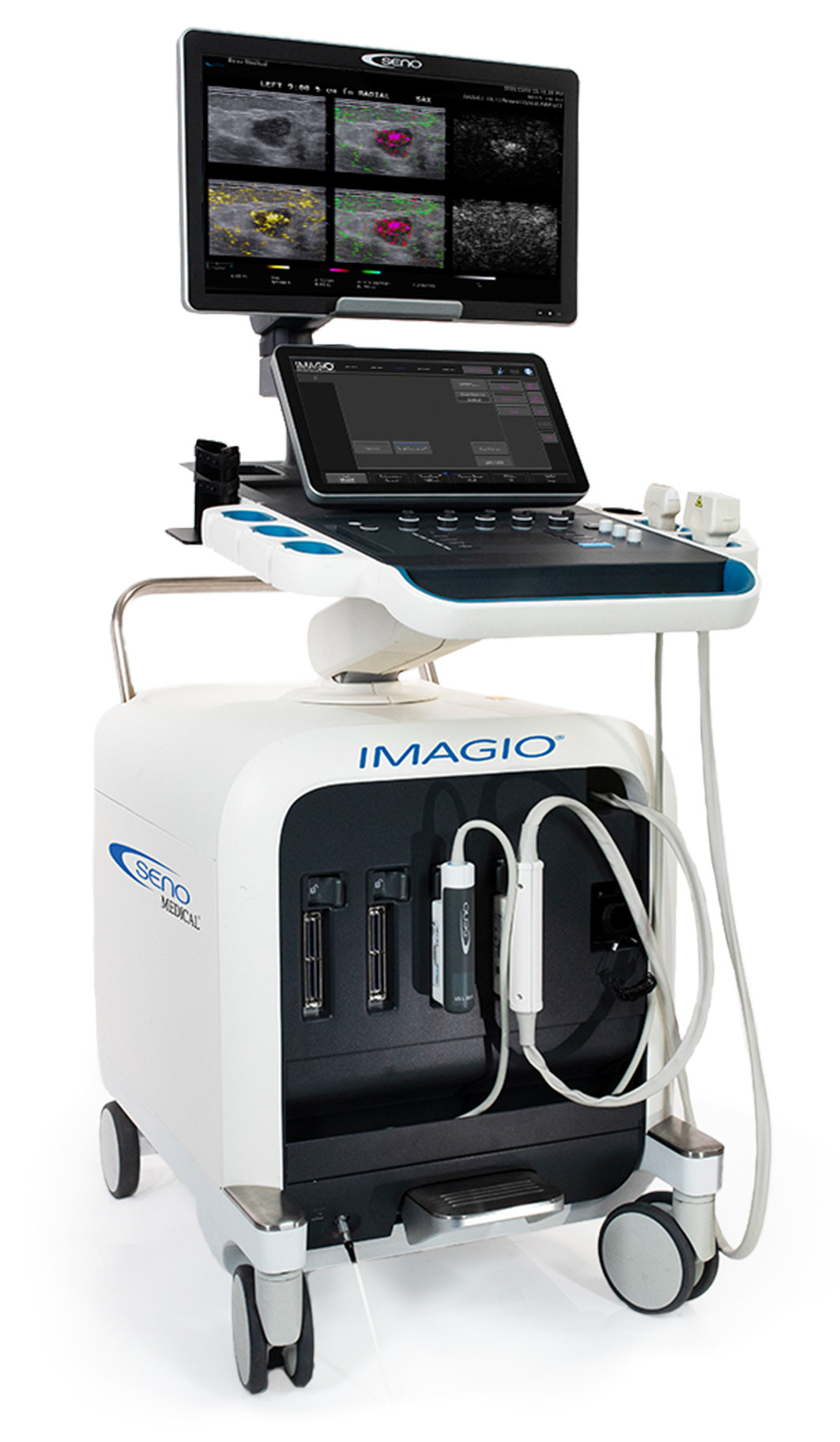
- The product: Imagio combines ultrasound with opto-acoustic breast imaging.
- The purpose: give radiologists more information when deciding whether a breast mass needs biopsy.
- The evidence: a reader study found higher specificity at the same 98% sensitivity.
Seno Medical has built its business around that decision. Its machine does not simply offer another view of a mass’s outline. It adds information about blood vessels and oxygenation in and around the finding. The attraction is easy to grasp: two things that look similar on a conventional image may behave differently underneath.
01 / The shape of doubt
Ultrasound is useful precisely because it shows structure. But benign and malignant masses can share features. A cautious interpretation may lead to a biopsy that ultimately finds nothing malignant. The difficulty lies in distinguishing a harmless lookalike while preserving the ability to identify cancer. Relaxing the threshold without better information would be a rather expensive form of optimism.
Imagio addresses adults referred for diagnostic breast work-up after a clinical concern or another imaging examination. Its customers are hospitals, breast imaging centers and qualified healthcare providers; its users are trained clinicians. It occupies the space after a finding has raised a question. That position matters: this is a diagnostic tool alongside the breast-imaging pathway, rather than a substitute for routine screening mammography.
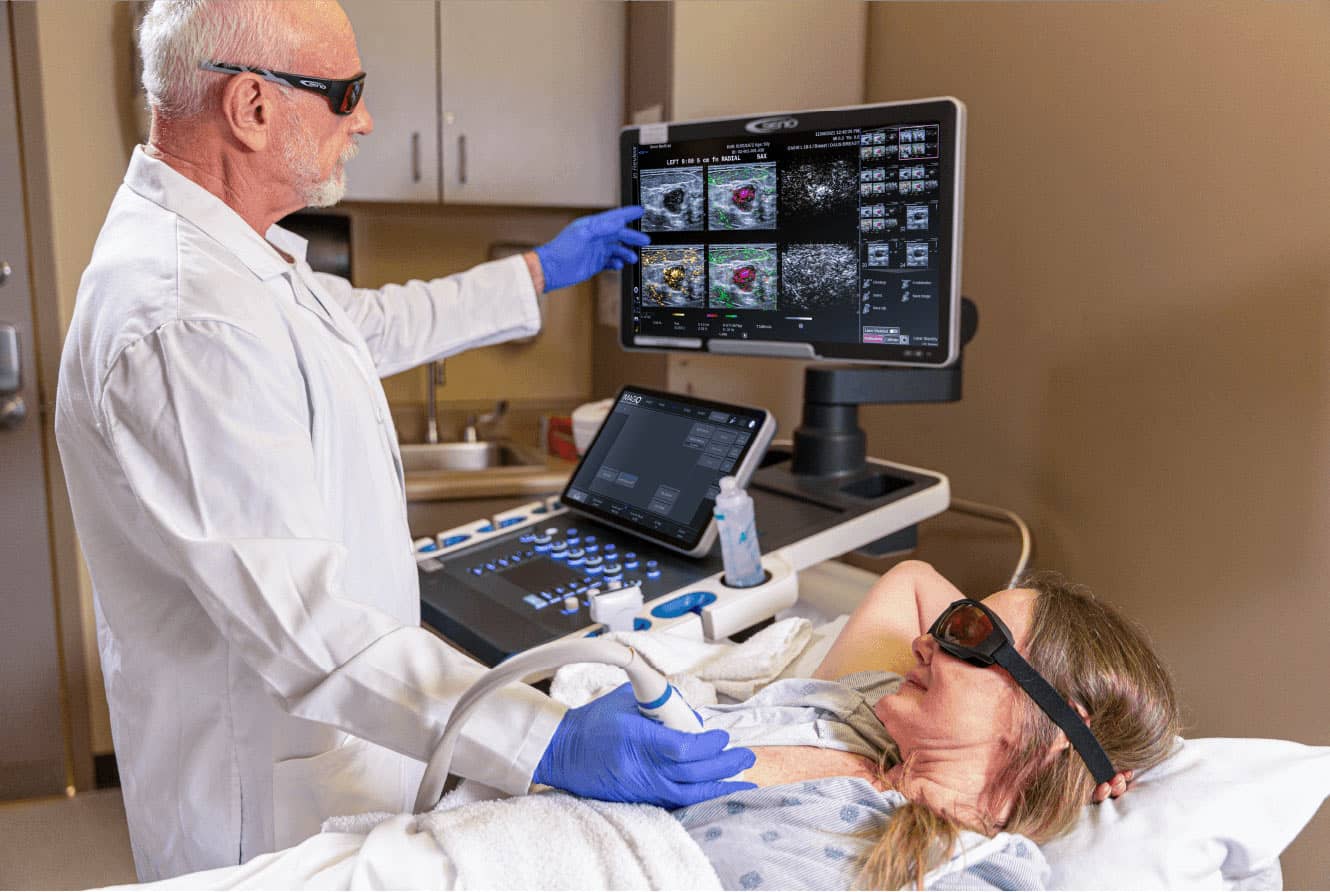
02 / Send light. Listen carefully.
The physical trick begins with two wavelengths of laser light. Blood absorbs that light, producing a tiny temperature increase and transient expansion. Expansion creates an acoustic wave. Sensors in the handheld probe detect it, and the system combines the resulting information with ultrasound images. Light supplies the stimulus; sound carries the reply.
Why blood? Malignant masses generally develop vascular networks and consume oxygen differently from benign ones. Imagio’s contrast reflects blood volume and oxygenation, providing clues about biological activity alongside anatomy. The examination uses no ionizing radiation or injected contrast agent. It also avoids the breast compression associated with mammography, although the two procedures serve different purposes.
Then comes SenoGram, the company’s AI-based decision support. Radiologists assign ultrasound and opto-acoustic feature scores, aided by reference keys. The software translates those inputs, together with clinical features, into an estimated likelihood of malignancy. It gives the reader a structured way to combine clues that may disagree with one another. The clinician still has a judgment to make.
03 / Nine points, with a condition attached
The revealing test was a retrospective study involving 15 readers and 480 breast masses. At a fixed sensitivity of 98%, average specificity rose from 38.2% with ultrasound alone to 47.2% with fused opto-acoustic/ultrasound imaging and decision support. Fourteen of the 15 readers improved on that measure.
480 masses · 15 trained readers · retrospective study
Read the published study
Specificity describes how well a test identifies benign cases as benign. Keeping sensitivity fixed makes the comparison useful: the gain was measured while holding the cancer-detection threshold constant. It was a nine-percentage-point improvement, not a finding that 47.2% of all patients could skip biopsy. Images came from an earlier prospective study, and readers received training. Equipment, interpretation and decision support were evaluated together.
“EU MDR certification is one of the most challenging regulatory processes”Tom Umbel, Seno Medical CEO, January 2026
04 / The long road into the exam room
Seno’s work started with existing science rather than an empty laboratory. Founded in 2005, it acquired early prototypes and intellectual property from Alexander Oraevsky and Fairway Medical Technologies in exchange for stock. Founder Janet Campbell led the company during its early development. Seno subsequently developed its own prototypes and expanded its patent portfolio.
That journey consumed capital and years. In February 2014, Seno reported selling $34.6 million toward a planned $39 million Series C, led by MedCare Investment Funds. The money supported clinical development and regulatory work. The original Imagio received FDA approval in January 2021; an updated system received supplemental approval in June 2022. Seno reports its first US clinical commercial shipment in 2023.
There is a human side to that development process. In 2018, Seno launched Making it Personal, an initiative connecting employees with community members affected by breast cancer. Its stated purpose was to help staff understand the journey from screening to diagnosis. For engineers working on signal quality and interface design, that is a useful reminder that the interval between appointments also belongs to the product experience.
05 / The purchasing meeting has a vote
The business model is equipment sold to healthcare facilities, supported by integrated software, education and distribution partners. Seno University offers virtual instruction in interpretation and BI-RADS assessment. Regional distributors include Medicore Consults in Germany, Austria and Switzerland, Genetik in Asian markets, and Teknikel in Turkey. A new modality needs people who can sell it, service it and teach its use.
Commercial plumbing arrived alongside clinical evidence. Category III CPT code 0857T became effective in January 2024, creating a way to seek reimbursement. A code alone does not ensure payment. A Vizient Innovative Technology contract followed in November 2024. In January 2026, Seno announced EU MDR CE certification for the current Model 9100, opening another regulatory door.
The lesson other builders can borrow is to identify a decision that existing information handles poorly, then test the extra signal against a clearly stated constraint. Here, the constraint was maintaining sensitivity. Adoption still depends on trained readers, suitable diagnostic cases and workable purchasing economics. Imagio’s FDA-approved role does not include replacing biopsy when tissue diagnosis is warranted. Better information earns its keep when it changes the right decision.