The first Eko stethoscope was not a stethoscope. It was a microphone. This distinction may sound pedantic until you show a microphone to a doctor and ask them to press it against a patient's chest. The doctors did not object to digitized heart sounds. They objected to the disappearance of the object that made the encounter intelligible. The stethoscope says, without speech, that an examination is taking place. A bare microphone says the podcast is about to begin.
- What it does: connected stethoscopes capture, amplify, display, share and analyze heart and lung signals.
- Who buys: individual clinicians, students, veterinarians, practices and health systems.
- What it costs: listed hardware runs from $259 to $449 before promotions; Eko+ is $119.99 a year; enterprise pricing is private.
- What failed first: the founders' microphone prototype ignored the stethoscope's familiar form and symbolism.
- What to copy: preserve the customer's trusted ritual, then improve the information moving through it.

A useful failure, shaped like a microphone
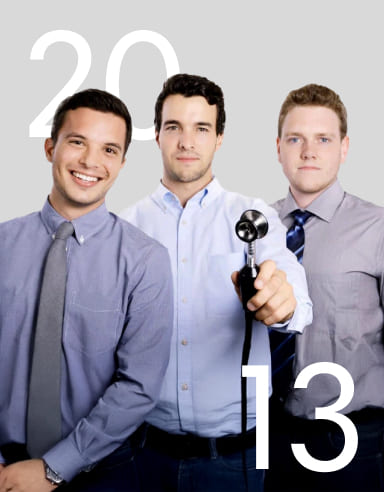
Eko began in 2013 when Connor Landgraf, then finishing bioengineering work at UC Berkeley, interviewed clinicians about stubborn problems. The stethoscope kept appearing. It was universal, cheap and beloved; it was also analog, difficult to teach, impossible to replay and dependent on ears separating a faint biological signal from a noisy room. Landgraf recruited classmates Jason Bellet and Tyler Crouch. Crouch built the early hardware; Bellet brought the business discipline; Landgraf became chief executive.
Their microphone proved the engineering premise and failed the human one. Clinicians told them they would not feel comfortable using it. The founders changed their minds about what innovation had to look like. Their next idea, the CORE attachment, slipped digital amplification and wireless recording into an instrument doctors already knew how to hold. In 2015 it received FDA clearance and could switch between analog and digital use. The compromise was the invention.
“Clinicians didn't want to give up the tools they trusted.”Eko's account of its origin
This is the part worth stealing. In conservative professions, a ritual is often an invisible feature. Replace it and the customer must learn new mechanics, explain a strange object to everyone nearby and risk looking less competent during the transition. Preserve it and your technology arrives disguised as muscle memory. Eko did not ask the clinician to stop listening. It made listening recordable.
One chestpiece, several businesses
The current range is a ladder. The CORE attachment upgrades a compatible analog scope with up to 40-times amplification and noise cancellation. The co-branded 3M Littmann CORE keeps Littmann's acoustic form and adds Eko electronics. The $449 CORE 500 is the digital-first flagship: high-fidelity audio, active noise cancellation, a color display and a three-lead ECG in the chestpiece. The DUO combines a digital stethoscope with a single-lead ECG in a compact handheld device.
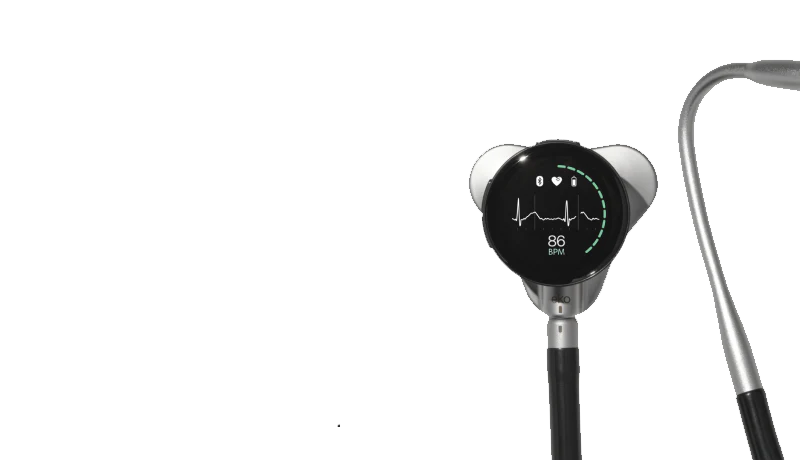
Heart sounds and, on selected devices, ECG arrive together.
Amplification, filtering and noise cancellation make the signal easier to hear.
Cleared algorithms flag findings such as AFib, structural murmurs and low EF.
Recordings, reports, referrals, telehealth and EHR workflows carry the finding onward.
Hardware is merely the admission ticket. Eko Standard provides basic app functions for free. Eko+ sells individual clinicians recording, reports, patient profiles and selected AI features for $119.99 annually. SENSORA is the enterprise system: guided exams, institutional administration, integration and FDA-cleared cardiac analysis sold on annual contracts. Eko Telehealth streams sounds and waveforms to remote clinicians while sitting beside, rather than attempting to replace, a hospital's video platform.
Public list prices observed for the CORE attachment through CORE 500, before promotions.
Annual Eko+ membership, or $12.99 when paid monthly.
SENSORA and Telehealth use contract pricing; eligible SENSORA analyses now have an outpatient payment route.
That last detail matters. A clever clinical algorithm can be accurate and still sit unused because nobody owns the budget or gets paid for the exam. The American Medical Association created Category III code 0962T for AI-enabled cardiac analysis, and CMS finalized hospital outpatient payment under APC 5734. Eko has been building not simply a better signal, but a reason for a health system to deploy it.
The trial was not in a laboratory
Medical AI companies adore retrospective accuracy. Health systems care about what happens on an ordinary Tuesday. The TRICORDER trial placed Eko's tools across 205 NHS general practices responsible for 1.5 million patients. Nearly 1,000 primary-care clinicians used the devices in routine care. Over 12 months, patients examined with the AI stethoscope were diagnosed at higher rates: 2.3 times for heart failure, 3.5 times for atrial fibrillation and 1.9 times for valvular heart disease versus standard practice.
The results explain Eko's position in the market. Against an analog stethoscope, it offers amplification, a visible record and decision support. Against digital scopes from Thinklabs, Stemoscope and others, it offers a broader regulated software stack. Against echocardiography, it is not a replacement; it is a cheaper, faster screen that can help decide who needs the full test. Against remote-exam kits such as TytoCare, Eko is narrower but deeper in auscultation and cardiac signals. Its unusual ally and alternative is Littmann: the famous stethoscope brand is also the name on an Eko-powered product.
Customers now span solo practitioners, medical students, veterinarians and large health systems. Eko said in May 2026 that more than 700,000 devices had been sold globally. Its telehealth platform is used by systems operating more than 800 U.S. hospitals. The 2026 veterinary launch with Boehringer Ingelheim is revealing: the same combination of amplification, visualization and algorithmic support can help a vet find a murmur in a panting dog and show an owner what the ear alone cannot display.
The machine still needs a clinician
Eko's products solve a particular problem: a valuable signal is already present during a familiar exam, but it is faint, variable and poorly preserved. The formula travels. Find the routine tool, digitize what passes through it, add assistance rather than autonomy, and make the output fit the next decision. It is less cinematic than replacing the professional. It is also easier to deploy.
The honest boundary
The model weakens when there is no trusted routine to inherit, no validated signal to capture, unreliable connectivity, no one to review a flag, or no pathway to confirm it. Batteries need charging. False positives can create follow-up work. An algorithmic alert is not a diagnosis, and a screening scope does not become an echocardiogram merely because it contains AI.
Eko's expertise is therefore more layered than “AI stethoscope” suggests: acoustics, sensor design, ECG, signal processing, clinical research, FDA submissions, mobile software, enterprise integration and reimbursement. Competitors can copy a feature. Reproducing the stack - and the evidence linking it to ordinary care - is slower.
The stethoscope survived two centuries because it is portable, immediate and social. Eko's bet is that its longevity is an asset, not an embarrassment. The company has raised at least $133 million across publicly detailed rounds, including a $41 million Series D in 2024, to put computation behind that old bedside gesture. The grand trick is modest enough to miss: the doctor still listens. Now the instrument remembers what it heard.