The most instructive thing Cresilon ever made may have been a stop decision. In the summer of 2015, the Brooklyn startup had invited veterinarians and researchers to Prospect Park Zoo for the debut of VETIGEL, a flowable gel designed to control bleeding in animal surgery. Interest was not the problem. Founder Joe Landolina says more than 15 percent of U.S. veterinarians had asked to buy it. The science-fair story had gone viral. The room was ready. The product was not.
The early gel sometimes performed exactly as promised and sometimes did nothing. Worse, six batches sent for outside sterility testing passed, only for syringes delivered to a partner to turn black from contamination. A material that sat awkwardly between liquid and solid had slipped through tests designed for one or the other. Cresilon canceled the launch. VETIGEL would not properly enter the market until 2020, according to the company's timeline.
A dramatic demo could stop a bleed. The company still had to prove that every sterile syringe would behave the same way after it left Brooklyn.
That gap - between an invention that works and a product that works every time - is Cresilon's real story. Today the company makes prefilled hemostatic-gel syringes for two markets. VETIGEL serves licensed veterinary professionals. TRAUMAGEL, cleared by the Food and Drug Administration in August 2024 and launched nationally in January 2025, is for licensed medical professionals temporarily controlling moderate to severe external bleeding. By July 2026, Cresilon said the latter was in use at more than 150 EMS agencies.
A mechanical barrier, not a magic potion
Cresilon's gel is built from non-animal-derived polymers and delivered through a syringe. The flowable material can settle into irregular wound geometry, adhere at the site and create a mechanical barrier against blood flow. The body forms its own clot underneath. No mixing or special storage is required. Once the patient reaches definitive care, the material can be irrigated away according to its instructions for use.
The wording matters. TRAUMAGEL is FDA 510(k) cleared, not “FDA approved,” and its indicated role is bounded: single use, temporary external control, professional use. It is not labeled as a wound-closure device or for surgical use. Nor does clearance mean that every possible battlefield or operating-room application has been proven. A 2024 Walter Reed study of penetrating traumatic brain injury was preclinical exploration, not permission to use the product inside the skull.
Deploy
A clinician opens a sterile, prefilled syringe. There is no mixing stage or material preparation.
Conform
The flowable gel reaches the wound surface and forms a physical barrier at the source of bleeding.
Transfer
The temporary control is meant to support movement toward assessment and definitive medical treatment.
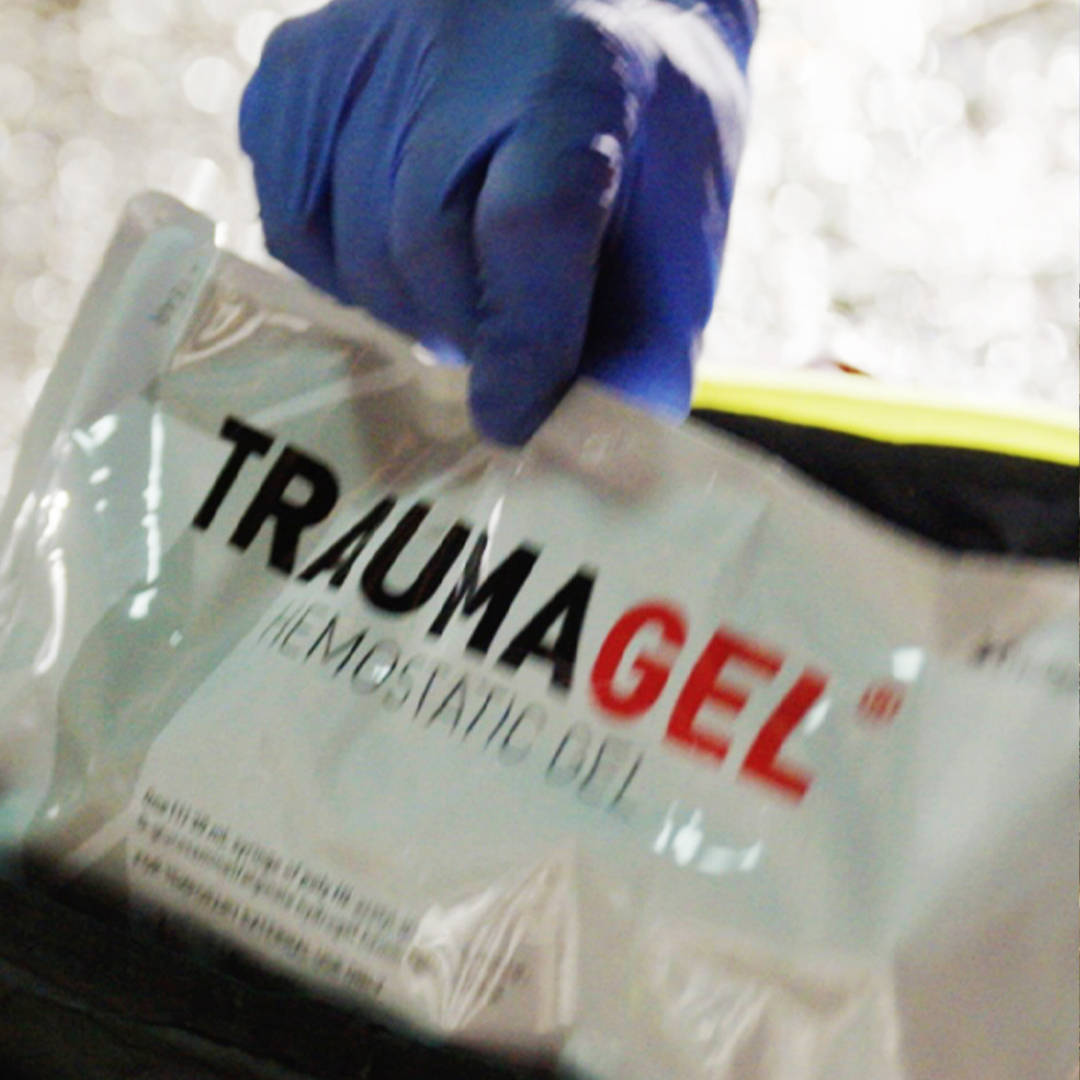
The established alternatives are not imaginary straw men. Direct pressure, packed gauze and tourniquets have long histories, trained users and low conceptual overhead. Commercial hemostatic dressings such as QuikClot, CELOX and ChitoGauze already occupy ambulances, hospitals and tactical kits. Cresilon's wager is that a ready-to-use gel can handle wound shapes that are difficult to pack, reduce preparation and preserve access for the next clinician. Whether that advantage is worth changing protocol depends on the wound, the setting, procurement budgets, training and the accumulating evidence.
The animal-health proving ground
Veterinary medicine was the first sensible commercial beachhead. The same clinic may handle a dental extraction, tumor removal, liver biopsy or traumatic wound, and animals present an unruly range of sizes and anatomy. A flowable material has obvious appeal when tidy rectangles of gauze meet untidy biology. Cresilon says VETIGEL has now supported more than 65,000 procedures across North America, Europe and Asia.
It is also a real business, not merely a regulatory rehearsal. VETIGEL reaches U.S. customers through Zomedica under an exclusive license and supply agreement. McCarthy Vet distributes it to Canadian veterinary surgeons. Cresilon manufactures; specialist animal-health partners supply customer access, sales infrastructure and clinical relationships. For a company with one material platform, each additional distributor makes the underlying factory more useful.
When outsourcing stopped working
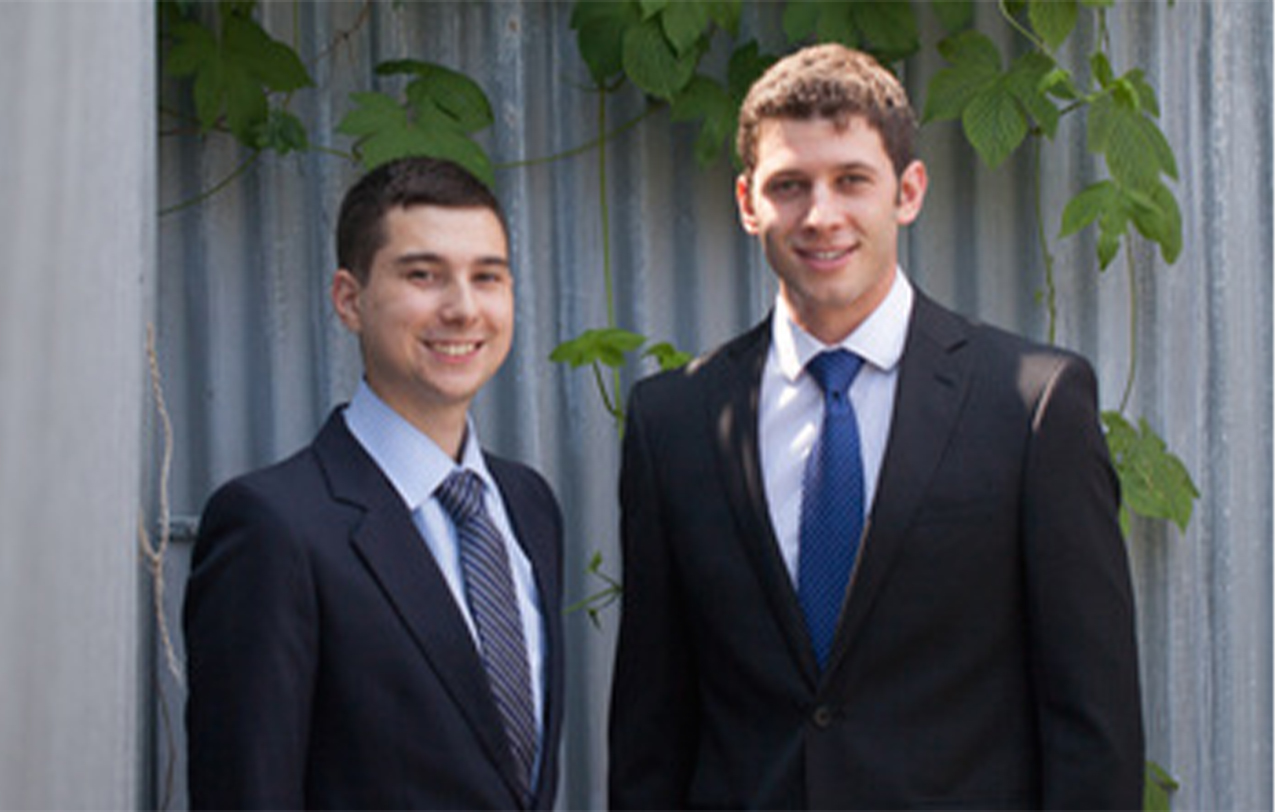
Landolina was 17 and headed to New York University when he combined long-chain sugars derived from algae in his grandfather's laboratory. He met Isaac Miller through an NYU entrepreneurship competition, where their project won at the engineering school and placed second at the business school. An early proof used an aquarium pump to move blood through butcher-shop meat. A friend posted the demonstration online; Landolina says it generated 140 million impressions and more than 8,000 investor inquiries.
Attention arrived much faster than qualified manufacturing capacity. Cresilon initially wanted contractors to make and test the gel. It found that few understood a novel, viscous biomaterial well enough to do either reliably. Faced with closing the company or learning production, the founders chose the expensive option. They found a former schoolhouse on Craigslist on Christmas Eve 2013, installed clean rooms and began turning themselves into manufacturers.
“The product is like hummus that needs to be made like a vaccine.”Joe Landolina, on the manufacturing problem
The failed 2015 launch changed their minds about how much of the stack to own. Cresilon brought a specialist in-house to develop a test suited to the gel, finished that protocol around 2017 and raised more capital. It eventually moved into a larger Industry City operation. The price was measured in years, facilities and funding: a $300,000 early seed round grew into more than $65 million raised by late 2021, followed by a $25 million Series A-4 round in 2022. By April 2026, the company said cumulative funding exceeded $100 million. It does not publish revenue.
The evidence ladder - illustrative, not a clinical score
A memorable demonstration starts a conversation. Clearance establishes a specific legal route to market. Case reports and small studies add signal, while broader comparative evidence still determines how deeply a new tool enters protocols.
The business is behavior change
Cresilon sells single-use devices to institutions whose buyers and users are often different people. A procurement officer weighs unit cost and contract access. A medical director weighs evidence and protocol. A paramedic wants something intuitive at two in the morning, wearing gloves, beside a patient who will not stop bleeding. A hospital clinician needs to know what arrives in the wound and how to remove it. The company's job is to satisfy all four.
That explains its restrained human launch. Instead of shipping nationally immediately after clearance, Cresilon began with 12 EMS agencies and trauma hospitals. Landolina says the limited release produced the first reported lifesaving use within 48 hours. The company used field experience and education before widening distribution. In March 2026, a Vizient Innovative Technology contract improved access among the purchasing organization's healthcare clients.
The evidence base is growing but still young. A 2025 peer-reviewed case report described EMS controlling a complex scalp wound after pressure and traditional interventions had failed. A randomized study in calves found a shorter median time to hemostasis with TRAUMAGEL plus pressure than with pressure alone. A 2026 three-case series described sustained control that allowed tourniquet removal without rebleeding. These are useful signals, not a universal verdict across injuries, providers and conditions.
What builders can steal
- Test repeatability before applause. A dazzling prototype can hide batch variation.
- Launch with a learning cohort. Twelve serious users can reveal more than a thousand casual ones.
- Own the stubborn bottleneck. Internalize work only when the market cannot safely meet the spec.
- Teach the workflow. In regulated products, distribution without training is unfinished distribution.
Where the playbook breaks
Cresilon's vertical-integration lesson is tempting to copy badly. It works when a core process is genuinely unusual, outside suppliers repeatedly fail a critical specification, quality mistakes carry severe consequences and investors will finance years of infrastructure before scale. It is a poor template for ordinary products with abundant qualified suppliers, low switching costs or short cash runways. A factory can be a moat; it can also be a building full of fixed costs.
The product has boundaries, too. TRAUMAGEL is not a consumer first-aid novelty, a substitute for training or definitive care, or an answer for every hemorrhage. Its current label does not cover surgery or leaving the material in contact for more than 24 hours. Adoption can stall if comparative data do not keep pace with case reports, if buyers resist the roughly $130 retail listing seen through one EMS supplier, or if users prefer familiar gauze and tourniquet protocols.
Still, Cresilon now occupies a distinctive patch of the market: part biomaterials company, part regulated-device maker, part local manufacturer and part training operation. The childhood experiment supplied the molecule. VETIGEL supplied a first market. TRAUMAGEL supplied the larger ambition. But the canceled party and blackened syringes supplied the discipline. Fifteen years in, that may be the ingredient with the longest shelf life.