There is a cruel arithmetic to internal bleeding. A trauma team can put a balloon in the aorta and reduce blood loss below it. The patient may gain the minutes needed for surgery. But the organs below the balloon need blood too. A device that stops one emergency can begin another, and no amount of elegant packaging changes the anatomy.
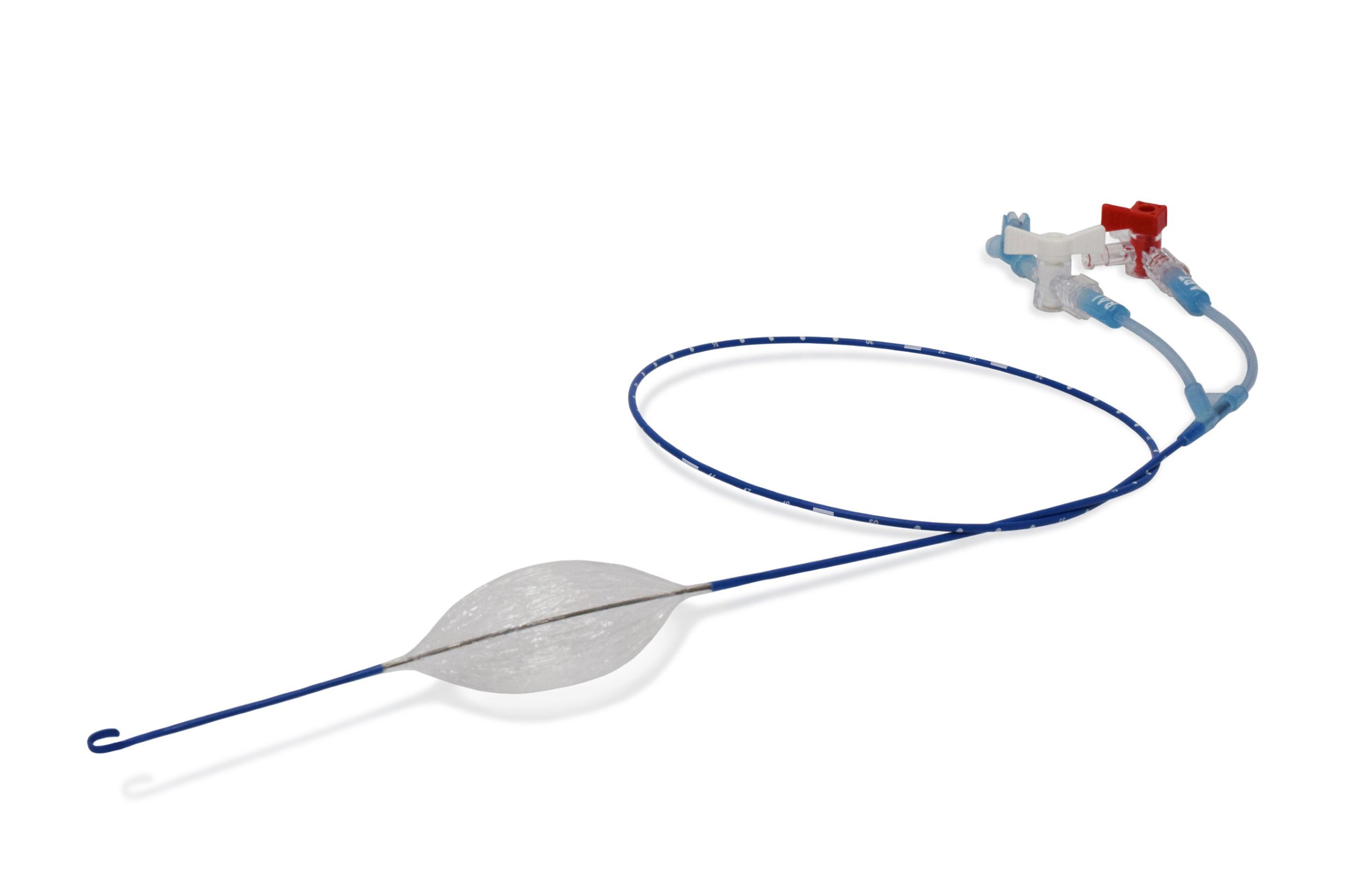
Prytime Medical Devices, a company in Boerne, Texas, built its business in that narrow interval. Its original ER-REBOA catheter helped make resuscitative endovascular balloon occlusion of the aorta - REBOA - practical for emergency teams. Its newer pREBOA-PRO asks a subtler question: how much flow can clinicians let through while still controlling a dangerous hemorrhage?
In 30 seconds
- Prytime sells REBOA catheters, access sets and training simulators to clinical teams.
- pREBOA-PRO is designed for controlled partial aortic occlusion.
- A 2025 FDA clearance expanded its labeled Zone 1 occlusion duration to two hours.
- Its market includes trauma centers, obstetric programs and military medicine.
The original trick was access
The concept of blocking the aorta with a balloon is older than Prytime. The hard part is doing it fast enough, through a small enough opening, in the wrong kind of room: a trauma bay rather than a planned vascular procedure. Older systems often needed large arterial sheaths and long guidewires. Prytime's original catheter was built for a 7 French sheath and could be placed without a guidewire. It also gave the team a central aortic pressure reading. Those are prosaic details until the patient is losing blood faster than the team can replace it.
The company began selling the original catheter to Level I trauma centers in 2016. A contemporary newspaper report put the price at $1,995 per catheter. That is a snapshot from launch, not today's price list. It also tells us the kind of business this is: specialized single-use equipment bought by institutions in advance of an unpredictable emergency. Procurement has to happen on a calm Tuesday so the tool is on the shelf on a catastrophic Saturday.
The cost of a closed road
Complete occlusion can push blood toward the heart and brain and limit bleeding farther down. It also deprives tissue downstream. Prytime's change of mind is visible in its product sequence: ER-REBOA, then ER-REBOA PLUS, then a catheter built specifically for partial occlusion. The newer device allows clinicians to titrate the balloon against pressure readings above and below it. That is a more demanding act than simply turning flow off. It is also the point of the design.
One vessel / two approaches
Complete aortic occlusion prioritizes rapid proximal pressure and hemorrhage control. Downstream blood flow is interrupted.
Partial occlusion lets clinicians adjust the balloon so some blood continues past it while bleeding is managed.
In October 2025, Prytime announced a new FDA 510(k) clearance for pREBOA-PRO that expanded its labeled Zone 1 occlusion duration to two hours. That is four times the 30-minute period commonly cited for conventional complete occlusion. The precise distinction matters. Clearance describes an allowed use profile for this device; it is not a promise that every patient gets two safe hours, nor proof that every trauma patient benefits from REBOA.
A UK randomized trial published in 2023 found no mortality benefit from a strategy that added emergency-department REBOA to standard care for exsanguinating trauma patients and raised concern about harm. It was not a trial of Prytime's later partial-occlusion label. Still, it is an important reminder that the right catheter in the wrong system, or the wrong patient, may simply consume precious time. Case selection, vascular access, monitoring and a route to surgery remain part of the procedure.
The mannequin is part of the product
Prytime sells a REBOA convenience set with the access needle, sheath, syringes, clamp and other supplies a team might need to place and secure a catheter. It also sells ARTI-PRO, a torso simulator with a vascular access area and pressure feedback. The simulator lets a team rehearse where to enter, where to position the balloon and what a changing pressure trace means. On a training day, mistakes can be discussed. In a trauma bay, they have a different price.
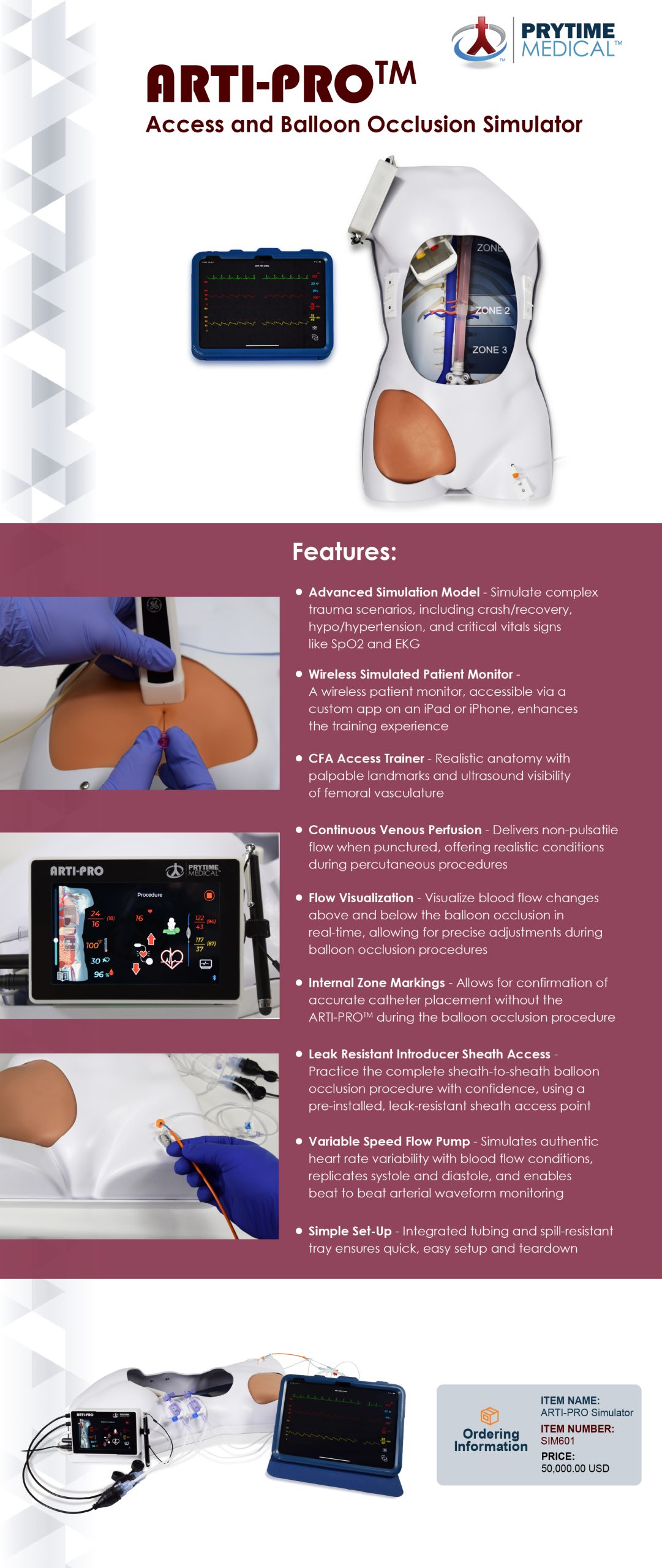
An ARTI-PRO brochure posted by the company in 2025 listed the simulator at $50,000. That figure may change, and it is a very different purchase from a disposable catheter. Yet the two belong together. An emergency device needs trained operators; a rare procedure gives those operators few chances to stay fluent. The simulator is both a product and an admission that hardware alone cannot make a complex rescue routine.
Who buys the minutes?
The obvious buyer is a trauma center. Prytime also pitches obstetric hemorrhage programs, where severe bleeding around childbirth can create a similar race to definitive control. Military medicine is woven into the company's origin. Founder and CEO David Spencer has described discovering combat casualty research around San Antonio and seeing a route from battlefield lessons to civilian trauma care. In 2017, Prytime named Combat Medical Systems its exclusive distributor for the US military market.
This is a global niche rather than a mass-market gadget. Prytime lists distributors in European countries and announced a first civilian European use of pREBOA-PRO in Sweden in January 2025. In February 2024 it said the catheter had seen more than 500 civilian patient uses in North America and was in limited release at 14 trauma centers in the US and Canada. Those numbers describe a specialized clinical market, not a general emergency-room standard.
The military connection became especially concrete in Ukraine. Prytime said it donated products and training worth more than $1.75 million, including 150 catheters, 130 convenience kits and seven simulator systems. It reported training more than 500 physicians across 22 hospitals in 2023. Those are company-reported figures, but the composition is instructive. A catheter shipped without instruction would be a box, not a capability. Prytime shipped an ecosystem.
What another company can borrow
Prytime's lesson is less about the balloon than the sequence of constraints. First, make the intervention physically possible in the setting where it is needed: smaller access, fewer placement steps, pressure monitoring. Then confront the side effect of the first solution: complete occlusion's ischemic clock. Finally, make adoption plausible through kits, training and local distribution. Its $6 million inside financing round in 2021 was explicitly directed at commercialization, not discovery alone.
There are limits to the analogy. A device that buys time works only when someone can use that time to control the bleeding. A hospital without trained vascular access, blood products, monitoring and a pathway to an operating room cannot buy the whole system by buying the catheter. Competitors such as Front Line Medical Technologies offer other aortic occlusion devices; surgery and interventional radiology without REBOA remain alternatives in selected cases. The market will be decided by evidence and logistics as much as engineering.
The most revealing thing about Prytime is its choice to work in increments. It did not invent the aorta or the balloon. It made a known procedure easier to deploy, then tried to make the period after deployment less unforgiving. In medicine, a little flow is not a small idea. It is the difference between stopping the clock and learning how to spend it.