Consider the modest indignity of a standard orthodontic bracket. It must sit on a tooth it has never met, in a mouth it was never designed for, and help produce a result that is supposed to be personal. The orthodontist supplies the missing intelligence. A wire gets bent. A bracket gets moved. Another appointment goes into the calendar. LightForce’s business begins with an objection to this arrangement: why should the expert spend treatment correcting a compromise the factory could have avoided?
- LightForce makes brackets for individual teeth, using a doctor-approved digital plan.
- Orthodontic practices buy the system; patients receive treatment from their clinician.
- Published retrospective studies report fewer visits and shorter treatment, with limits.
- Custom metal brackets and a new CEO made 2026 a year of expansion.
A bracket with a very particular job
Founded in 2015 by Alfred Griffin and Lou Shuman, LightForce combines clinical knowledge, treatment software and additive manufacturing. It introduced its custom braces approach in 2019 and launched commercial operations in 2020. The ambition was unusually concrete. Each tooth would get a bracket whose base matched its surface and whose prescription reflected the doctor’s intended result.
A bracket is a small mechanical intermediary. Its base meets enamel; its slot receives the archwire. Those relationships help determine how forces reach the tooth. Conventional systems offer established prescriptions in stock parts. LightForce generates the part around the individual anatomy and treatment plan. Customization happens in the geometry, where it can influence the work, rather than merely in a choice of colour.
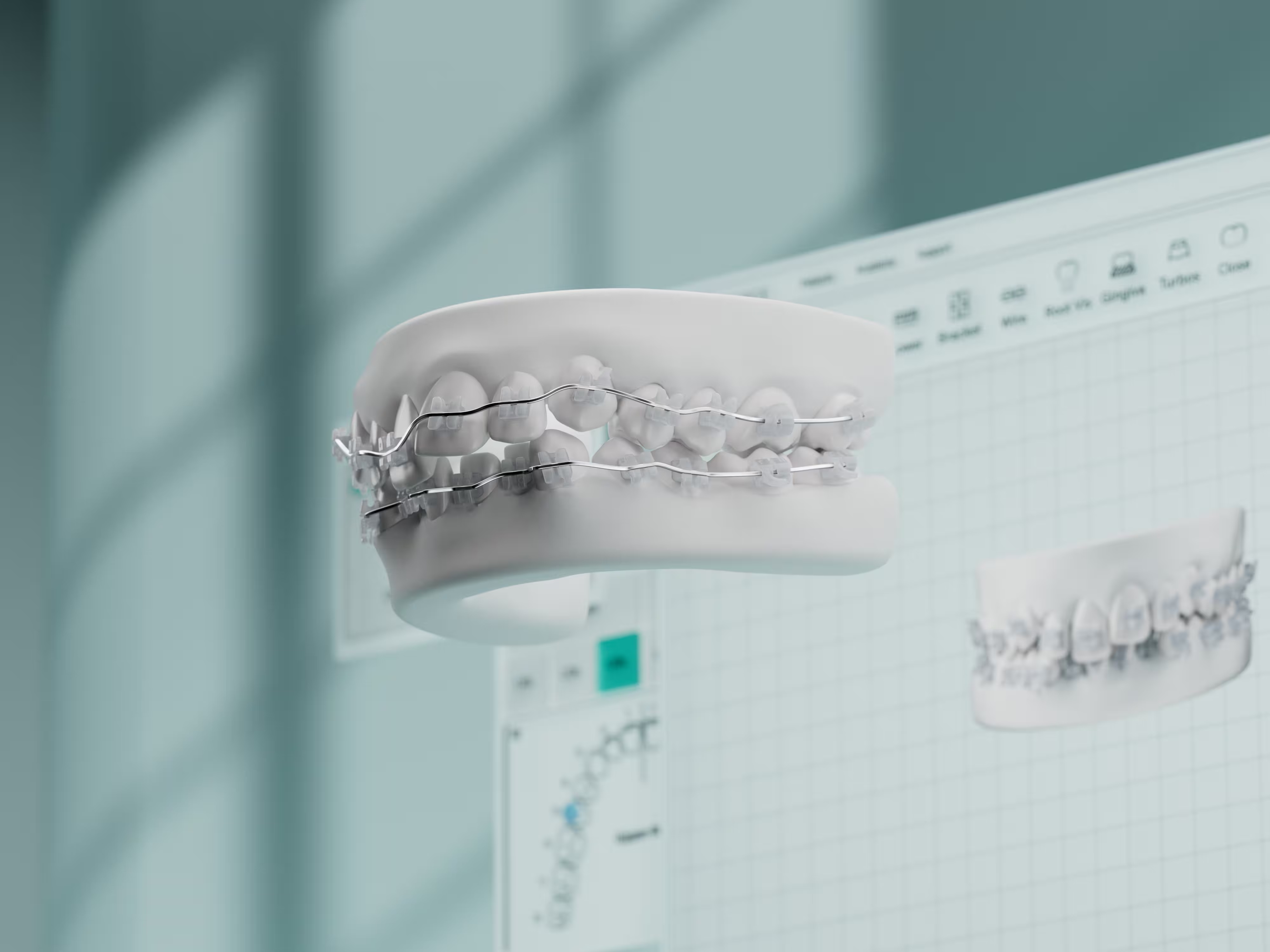
The company calls these “generative braces.” There is AI in the platform, including tools for representing anatomy, but the term should not obscure the division of responsibility. The clinician sets the treatment goals and approves the plan. Software and manufacturing turn those decisions into appliances. The patient still has an orthodontist, brackets and wires, and the ordinary obligations of treatment.
The plan has to survive the chair
LightPlan is the web-based planning and case-management environment. A practice submits scans, photographs and instructions. Treatment planners prepare a digital setup for the doctor to review and modify. LightForce’s support instructions allow direct scan submission through iTero and 3Shape, as well as STL file uploads. This is a workflow for a professional practice, with clinical choices and approval steps.
The transfer matters. LightTray, the patient-specific indirect bonding tray, carries planned bracket positions into the mouth. A beautifully specified appliance placed inaccurately has acquired a new problem. LightForce therefore sells a linked system: plan, brackets, trays and clinical support. Its instructions make clear that practices supply commercially available archwires, ligatures and bonding agents.
Adoption also means learning. The company offers in-person clinical integration, digital education and peer support. Its 2024 release added CBCT integration to LightPlan and revised packaging for bonding. These are useful clues to the business. A digital model, a box arriving at reception and an assistant handling the contents must all belong to the same process.
The appointment nobody has to attend
For a family, efficiency is a school pickup that does not happen. For a practice, it is chair capacity available for another patient. For the orthodontist, it may mean less finishing work. LightForce’s proposition connects all three: put more of the intended correction into the appliance before treatment begins.
The evidence deserves a close look. A 2023 Journal of Clinical Orthodontics study compared 103 completed LightForce cases with 74 conventional-appliance cases in one practice and reported shorter treatment. A 2024 paper expanded the comparison to four practices. Across those offices, LightForce patients averaged 15-17 months of treatment; conventional-bracket patients averaged about 24 months.
Reported practice-level means; bars illustrate 24 and 16 months. Retrospective comparison, not a forecast for an individual patient.
That is encouraging evidence, not a personal deadline. The comparison was retrospective rather than randomized, and one author had a LightForce affiliation. The study excluded several clinical circumstances, including orthognathic surgery and significant periodontal disease. Its results should not simply be carried into every case. The authors also reported that some patients still needed bracket repositioning or wire adjustments.
“Made for one.”LightForce’s patient-facing promise
A patient can reasonably ask an orthodontist what the system changes in their particular treatment, how the practice uses it, and what happens if an appliance needs replacement. A practice can ask whether fewer visits translate into better scheduling and patient experience. The valuable unit is a completed case handled well. A percentage on its own cannot tell you that.
The price of making one
LightForce occupies the fixed-appliance side of digital orthodontics. Invisalign offers removable clear aligners; stock metal and ceramic brackets remain familiar alternatives. KLOwen and Ormco Insignia also belong in the discussion of customized fixed treatment. LightForce’s particular proposition joins tooth-specific printed brackets with its own planning and placement workflow. A clinician must judge the alternatives against the case.
The commercial customer is the practice. AAO TechSelect’s product comparison lists planning and support as included and directs buyers to LightForce for pricing. Patients pay their treating practice. The sensible comparison is therefore the full treatment quote and service, including what is covered if the plan changes. A supplier’s case charge and a patient’s orthodontic bill are different numbers.
At company level, the costs are easier to see. LightForce announced a $14 million Series B in 2020 and a $50 million Series C led by Kleiner Perkins in 2021. An $80 million Series D in 2023 accompanied plans for a second, 36,000-square-foot manufacturing facility in Wilmington, Massachusetts. In September 2024, Trinity Capital committed $50 million in growth capital, a debt financing rather than another equity round.

The factory makes the economics interesting. Software can reproduce a plan cheaply; a medical device must be made, checked and delivered. LightForce has to scale a process in which the output keeps changing. The investment goes toward production capacity, people, software and education. Its funding history is a reminder that a clever digital interface does not remove the physical demands of medicine.
Metal joins the argument
In October 2025, LightForce 3.0 introduced LightBracket HD, new tooth-movement tools including Hinge Control, and revised LightTrays. The stated goals were smoother brackets, fewer planning clicks and easier bonding. Posterior trays gained plier notches. A notch rarely stars in a technology launch, but an assistant trying to remove a tray might have a different view.
These changes show how the product evolved in response to clinical feedback. The company did not merely add more software controls. It also revised the pieces patients feel and staff handle. Its careers page describes listening to customers as a core value. The tray changes give that statement something tangible to stand on.
April 2026 brought LightBracket Metal, extending patient-specific printing beyond ceramic appliances. This is a material expansion with a consistent underlying argument: the same doctor-directed approach can serve patients who want metal brackets. Evidence from earlier ceramic cases should still be identified as ceramic evidence; a shared platform does not automatically prove identical clinical results for a new material.

In July 2026, LightForce appointed Rogers CEO and moved Griffin into the Chief Product Officer role. The announcement framed the handover as a transition from technology validation to commercial scale and reported more than 200,000 patients treated. The next assignment is adoption: helping more practices make the entire system work, consistently.
Copy the question, then do the work
The useful lesson travels beyond orthodontics. Look at the adjustments experienced people repeat. Ask which compensate for a stock component and which require fresh judgment. LightForce tries to encode part of the former into the product, while leaving the latter with the clinician. That distinction is worth copying.
The approach depends on accurate scans, sound planning, reliable manufacturing and careful placement. The 2024 study’s discussion identifies incorrect planning and inadequate tray seating as possible reasons further adjustments were needed. A practice with weak execution at those steps can lose the benefit of customization. More precise instructions make those steps consequential.
LightForce has chosen a wonderfully inconvenient business: manufacture a different answer for each tooth, then help a busy practice use it. The appeal is easy to understand. Nobody goes to an orthodontist hoping to become average. The factory, at last, has been asked to take that personally.