The New School had a small calendar problem. Its Founder’s Day fell on a Sunday. The fundraising team put together an email appeal anyway, unsure whether people would respond on a weekend. They did: 54 gifts, totaling $5,400. In Emma’s account of the campaign, the discovery was wonderfully ordinary. Sunday could work for this audience.
That is a useful place to begin with Marigold, the company behind Emma. Marketing software is usually explained through features. Here, its value begins with a question someone can answer after pressing send. Did the people we wanted to reach actually do something?
- Three tools, different jobs: Campaign Monitor for growing teams, Emma for distributed organizations, Vuture for professional services.
- A changed company: its enterprise portfolio moved to Zeta in November 2025.
- The useful idea: organize the work, test the message, measure the response.
01 / The inbox has an organization chart
Consider another Emma customer: an unnamed public research university in the southwestern United States. Departments had been sending messages through Outlook in separate silos, without useful list management, opt-outs, or engagement tracking. The first thing to fail was coordination. Recipients experienced campus communications as spam.
The university chose Emma through an RFP and began with a weekly newsletter. The deployment expanded to 176 sub-accounts and more than 600 active users. Those figures, published in Emma’s case study, describe adoption at one customer. They also reveal the actual buying problem: many people need to speak for one institution.
Emma’s answer includes template locking, permissions, account hierarchies, and approval workflows. A central team can establish the shared rules while departments handle their own communications. The expertise lies partly in knowing which decisions should be centralized and which belong with the people closest to the audience.
An illustration of the workflow, not a measured performance funnel.
02 / The company that stayed
There is an ownership wrinkle worth understanding before shopping. Marigold’s name arrived in January 2023, when CM Group brought its collection of marketing businesses under a common brand. It was an assembled family of products with different histories, rather than a single application invented that year.
In November 2025, Zeta Global completed the purchase of Marigold’s enterprise software business. The headline consideration was up to $325 million, subject to adjustments. That was the price of a business sale. Treating it as a funding round would tell the wrong story.
Cheetah Digital, Selligent, Sailthru, Liveclicker, Grow, and Marigold Loyalty were included. Campaign Monitor, Emma, and Vuture stayed outside the transaction. A buyer looking at an older Marigold presentation can therefore be looking at a materially different portfolio.
Emma
Vuture
Cheetah Digital · Selligent · Sailthru · Liveclicker · Grow · Marigold Loyalty
Lisa Mayr, previously Marigold’s CFO, became CEO in January 2026; Mike Gordon became Executive Chair. The leadership announcement described a sharper commercial focus on growing organizations. The remaining products make that focus concrete.

03 / Three different working days
Campaign Monitor serves small businesses, agencies, and growing marketing teams that need to build and automate email campaigns. In September 2026, it added Marketing Studio, gathering writing, image creation, branding, translation, and Instagram publishing into a connected workflow. Its target is easy to recognize: the marketer who is also today’s copywriter and designer.
Brand Hub pulls branding from a website. Email Workspace generates a campaign around a chosen goal. Creative Lab produces imagery, while Translation and Social Suite help reuse the campaign elsewhere. The marketer can edit the output before publication. At launch, direct customers had access; agency access was planned for later.
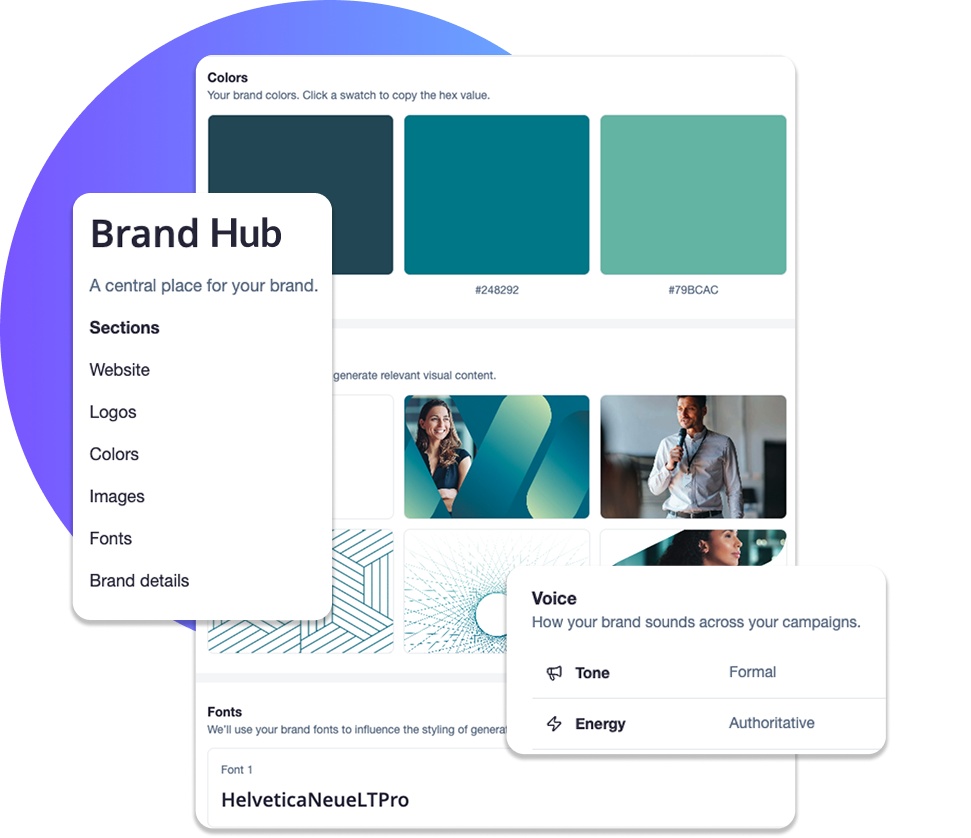
Emma addresses a different day: multiple departments or locations producing communications under a common identity. Vuture follows the routines of law firms and consultancies, combining email, events, reporting, and microsites with CRM connections. Its integrations include Salesforce, Microsoft Dynamics, and Intapp DealCloud.
The distinction is Marigold’s market position. Campaign creation, institutional governance, and professional relationships are related jobs with different constraints. Its portfolio offers separate products for those contexts. Buyers can compare alternatives such as Mailchimp, Constant Contact, or broader marketing suites against the particular job they need done.
For buyers, that makes the demo more useful when it follows a real assignment. Bring a departmental newsletter, a client invitation, or a recurring promotion. Watch who can edit it, who approves it, and how the response comes back to the team.
04 / What the send button costs
The business model is subscription software. Campaign Monitor’s monthly bill depends on subscriber count and plan; sending limits also matter. Its published USD pricing data lists $13 for Lite, $31 for Essentials, and $171 for Premier at the 0-500 subscriber tier. These are a pricing snapshot, not a universal quote.
Vuture quotes according to audience size, features, and support. The practical budget question includes the people maintaining contact data, permissions, templates, and integrations. A cheaper subscription does little for a team that cannot keep those basics organized.
05 / Let the audience change your mind
Return to The New School. Beyond the Sunday appeal, its team used template controls and approvals to maintain consistency. The result offers a modest practice to copy: give local teams a workable structure, then test a specific assumption about their audience. Track the action that matters, such as a donation.
“Email is the only cost effective way to get in front of somebody right now.”
Dustin Bryant · The New School
Published Emma customer story
That enthusiasm belongs to one customer. A Sunday send will not rescue an irrelevant appeal, and automation still needs reliable data and permission to contact people. The appealing part of Marigold’s proposition is how concrete it can be: fewer handoffs, clearer ownership, and a response that helps someone decide what to try next.