The first Leviton product belonged to a market with an expiration date. In 1906, Evser and Isidor Leviton made brass mantle tips for gas lamps in Manhattan’s Lower East Side. Electric light was no distant laboratory trick; it was the thing arriving to replace their customer’s equipment. A defensive company might have perfected the mantle tip. Leviton made a screw-in lampholder instead.
That choice explains more about the company than a catalog ever could. Leviton has spent 120 years changing what it manufactures while preserving the practical job underneath: help people safely light, power and connect a space. The modern company sells switches, outlets, circuit protection, lighting controls, smart-home gear, EV chargers, submeters, copper and fiber cabling, network enclosures and industrial connectors. Its products sit in houses, hospitals, factories, schools, offices, marinas and data centers. The wall became a rack, the socket became a software-controlled load, and the installer remained close by.
At the company’s 120th anniversary, president and CEO Daryoush Larizadeh put the operating idea plainly: “We remain at the forefront of industry change.” The history supports the claim in a literal, less promotional sense. Leviton has repeatedly stood where one infrastructure generation meets the next.
01 / The job beneath the productThe company in the wall
Leviton’s consumer identity is the Decora switch: the broad rocker launched in 1973 and now so visually ordinary that it hardly registers as a branded object. That anonymity is a feature. Electrical infrastructure wins when people trust it, understand it and stop noticing it. The buyer is not always the user. Homeowners touch the switch, but electricians install it, distributors stock it, builders specify it, inspectors approve it and retailers put it on a shelf. Every new product has to satisfy that small parliament.
The same pattern holds in enterprise markets. A data-center operator needs bandwidth, but also predictable delivery, documented performance, compatible components and engineers who can help draw the physical network. A hospital needs a receptacle, but the actual purchase is reliability under cleaning, heavy use and code requirements. Leviton makes money selling the hardware, then makes the hardware easier to choose through warranties, training, technical support, design assistance and a distributor network. Software such as My Leviton adds coordination, but the business remains grounded in products that must survive installation.
Leviton’s moat is not the switch. It is permission to be inside the wall.
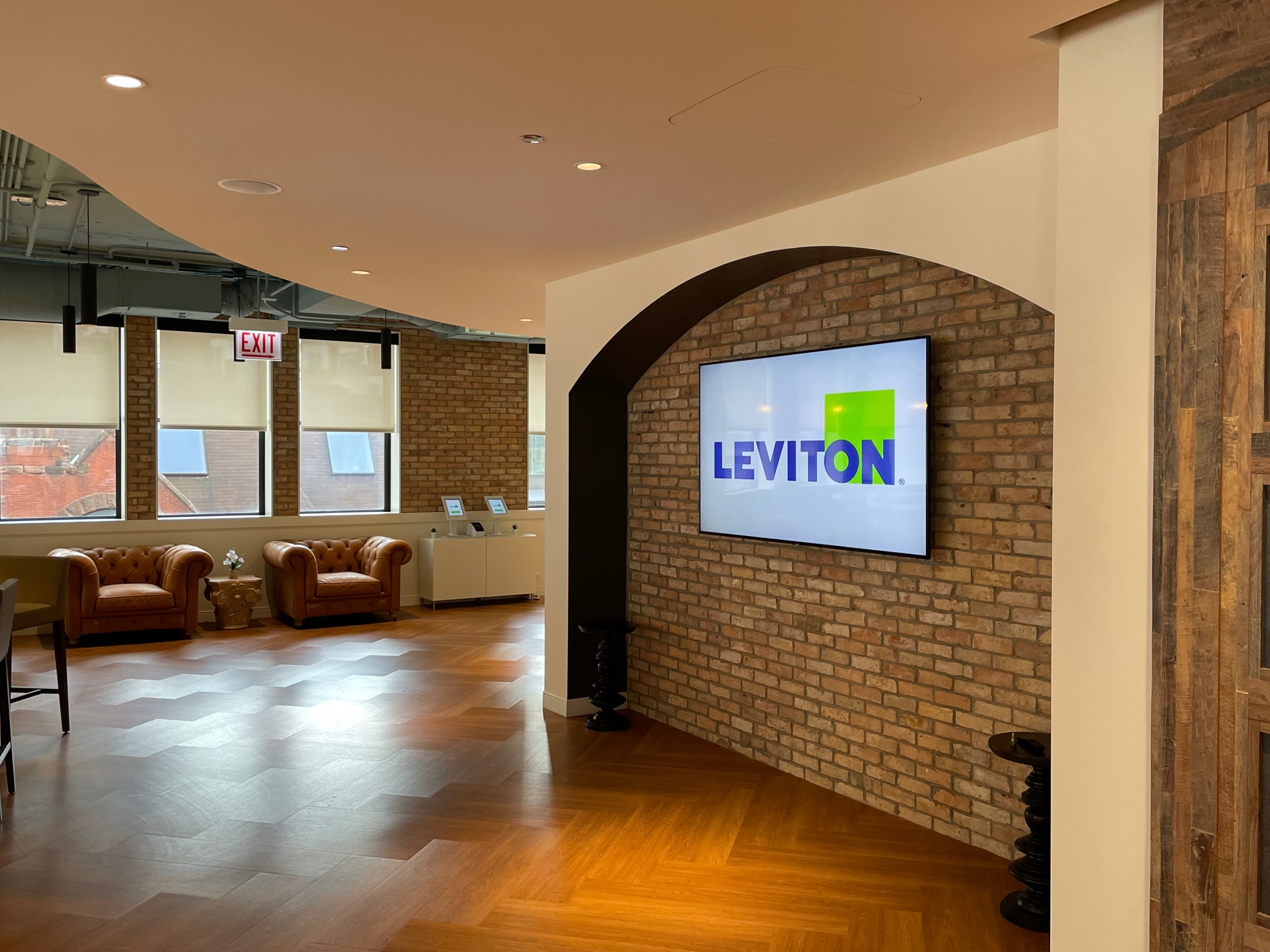
The screen says electrical manufacturer. The leather chairs say someone finally read the facilities budget.
02 / A repeatable adjacency machineFollow the customer, not the artifact
The expansion looks sprawling until it is viewed as a chain of adjacent problems. Lamp holders led to switches and outlets. Safety needs led to ground-fault protection. The 1980s deregulation of American telecommunications opened demand for structured voice and data wiring, so Leviton formed a telecom division near Seattle. Fiber followed. Acquisitions added lighting controls, home automation, European cabling, cabinets and specialty products. Each move supplied another piece of infrastructure to customers already buying, installing or specifying related pieces.
The four-move expansion loop
The clearest priced example is Berk-Tek. In 2020, Leviton bought the copper and fiber cable maker from Nexans for $202 million. That was not reported as fundraising for Leviton; it was Leviton spending to own more of the network system. In 2025, it completed a separate $25 million expansion that doubled its fiber-cabling factory in Fuquay-Varina, North Carolina. By November, the company was marketing STRATA systems with as many as 3,456 fibers in one rack unit and TORRENT products tested for liquid-immersion cooling environments. The sequence is acquisition, capacity, then a product aimed at a sharp demand spike: AI clusters.
This also reveals where Leviton differs from narrower competitors. Lutron is a formidable alternative in lighting controls; Legrand, Schneider Electric, Eaton, Hubbell and ABB cover overlapping electrical categories; Belden, CommScope, Panduit and Corning fight for network infrastructure. Leviton’s pitch is breadth without becoming merely a catalog. A contractor can carry familiar device families across residential, commercial and industrial jobs. A data-center customer can source cable, connectors, assemblies and enclosures from one vertically integrated manufacturer. The value is fewer seams.
That breadth creates an odd customer list. A homeowner buying one dimmer at retail and a hyperscale operator ordering thousands of fiber assemblies are both Leviton customers, but they do not meet the company in the same place. Consumers find Decora devices through stores and ecommerce. Contractors and builders buy through electrical distribution. Architects and engineers influence specifications before construction begins. Industrial and data-center teams bring in applications engineers, custom assemblies and project support. The product may have a barcode, but the sale can begin in a drawing months before anyone opens a box.
This is why expertise belongs inside the business model. Training helps an electrician install a new device correctly. Compatibility testing reassures the network architect. Design support helps a dense rack become a bill of materials. Warranties make a complete system easier to specify than a basket of unrelated components. None of these services is as photogenic as a smart dimmer, yet each lowers the customer’s risk and pulls hardware through the channel. Leviton earns primarily from manufactured products; advice, documentation and software make those products stickier.
The portfolio also gives the company more than one economic clock. Housing and renovation drive residential devices. Commercial construction moves lighting and wiring. Factory investment drives industrial connectors. Cloud and AI spending push fiber capacity. Electrification creates demand for chargers, load centers and energy monitoring. Diversification cannot erase a downturn, but connected categories let Leviton reuse engineering, factories, sales relationships and a reputation built around electrical safety.
03 / The first thing that failedObsolescence was the teacher
There is no tidy public confession of a disastrous Leviton launch that changed management’s mind. The more instructive failure came before a modern product roadmap: its founding category was being made obsolete. Gas illumination was yielding to electricity. Leviton’s response was neither to romanticize craftsmanship nor to become a generic conglomerate. It transferred what it knew - metalworking, electrical interfaces, installers and building needs - into the replacement system.
That pattern repeated when data moved into buildings and when homes became connected. The 2012 acquisition of Home Automation, Inc. gave Leviton more smart-home capability. Today, Decora Smart devices can work with Matter, Apple Home, Google Home, Amazon Alexa, Samsung SmartThings and other platforms. In 2026, a Sonos integration let three buttons on a Decora scene controller play, pause, skip and adjust volume while a fourth works as the light switch. The charming part is not that a switch can start a party playlist. It is that Leviton chose the most boring, legible object in the room as the control surface.
04 / Carbon, countedA climate claim with a visible denominator
Manufacturing electrical products makes sustainability complicated. The company sells dimmers, sensors, LED lighting and energy monitors that can reduce customer consumption, but its factories and supply chain still carry emissions. Leviton’s CN2030 program targets company-wide carbon neutrality by 2030. Its latest public scorecard shows total greenhouse-gas emissions falling from 89,394 metric tonnes of CO2 equivalent in 2021 to 49,241 in 2025. Carbon-neutral sites rose from eight to 23. The program combines reductions, cleaner electricity and offsets for residual emissions, a distinction worth keeping visible.
The climate business case lands on both sides of the meter. Internally, energy and waste reductions lower exposure to resource costs and customer procurement requirements. Externally, controls, submeters and efficient lighting help owners see and reduce building loads. This is where Leviton fits in the market: not as a renewable-energy developer, but as the component maker that turns an efficiency plan into switches, sensors, panels and measurements people can install.
05 / Steal this carefullyThe playbook and its boundary
What can another company copy? Begin with the workflow, not an arbitrary total-addressable-market slide. List what the same customer installs immediately before and after your product. Find the failure, delay or coordination cost at that boundary. Decide whether the missing capability should be built, partnered for or acquired. Then make the new product inherit the old product’s trust: compatible interfaces, clear certification, familiar distribution, technical documentation and service.
Leviton also shows the value of patient operating structure. The company is private, family-run and says it has had only four CEOs since 1906. That continuity can support factory investments and integrations whose value compounds slowly. It also reduces the pressure to describe every adjacency as a reinvention. Sometimes a pin-and-sleeve connector is simply the next useful object in the bag.
The method will not work everywhere. Adjacency becomes dilution when the new product has a different buyer, channel, certification regime or service burden. Smart hardware can turn a low-support device into a permanent software obligation. Acquisitions fail when the acquired factory or brand cannot share distribution and engineering. And private patience does not excuse slow feedback: a company can preserve its heritage so reverently that it misses the replacement technology.
Leviton’s sharper lesson is less sentimental. Keep the customer relationship, the installation knowledge and the reason people trust you. Be willing to replace almost everything else. The mantle tip did not need to survive for the company to do so.