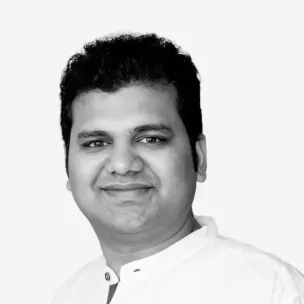
He co-founded a company at 22. Called it Giftxoxo. Today it processes a quarter-million reward transactions every single day.
Late 2012. Four friends from Bangalore, all in their early twenties, rent a small office and start typing. They have no investors, no enterprise clients, and a company name that sounds like a text message. They call it Giftxoxo - "xoxo" meaning hugs and kisses, accidentally perfect for a company whose entire premise is making people feel appreciated.
Kushal Agrawal is one of those four. His background is unusual for a SaaS founder: a B.Tech in Electronics from Vishwakarma Institute of Technology, an MBA from Welingkar, a stint at Flipkart, and then - crucially - time selling FMCG products for Bidco Oil Refineries in Kenya. That African detour gave him something most tech founders lack: a visceral understanding of distribution, of what it takes to get product to people who aren't waiting for it.
The company that became Xoxoday started as a consumer gifting platform. You could book curated experiences, send gift vouchers, create meaningful moments. It was charming. It wasn't scalable. The real turn came when they pivoted toward corporate rewards - the annual market where companies spend billions recognizing employees, rewarding customers, and motivating channel partners. Four friends who understood that "thank you" is a business decision.
The pivot was deliberate and slow. By 2016, they were merging multiple brand experiments - Giftxoxo, Frogo, others - into a single Xoxoday identity. The Diwali rebranding sprint that year wasn't just cosmetic. It was a declaration: we're not a gifting site. We're infrastructure for rewards.
Kushal's role in this transformation was central to how Xoxoday grew outward. As Chief Marketing Officer, he owns the story - the narrative that convinces HR directors in Singapore, sales managers in Dubai, and loyalty programs in London that rewarding people is not a cost center but a growth lever. That framing took years to perfect. It required the kind of cross-cultural fluency that comes from actually traveling, not just reading about it.
He drove the Mongol Rally - a notoriously chaotic adventure race from Europe to Mongolia. The kind of trip where the car breaks down on a steppe and the nearest mechanic is three days away. That same tolerance for ambiguity is probably why Xoxoday's earliest years didn't break him.
Xoxoday is not one product. It's a portfolio of platforms, each solving a different version of the same problem: how do you make someone feel genuinely valued, at scale, across borders, in their own currency and language?
At Xoxoday, Kushal has worn multiple executive titles over the years - Chief Strategy Officer, Chief Growth Officer, Chief Marketing Officer. The titles shift. The function stays the same: he's the person who figures out where Xoxoday grows next and tells that story to the people who need to hear it.
He spoke at SHRM Conferences and CII Karnataka events on employee experience and gamification. He appeared on podcasts exploring B2B2C growth flywheel strategies - the mechanics of building platforms where business customers drive consumer behavior at scale. He published analysis on how people analytics is reshaping modern HR.
That's a lot of surface area for one person. But it reflects something specific about how Xoxoday's founding team built the company: each founder took full ownership of a domain and ran it. Kushal owns the outward narrative - go-to-market, brand, growth strategy, and the relationships that carry those things.
In January 2022, he started angel investing. The sectors: entertainment, financial services, software. The timing is notable - 2022 was also the year Xoxoday closed its $30M Series A, the company's biggest round to that point. He was investing in others while building one of India's more ambitious SaaS stories.
Before co-founding Xoxoday, Kushal spent time in East Africa doing sales and distribution for Bidco Oil Refineries. Selling edible oils in a market where distribution chains are long and informal taught him something that software school doesn't: how to reach people who aren't already looking for your product. That instinct shaped Xoxoday's channel and partner strategy.
Kushal Agrawal has visited more than 70 countries. He's also participated in the Mongol Rally - a deliberately underpowered car, no race support, no guaranteed route, Europe to Mongolia. It's the kind of trip that separates the people who like the idea of adventure from the people who actually want it.
That distinction matters when you're reading his professional story. Building Xoxoday from 2012 to now wasn't a venture-backed sprint with a clean exit. It was a decade of pivots, rebrands, market corrections, pandemic disruptions, and international expansion into markets where none of the founders had prior networks. What kept the company going was partly product-market fit and partly the founding team's tolerance for being uncomfortable.
People who've worked with Kushal describe him as a relationship nurturer - someone who maintains connections across his professional network with unusual care. He's an energetic storyteller, which is useful when your job is convincing enterprise HR teams to overhaul how they think about employee recognition. The narrative of "rewarding relationships drives growth" sounds obvious once you hear it. Making it land in a 30-minute demo is a different skill.
His philosophy - "in the greatest strength lies softness, power flows through rhythm" - reads almost like a martial arts principle. Applied to business, it suggests someone who thinks about growth as a cadence rather than a series of sprints. Consistent, long-cycle, patient. Xoxoday's twelve-year arc from Bangalore startup to Series C-funded global platform is that philosophy made operational.
Kushal has been consistent in his public thinking: the future of enterprise software runs through people-first design. Not just HR tech, but any platform where the end user is a human being whose behavior you're trying to shape. Rewards, recognition, incentives - these are behavioral tools. Done badly, they're patronizing. Done well, they create genuine engagement loops.
At the CII Karnataka State Annual Meeting, he spoke on gamification in employee experience - the mechanics of turning abstract HR goals into concrete, visible feedback systems that employees actually interact with. At SHRM Conferences, the audience was CHROs and HR leaders. His message: the companies winning on talent retention aren't the ones paying the most, they're the ones making employees feel seen most consistently.
The B2B2C growth flywheel talk - featured in a NachoTuesday webinar - gets at something more technical. Xoxoday's model requires B2B sales (getting the enterprise to deploy the platform) but the actual product experience is B2C (the employee or customer using the reward). Getting both sides right simultaneously is the hard problem. Most B2B SaaS companies solve for the buyer and ignore the user. Kushal's framing flips that.
TechObserver: "Changing nature of people analytics and modern day HR: six hot trends to look for" - Kushal's take on how data is reshaping how companies understand and respond to their workforce.