In March 2019, Kishore Patel took a business argument to a TEDx stage in Ohio. Its subject was location. Its examples came from the retail and logistics industries around Columbus. A place, in this telling, did more than give a business somewhere to receive its post. It helped explain how that business grew, whom it could reach and what it could become.
The talk was called Location Is Everybody’s Business. For Patel, that was also a reasonable description of his working life. He had co-founded CyberSWIFT with his brother Paresh in Kolkata in 1997. More than two decades later, he was discussing the commercial consequences of geography in the American region where he worked. His own career supplied a modest demonstration: the same enterprise could have roots in one city, management in another and customers whose problems refused to stay inside either boundary.
The city as a business argument
Patel appeared at TEDxOhioStateUniversitySalon, an independently organised event. The programme brought together speakers on logistics, retail and the experience economy. Among them were logistics professor Terry Esper and students considering last-mile delivery and Columbus’s place in a larger commercial picture. Patel’s contribution belonged in that company. He was asking an audience to notice the business significance of something it encountered every day.
Location can be easy to take for granted because it looks like background. A warehouse has to stand somewhere. A shop has neighbours. Deliveries cover a distance. Patel chose the Columbus region to discuss how those facts contribute to retail and logistics growth. The subject connected his professional speciality, geographic information systems, to a city people could recognise beyond the screen.
A TEDxOhioStateUniversitySalon talk about geography, retail, logistics and the Columbus region.
Watch the 12-minute talkTwo brothers, one practical beginning
The earlier chapter begins in Kolkata. In 1997, Kishore and Paresh Patel formed CyberSWIFT around integrated GIS and software solutions. The business worked in domains including utilities, urban development and land management. Its early concentration was eastern and northeastern India; in 2018, the company expanded its business across India.
Paresh has described entering the industry through a sequence of opportunities rather than a carefully plotted arrival. He has also recalled the difficulty of collecting data in challenging geographic areas. Those details put some ground beneath a technology-company origin story. Before a map can become useful inside software, someone has to obtain information worth mapping. An application may be elegantly designed and still inherit the disorder of the records beneath it.
Kishore’s education includes an MBA at IISWBM, listed for 1992 to 1995. The company followed in 1997. The combination of management education and a business built around software delivery becomes more interesting when his career is viewed through specific assignments. His work has included architecture, design, project management and implementation. These are the jobs that turn a proposal into something another person has to use on a Monday morning.
The consultant inside the CEO
One glimpse of Patel at work comes from a former collaborator, Conrad - Koen K.R.A. Kuiken. He describes an iQor assignment involving automated transfers of third-party files containing account information. Patel took the technical lead, using Scrum with the team. Kuiken remembered his ability to explain the obstacle that needed resolving and keep technical resources moving.
That is a more revealing professional detail than a ceremonial title. Files had to arrive and leave correctly. Several people had to make progress together. The assignment required technical judgement and the ability to make the next problem intelligible to colleagues. Another recommender, James Coughlin, singled out Patel’s adaptability and team-building skills. Both descriptions concern how work gets done with other people.
Today, Patel is CEO and managing member of CyberSWIFT LLC in the United States. Paresh leads CyberSWIFT Infotech in India, while Nanda Nair is president of the US business. The operating arrangement combines US project supervision with development teams in India. It places Kishore at a junction between a client’s requirements and the people responsible for delivering them.
The company’s account of that arrangement includes face-to-face discussion, work at client sites and coordination across teams. These are substantial commitments hidden inside the compact word “delivery”. Someone has to understand a requirement well enough to explain it, then stay involved while the explanation becomes software. Distance makes that responsibility more conspicuous.
For a client, the arrangement also makes communication part of the service being purchased. CyberSWIFT offers fixed-cost projects, time-and-material engagements and dedicated resources. Each model distributes the work differently. The requirement still has to be understood, the implementation reviewed and questions answered as the project changes. Patel’s background in both management and technical implementation sits directly inside that continuing exchange.
A pothole is a useful place to start
Patel’s work with geography can also be understood through a less glamorous object: a pothole. In a public demonstration, he described a CyberSWIFT system that used artificial intelligence to detect potholes from road video. The footage could be recorded with an inexpensive camera. Detection could then lead into analysis, notifications and custom workflows.
The ordinary camera matters. It makes the idea tangible without asking the audience to begin with a catalogue of specialist equipment. A road is filmed; a defect is identified; information can move into a process. Patel invited comments and input on the demonstration. The presentation put a specific use in front of people who might have something practical to say about it.
His February 2024 writing on GeoAI explored the broader combination of artificial intelligence and geographic information systems. He discussed pattern recognition, predictive modelling, monitoring and the potential to automate repetitive analytical tasks. The road example gives those ideas a recognisable shape. A useful result must eventually reach somebody with a reason to act on it.
The trouble with a parcel of land
Land brings another collection of practical complications. In October 2025, Patel described an unnamed oil and gas client whose mineral rights, leases and regulatory obligations stretched across multiple states. Records were divided among county systems, offices, paper documents and spreadsheets. Renewal dates and approval steps were difficult to track. The problem had a geography and a filing problem, sometimes in the same folder.
His account described a customised deployment of CyberSWIFT’s Land Acquisition & Management System, LAMS. Ownership records, contracts, GIS data and supporting documents were brought into a shared repository. Approval workflows, renewal alerts, payment tracking and audit logs connected the records to continuing obligations.
Patel reported that title verification fell from two or three weeks to fewer than three days within the organisation. That figure belongs to his account of this particular client. The more transferable idea is visible without a stopwatch: knowing where a parcel lies becomes more useful when the related documents and responsibilities can be retrieved with it.
Title verification time reported by Patel after the LAMS implementation. Client unnamed; result reported in his case account.
A room full of neighbours
Another part of Patel’s life takes place much closer to his Ohio base. In 2019, he shared photographs of an Asian Indian American Business Group gathering with City of Dublin officials. He said he was proud to host the event and thanked the visiting city team for attending and sharing updates.
His thanks named then-mayor Greg Peterson, then-city manager Dana McDaniel and officials working in economic development, education and policing. The list conveys the nature of the occasion: a business group making room for a conversation with its local government. The photographs show tables, a screen, speakers and listeners. Geography has acquired chairs.
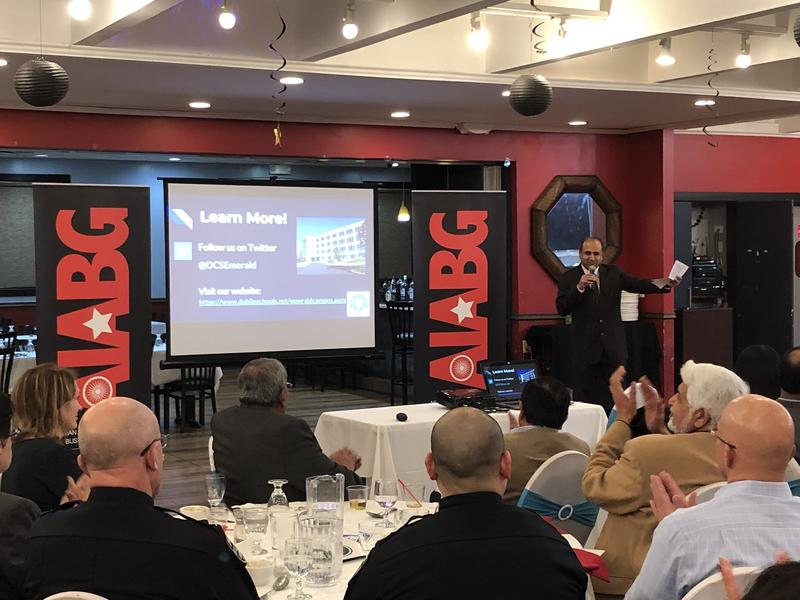
By October 2020, his public biography documented a board role with AIABG and an interest in helping central Ohio community members move forward. That historical role belongs alongside the business record. It shows a form of participation beyond client work: bringing people together in the region where his professional life had taken root.
He also named family, friends and golf among the things he enjoyed. The list is pleasantly free of an elaborate theory of executive recreation. Golf can keep its scorecard; an interest does not have to become a management parable to deserve a place in someone’s life.
“the only thing that matters to a customer is to get their problem solved.”
Kishore Patel / 2020
Keeping the work small enough to fix
Patel’s technical writing moves between scales. In November 2024, he addressed Salesforce Lightning Web Components, discussing reusable modules, performance and maintainability. His advice included keeping components focused on a single responsibility, documenting code and avoiding unnecessary work in an application. A business-software executive was spending time on the details that determine how difficult software becomes to change.
In March of the same year, he wrote about sustainability in US land management. The subjects included conservation, urban greening, Indigenous stewardship and cooperation among public bodies, businesses and communities. Here the frame widened again, from a component’s responsibilities to the interests surrounding a landscape. The writing shows the range of questions he was choosing to discuss publicly.
There is a practical aspiration running through his stated approach: solve the customer’s problem and help people make progress. The task may involve transferring account files, connecting land documents or interpreting road footage. Each case gives the technology a job beyond being interesting in itself. Patel’s career is easiest to understand at that level of detail.
The TEDx title remains a useful way back into the story. Location gave him a subject for a talk, a field for a business and a community in which to participate. Between Kolkata and central Ohio, the work has involved both software and the less easily automated business of understanding what people need from it. A map can show the distance. The intervening years contain the work.