The robot was already there. That was the awkward part. When Andy Lonsberry and his older brother, Alex, visited Corsa Performance, a manufacturer of exhaust systems near Cleveland, they encountered a business that needed more welding capacity and owned a robot intended to provide it. The machine sat beneath a tarp. Buying an arm and attaching a torch had failed to settle the matter.
For an engineer looking for a company to start, a covered machine is a useful sight. It suggests that someone has already written a cheque for the problem, and remains sufficiently annoyed to consider writing another. The Lonsberry brothers were exploring business opportunities while doing graduate research at Case Western Reserve University. Here was an unusually concrete question: why could a skilled welder cope with parts that defeated an expensive machine?
Their answer became Path Robotics. Andy is its co-founder and chief executive; Alex is its co-founder and chief technical officer. Years later, the company would be working toward autonomous production for naval shipbuilding. But the distance between those two moments is best measured in small discrepancies: a gap, a misalignment, a piece of steel that declines to resemble its drawing.
The family business was making things
Lonsberry grew up in suburban Cleveland, in a family where manufacturing was ordinary life. His father, Ken, was a mechanical engineer who ran a business making off-road vehicles for roughly five years. Between the ages of eight and twelve, Andy and Alex spent weekends at the shop, working on the systems. Their education involved actual objects with an inconvenient habit of requiring attention.
“We liked working with our hands,” Andy recalled. It is a modest sentence for a childhood that would supply the raw material for a career. Before there were neural networks and venture investors, there were tools, metal and their father. The company’s account of its beginnings returns to the garage and the value of precision. A family photograph preserves the cast: Ken, Alex and a young Andy with welding equipment.
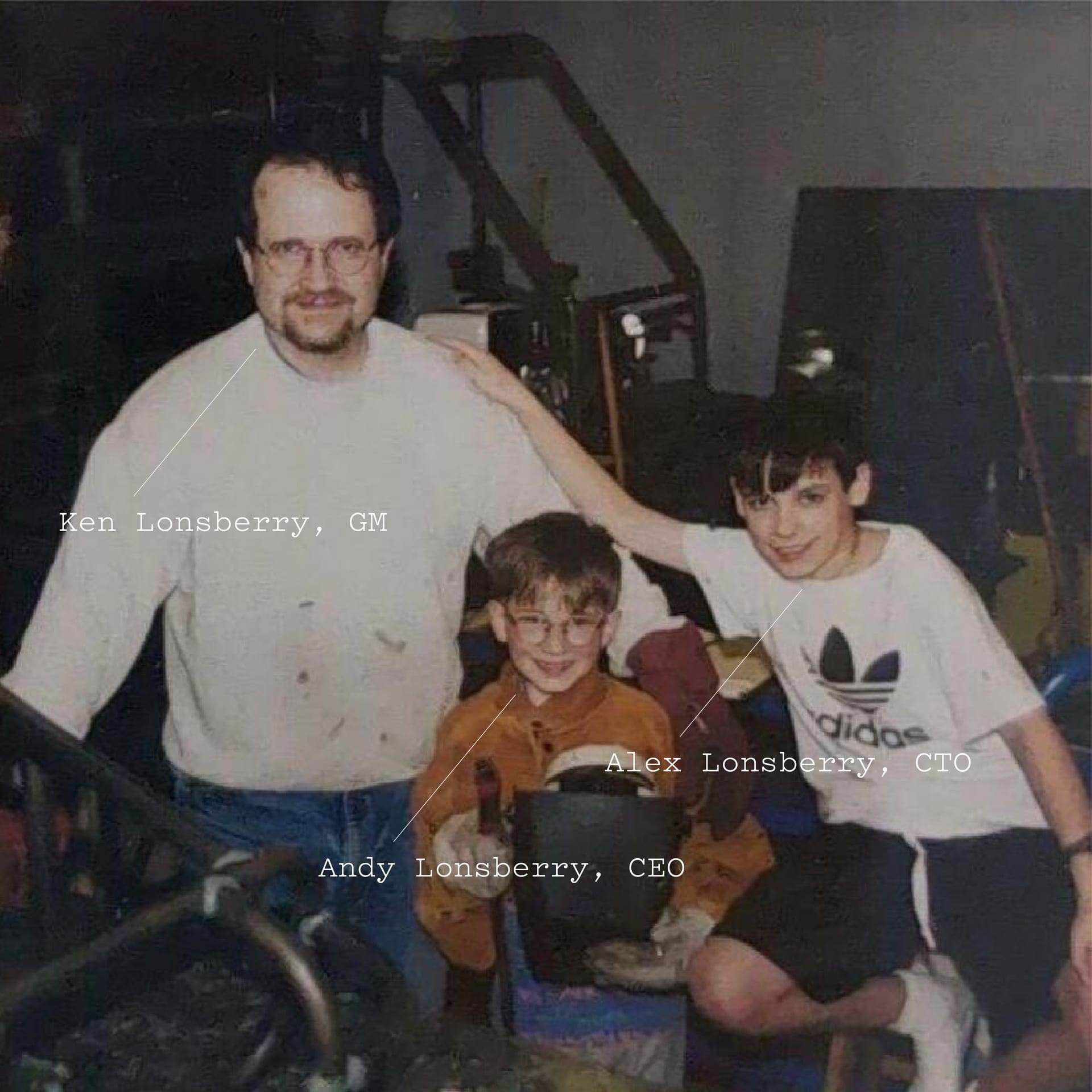
This gives the familiar garage origin a useful wrinkle. The brothers had a manufacturing background before they had a robotics company. They knew the attraction of building something tangible. Their later ambition, as they describe it, was to put intelligence into machines that could build things too. The garage supplied an interest that survived the move into software.
A research problem meets a customer
At Ohio State, Andy studied mechanical engineering, graduating in 2013. He also learned programming as intelligent machines captured his attention. Graduate work at Case Western Reserve took him further into robotics and deep reinforcement learning. Alex was pursuing related questions in computational neuroscience. The brothers were working on ways for machines to respond, learn and generalize.
University research offered room to explore. The Sears think[box] innovation center offered something equally useful: equipment. The brothers used the makerspace to design and test early manufacturing technology. Fellow graduate student Matt Klein became a collaborator and co-founder. Behind the neat phrase “university startup” were tools they could use and experiments they could afford to attempt.
The workshop and the laboratory were connected by a question of judgment. A welder watches the joint and adjusts. Teaching a machine that flexibility requires more than specifying a route for its arm. For Andy, research into learning systems acquired a customer who needed the answer to work on a production floor.
“The future of manufacturing hinges on highly capable robotics.”
Andy Lonsberry
Path’s origins stretch through research, consulting and prototypes. By 2018, the company had taken shape around adaptive welding. Its founding circle included the brothers, Klein and Ken. The family connections remained practical ones: their father would continue working in the business. A childhood spent around machinery had become a rather elaborate family enterprise.
The trouble with a perfectly obedient robot
Industrial robots already knew how to weld. The difficulty was persuading them to handle the variation found outside carefully controlled production lines. A repeated motion works well when every part arrives as expected. Change the part or the fit between pieces, and obedience can become a liability. The robot faithfully follows instructions that no longer quite apply.
Path builds sensing and software to let robotic systems inspect the work in front of them and adjust. Its sensors produce information about individual parts; the software uses that information to plan motion and positioning. The aim is a machine that can respond to the actual joint, including the imperfect ones that make manufacturing such an absorbing occupation for humans.
- 01 / SenseInspect the actual part
- 02 / PlanFind the joint and path
- 03 / WeldExecute and adjust
- 04 / LearnUse production experience
A simplified view of Path’s adaptive approach. The steel supplies the complications.
The challenge suits Lonsberry’s interests because it forces learning software to answer a physical question. A convincing demonstration is one step. Repeated useful work is another. A customer has schedules, material costs and orders to fulfil. The technology has to earn its place among those concerns, however interesting its underlying mathematics may be.
That customer requirement also explains the choice of welding. The brothers heard manufacturers describe difficulty finding skilled labor. In welding, they found a task where those shortages constrained output and where existing automation left substantial work untouched. The opportunity was visible in the space between an available machine and an unfinished job.
Columbus, with a reason to stay
The company moved from Cleveland to Columbus in 2019. Access to engineering graduates was part of the attraction, along with proximity to investor Drive Capital. Lonsberry had gone west to raise money; early backing came from Lemnos Labs in Silicon Valley. Building the company did not require moving the whole operation there.
Columbus gave him a place to recruit and a base close to manufacturing customers. In 2021, he spoke about wanting the city to become a center for robotics. It was an ambition with a local address: grow a company, bring in engineers, deliver machines, and give the next group a reason to build nearby.
Andy later returned to Ohio State alongside Nimble Robotics founder Simon Kalouche for an engineering lecture and discussion moderated by Dean Ayanna Howard. The two alumni had taken robotics into different markets. Their return put the work of starting companies in front of students still deciding what to do with an engineering education.
Lonsberry’s account of graduate school was candid. He described the time as a chance to develop expertise in deep reinforcement learning and explore what he cared about. That is a useful detail in a founder’s biography. The eventual company can make the earlier choices look tidy; his description leaves room for exploration before the application became clear.
Experience has to come from somewhere
Path calls its welding AI model Obsidian. The name is compact; the work behind it involves gathering experience from welding. Deployed systems provide examples of real production conditions. Path also runs an internal data operation to cover situations that need more training examples. Ken has worked as that operation’s general manager, bringing the family story back onto the shop floor.
The data matters because physical work contains details that are easy to underestimate from a distance. Parts differ. Fixtures and surfaces differ. The machine has to cope with those differences while producing a useful result. Lonsberry’s business depends on turning encounters with that variability into better performance across the fleet.
It also depends on delivering hardware and keeping it working. In a 2025 interview, he recalled a paid camera order being diverted to a larger buyer during the 2021 supply shortage. Path responded by building a supply-chain team and qualifying alternative vendors. A learning robot still needs its camera to arrive.
The company offers robotics through a service model that includes support and updates. That arrangement makes continued operation part of the relationship with the customer. For the chief executive, the work extends from research and recruiting to spare parts and field service. Ambition acquires a logistics department.
Now the work is ship-sized
In April 2026, Path introduced Rove, pairing its Obsidian model with a four-legged robot. Bringing welding capability to a large structure expands the possible settings for the technology. It is also a pleasing turn in Andy’s career: research interests that included legged robots now sit alongside a welding system with legs.
The larger commercial development came in August. HII signed performance-based production agreements with Path and GrayMatter Robotics under its HYPR program. The combined work could reach $900 million over seven years. Path described its share as more than $600 million. The agreements depend on technology, manufacturing readiness and performance milestones.
Path’s stated share of the HII program
Potential work, subject to milestones. The broader agreements total up to $900 million over seven years.Those conditions are central to the story. The program begins with development, testing and qualification for Navy-grade production. Delivery follows if cost, schedule and quality requirements are met. HII’s plan starts with smaller steel structures and can grow toward larger units and modules. There is considerable distance between signing an agreement and delivering the work it describes.
For Lonsberry, the agreement gives a broader form to an ambition he has expressed for years. Welding is the starting point for applying adaptive robotics to manufacturing. Assembly and other tasks sit within that larger aim. His interest is in giving factories more capacity to produce the physical things their customers need.
A family resemblance, in steel
The scale has changed considerably since the brothers visited a shop with an idle robot. The underlying demand remains recognizable: make this equipment useful on the work we actually have. Lonsberry has built his career around answering that request, drawing on a childhood in manufacturing and years spent studying how machines learn.
The family photograph gives the story a welcome sense of proportion. The adult titles were added later. At the time, there was a father, two sons and equipment to understand. Andy’s next assignments involve investors, production milestones and shipbuilding partners, but they still require something that would have made sense in that garage: take the parts in front of you, work out what they need, and make something that holds.
Follow the work
Conversations, company notes and a closer look at the machines.
Path Robotics Company website ↗Andrew Lonsberry LinkedIn ↗Building the future of robotics Watch on YouTube ↗A conversation about adaptive manufacturing Interview / August 2025 ↗A Turning Point for American Shipbuilding Andy’s company blog ↗The HYPR production agreements HII announcement / August 2026 ↗The early days at think[box] Case Western Reserve ↗