A car flies toward a football. Another car cuts across its path. Four players see the same collision from different angles, and each expects the ball to end up in the same place. In Rocket League, this is ordinary entertainment. For General Intuition, getting that little agreement right is a research problem with a rather large price tag.
- Builds AI that predicts outcomes and chooses actions.
- Uses gameplay paired with controller inputs, drawing on Medal.
- Offers a public MIRA demo and selective commercial partner access.
- Raised $220 million in September 2026 at a $6.2 billion valuation.
The company’s proposition begins with a familiar distinction. Watching somebody turn a steering wheel tells you what happened. Recording the turn alongside the resulting movement gives you a better example of how an action changes a scene. General Intuition wants machines to learn from those paired observations. A button press, usually the least glamorous part of a gaming clip, becomes the interesting bit.
The archive with a controller attached
General Intuition spun out of Medal, the platform people use to capture and share gaming moments. Its ambition is to build models with spatial and temporal reasoning: systems that can make sense of movement, anticipate consequences and act. In September, CEO Pim de Witte said Medal was on track for three billion uploaded videos a year. That is a company projection, but it explains the attraction of starting here.
Picture a robotics team assembling demonstrations one task at a time. Each recording requires equipment, an operator and somewhere to work. Gameplay offers a different collection mechanism: people already want to play. The strategic inference is appealing. Build around an activity that produces useful examples as a byproduct, and the data pipeline has a reason to keep running beyond the research budget.
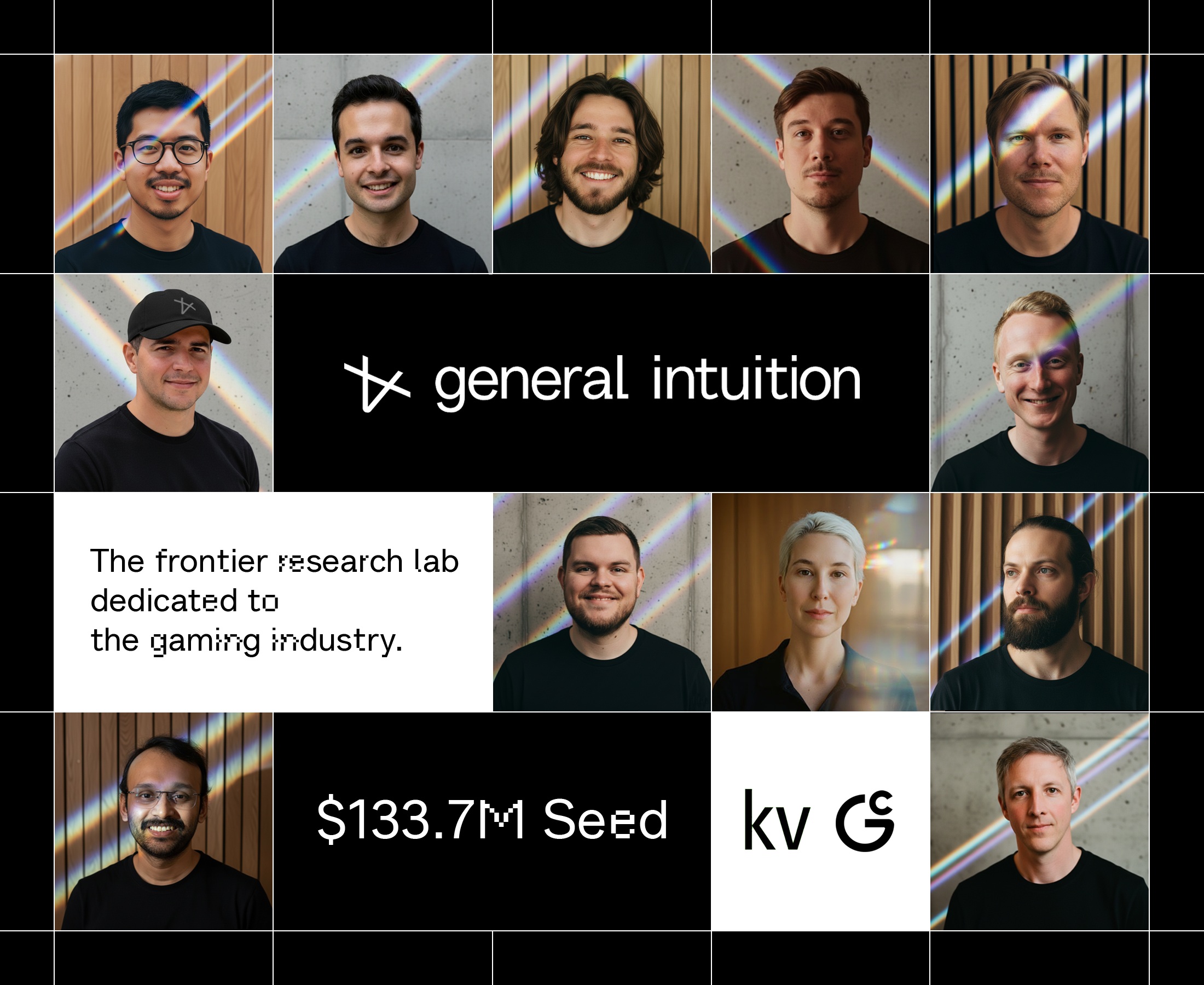
De Witte brought the Medal connection. Co-founders Eloi Alonso, Adam Jelley and Vincent Micheli brought research in reinforcement learning and world models. Alonso and Micheli studied in François Fleuret’s group at the University of Geneva; Jelley worked on efficient reinforcement learning at Edinburgh. Their shared work on DIAMOND, presented at NeurIPS in 2024, predates the company. The research did not begin when the first cheque cleared.
Four players must agree on one ball
MIRA, released in July 2026 with Kyutai and in collaboration with Epic Games, makes the ambition tangible. It generates a multiplayer Rocket League match in response to controls. Four players can participate in a two-versus-two game at 20 frames per second on a single B200 GPU. The model must reconcile several viewpoints and several people’s decisions while keeping the match recognizable.
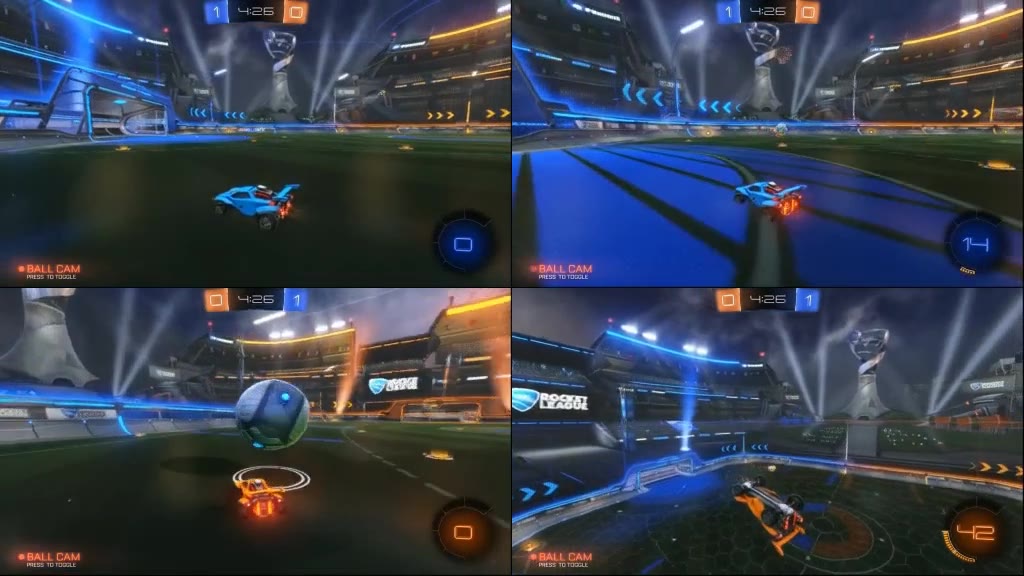
There is a useful wrinkle: MIRA’s training matches came from bots, not human Rocket League players. The project used roughly 10,000 match-hours of bot self-play, pairing synchronized video with actions. The researchers also recorded the underlying game physics for evaluation, while training on pixels and actions. This controlled experiment is distinct from the broader company’s Medal-based data strategy.
A world model forecasts what an action will do. An action model chooses what to do. Put the two ideas together and you can imagine a machine rehearsing a move before attempting it. The possible value for simulation and robotics is considerable: a useful learned environment could let developers test behavior before committing hardware to it. “Useful” demands more than attractive pictures.
“You should play Rocket League!”General Intuition and Kyutai, explaining why MIRA exists
That cheerful instruction answers an obvious question. Rocket League already runs perfectly well as a game. MIRA is an experiment in learning an environment from observations, intended to inform physical AI research. Kyutai researcher Václav Volhejn describes it as work in a controlled setting that might help later with robots and self-driving. The football car is laboratory equipment with an unusually good paint job.
The cars disappeared. The researchers changed the representation.
The MIRA team’s account includes a revealing sequence of disappointments. A pixel-space approach performed poorly. Compressing images helped, but earlier representations still lost coherence. A video representation codec produced the largest improvement in modeling performance. This is the practical change of mind: preserving a picture and providing a useful representation for generating future pictures are different jobs.
The awkward behavior remains instructive. A short context window lets the model invent plausible replays rather than remember the goal. Hidden cars can disappear in single-player versions. Unfamiliar play can destabilize the scene. These are specific warnings about using a learned simulator: limited memory, occlusion and behavior outside its training experience can undermine it. A convincing match is evidence about that match.
The price of investigating a possibility
The funding arrived quickly. An October 2025 seed round brought $133.7 million, led by Khosla Ventures and General Catalyst with Raine participating. June 2026 added a $320 million Series A at a $2.3 billion post-money valuation. September brought another $220 million at a $6.2 billion valuation, with Valor, Atreides, Seven Seven Six, Point72, Khosla Ventures and General Catalyst among the backers.
Round amounts, not expenditure. Approximately $673.7 million combined; latest round stage undisclosed.
Those rounds buy room to investigate; they do not reveal the cost of training a particular model. The company’s commercial route is selective API access for partners in games, simulation and robotics. Its potential buyers are teams that need models of interactive environments or agents operating within them. That positioning puts it upstream of applications, supplying intelligence other developers could build around.
Google DeepMind’s Genie work and Wayve’s driving-focused GAIA models occupy adjacent territory. General Intuition’s distinguishing argument is its connection to action-labeled gaming data. A prospective partner should compare controllability, consistency and task performance in its own environment. The volume of an archive is a reason to run an experiment, not a substitute for the result.
Keep the inputs. Test the consequences.
There is something here a smaller team can copy without raising hundreds of millions: preserve the actions alongside the outcomes. Measure whether a model follows those actions. Keep known state for evaluation when you can. MIRA’s released code and dataset give researchers a place to start. The harder lesson is to test unusual behavior deliberately, because users rarely confine themselves to the tidy examples researchers prepared.
General Intuition has made learning through interaction into a company. Its next challenge is wonderfully concrete: help a partner perform a useful task more reliably. Somewhere between a generated arena and a physical workspace, the question changes from whether the car looks right to whether it makes the right move.