Close your eyes and touch your nose. There is a small miracle in this ordinary act: your hand arrives without consulting a camera. For a machine, the equivalent manoeuvre presents an awkward question. Where, exactly, is the hand? And what happens when another finger, a tool or a patient blocks the view?
Ommo Technologies, Inc. has built its business around that interruption. The Texas company develops permanent magnet-based tracking: hardware and software that report a sensor’s position and orientation in three-dimensional space. Its proposition is particularly interesting wherever the object being tracked is small, the movement matters and a clear camera view is an unreasonable demand.
- Permanent magnet tracking reports position and orientation without an optical sightline.
- Medical device makers and robotics teams integrate the platform into their own products.
- Range, metal interference and production requirements remain practical constraints.
A magnet with something to say
An ordinary magnet is an unlikely narrator. Its field is there whether anyone is listening or not. Ommo makes that field informative by moving the magnet in a controlled pattern. Sensors measure the changing signal; computation turns those measurements into a location and an orientation. The base station supplies the reference point.
Its patent for a position-detection system describes a permanent magnet rotating about two axes. The invention lies in the mechanism as well as the mathematics. A magnet, by itself, cannot hand a robot a useful coordinate. The engineering task is to make its motion and the resulting measurements sufficiently interpretable to do so.
Six degrees of freedom means three location coordinates and three rotational coordinates. Ommo tracks both, including when the physical object disappears from view.
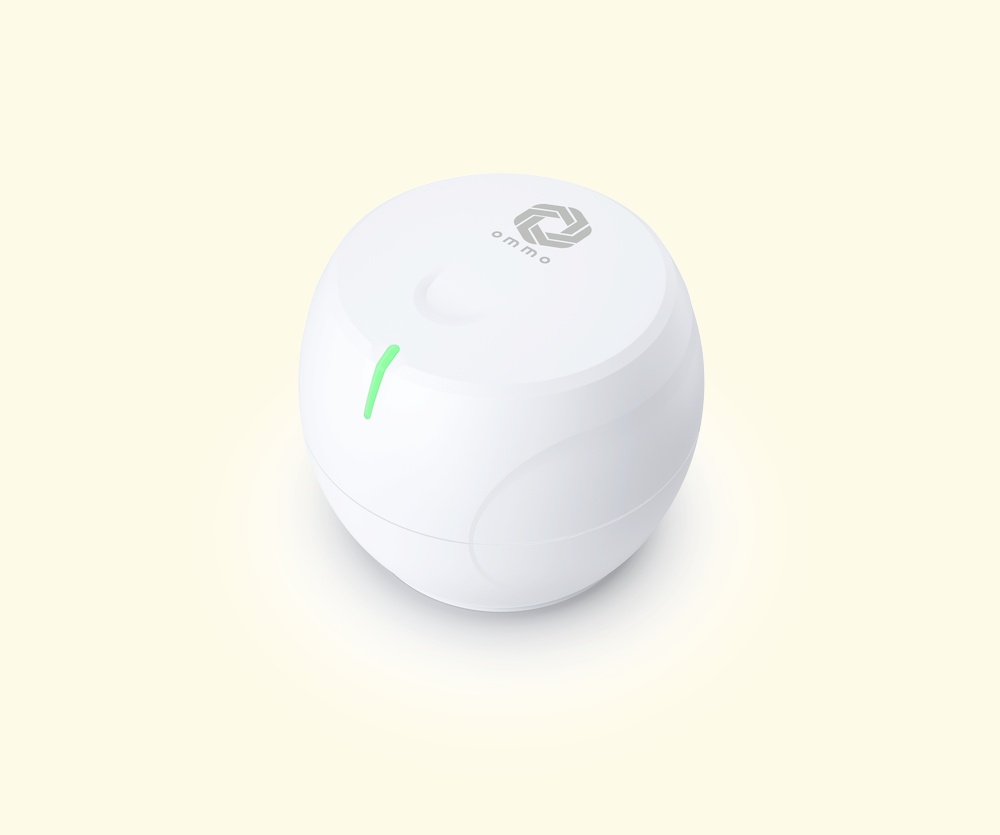
Position + orientation = six degrees of freedom
The operating room supplies the test
Ommo’s current medical focus includes neurological, dental and orthopedic applications. Its customers are medical device manufacturers and technology teams integrating tracking into their own systems. The company describes its role as enabling navigation akin to a GPS for anatomy. That is a useful analogy, provided one remembers that the tracking component is only part of the finished medical system.
At MWC Barcelona, Ommo describes a disposable sensor model intended to lower the cost of medical navigation and broaden its applications. The attraction is easy to understand. A compact sensor incorporated into a tool offers a different design choice from arranging external markers where a camera can reliably observe them.
The customer journey is unusually revealing: a demonstration and pilot, integration and customization, clinical or certification support, then commercialization. This is a business built alongside other engineers. A tracking reading must become something a partner can manufacture, validate and use. The glamorous coordinate is accompanied by a considerable quantity of ordinary work.
Four names, one practical question
Orbit is the base-station side of the proposition, an all-purpose tracking system built around the permanent magnet mechanism. Axon supplies wired sensors and sensor interface units. Its June 2025 manual describes a USB connection to the data processing unit and permits tools to incorporate standard hardware or a custom design.
Soma takes the wireless route. In a public product post, Ommo describes a power unit that snaps into compatible instruments and works with an Orbit Pro base station. The company advertises position precision down to 0.26 millimetres and a data rate up to one kilohertz for that system. These are product claims, dependent on the specified setup, rather than a promise for every room.
Kata addresses data acquisition for physical AI. Its product page highlights twelve patent-pending tensioners and a replaceable battery and communication module. The apparently modest concern with tangled cables is instructive: capturing dexterous movement requires equipment that can live with moving hands. A beautiful measurement becomes less beautiful when its wiring gets in the way.
Company-reported figures for the specified Soma setup.
The business beyond the coordinate
The broader ambition is to give robots a form of proprioception: feedback about their own position and movement. Ommo frames its robotics offering around contact and interaction, and its MWC description stresses real-world data for fine manipulation. The opportunity is to supply measurements that connect simulated movements to physical ones, rather than asking visual perception to answer every question.
This places Ommo among component and platform suppliers, with hardware, software and integration expertise sold to other businesses. The commercial logic includes reusable base stations and sensors embedded in partner products, including disposable medical tools. It is reasonable to see repeated sensor demand as an attraction of that model; public marketing alone does not establish recurring revenue.
Funding databases report a $30 million Series A in August 2026. That figure is financing, not the price of a tracking system or an accounting of development costs. Reporting around the round identifies technology development, manufacturing capacity and commercialization as priorities. Hardware must survive the transition from an impressive demonstration to repeatable production.
An early lesson in choosing the translator
One unusually candid episode concerns patents. In a case study published by Henry Patent Law Firm, founder and CEO Minjie Zheng describes learning how to select an attorney. Ommo had undertaken smaller projects with other firms before committing to a lawyer whose physics background fitted the invention. A mutual introduction helped make the match.
“The fundamentals of our technology are all based in physics,” Zheng said. The useful lesson is concrete: choose advisers who can translate the actual mechanism into protection aligned with the business. The firm reported that all applications it had filed for Ommo had received allowances at the time of its account. That is a historical result, not a forecast.
Zheng previously worked at Riot Games and Huawei. Co-founder and COO Kyul Ko brings experience from LG, Samsung and Apple. Their company’s careers page describes collaboration across engineering, product and manufacturing. It also records an inaugural Orbit Cup tournament in June 2026. Even people preoccupied with precise movement apparently enjoy a little friendly competition.
“The fundamentals of our technology are all based in physics.”Minjie Zheng · Founder & CEO
Where the field earns its keep
The tradeoff deserves as much attention as the advantage. Ommo’s technology comparison acknowledges limited range and susceptibility to ferromagnetic metals, with compensation possible. Removing a camera’s sightline requirement does not remove the environment. A wide workspace or troublesome metal arrangement still calls for application-specific evaluation.
The practical lesson for a prospective customer is to run the pilot around the awkward movement: the hidden instrument, the crossing fingers, the tool inside a confined space. Establish the needed range and tolerance before admiring the headline precision. Ommo’s interesting wager is that knowing where something is can become a business of its own. The customer decides whether that knowledge survives the room in which it must work.