BREAKING Skild AI closes $1.4B Series C - January 2026 Valuation tops $14B after tripling in seven months Backers: SoftBank · NVIDIA · Jeff Bezos · Samsung · LG The Skild Brain: one model, any robot body Live revenue: $0 to ~$30M in months Founded in Pittsburgh, 2023 BREAKING Skild AI closes $1.4B Series C - January 2026 Valuation tops $14B after tripling in seven months Backers: SoftBank · NVIDIA · Jeff Bezos · Samsung · LG The Skild Brain: one model, any robot body Live revenue: $0 to ~$30M in months Founded in Pittsburgh, 2023
Company Profile · Robotics & Physical AI

Skild AI wants one brain for every robot.

A single foundation model built to pilot quadrupeds, humanoids and arms it has never met before.

$14B+
Valuation
$2B+
Raised in 18 mo
2023
Founded
1
Brain, any body
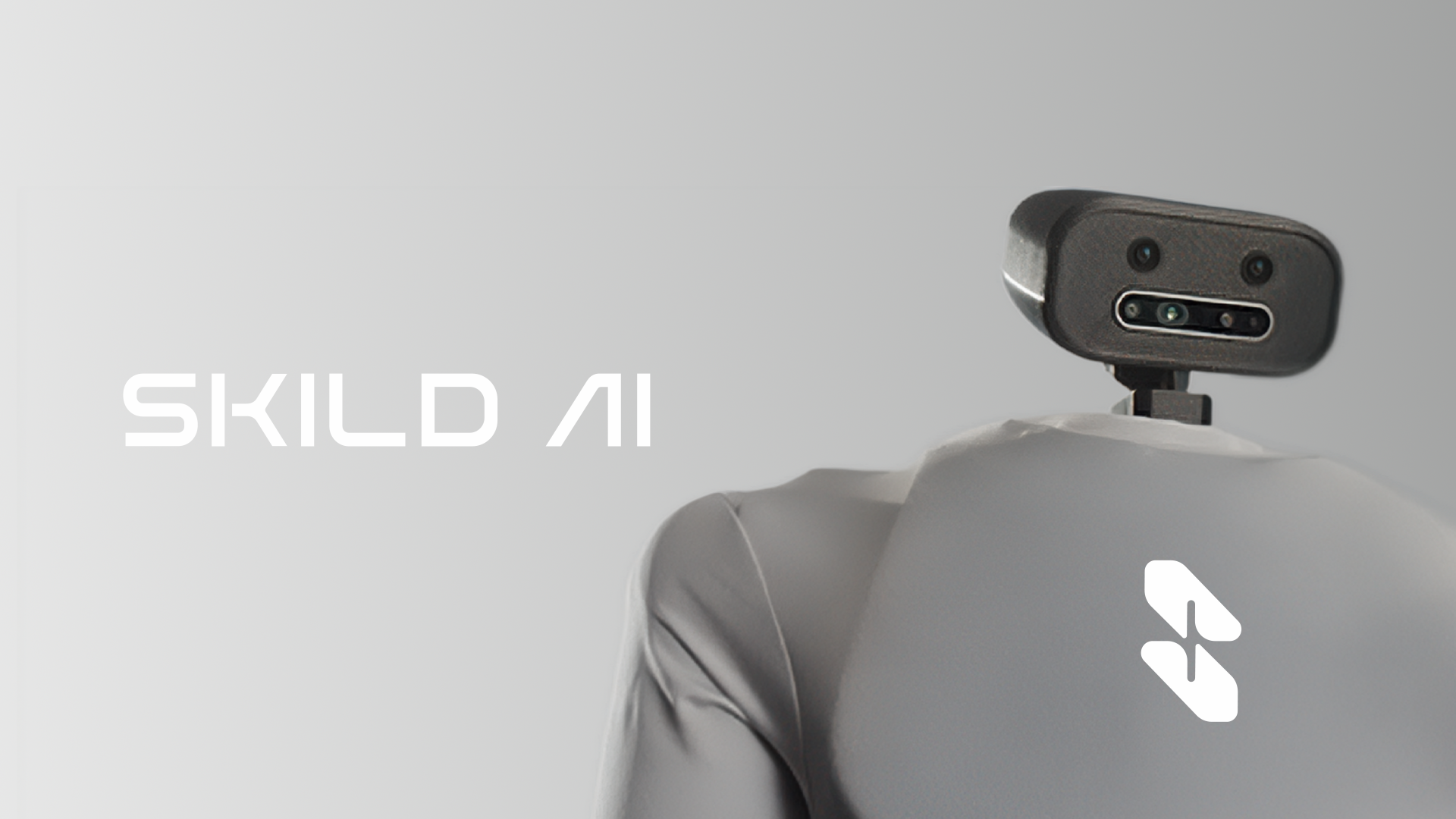
Skild AI brand image showing the company name, logo and a robot

The Skild Brain, in repose: a robot with a sensor head where you would expect a face, and a wordmark that has already raised more money than most countries spend on robots. Source: Skild AI.

Filed from Pittsburgh, Pennsylvania Robotics · Foundation Models · Updated June 2026

A robot stands in a warehouse it has never seen, holding a tool it was not trained to hold. It hesitates, adjusts, and gets on with the job. The robot is not running code written for that warehouse. It is running the Skild Brain - and that distinction is the entire bet of a company now worth more than fourteen billion dollars.

This is Skild AI today: a three-year-old company in Pittsburgh selling something the robotics industry has chased for decades and rarely delivered - software that does not care which robot it is driving. Most robots are brilliant at exactly one thing and useless at everything else. Skild AI is trying to make that sentence obsolete.

"The Skild Brain is the industry's first unified robotics foundation model that generalizes across tasks and robot hardware."

- Skild AI, on what it actually built

01 / THE PROBLEMRobots are specialists in a world that needs generalists

Here is the inconvenient truth the robotics industry prefers not to dwell on: a robot arm that flawlessly welds a car door knows nothing about climbing a staircase, and a four-legged robot that scrambles over rubble cannot stack a dishwasher. Each machine is a custom project. Each new task is months of engineering. The hardware got cheap; the intelligence stayed expensive and bespoke.

Meanwhile, the jobs keep going unfilled. Security patrols, building inspections, warehouse picking, factory assembly, deliveries through buildings designed for humans - the physical economy has a labor shortage, and the robots that could help are too narrow, too brittle, and too slow to teach. Every robot that falls over and cannot get back up is a small argument against the whole enterprise.

"A GPT-3 moment is coming to robotics."

- Sequoia Capital partner, attributed

That line explains the money. Language models learned to generalize by swallowing the internet. Skild AI is asking whether robots can do the same - whether one model, fed enough of the right data, can learn the physical world well enough to walk into an unfamiliar body and an unfamiliar task and simply work.

02 / THE BETTwo professors who waited a decade

Skild AI was founded in 2023 by Deepak Pathak and Abhinav Gupta, both former Carnegie Mellon computer-science professors, and reportedly people who had talked about building a company together for the better part of ten years before they actually did it. Between them they have racked up more than 75,000 academic citations, which is the research world's way of saying other people kept needing their ideas.

Co-founder & CEO

Deepak Pathak

IIT gold medalist, PhD in AI at Berkeley, alumnus of Facebook AI Research, and previously co-founder of VisageMap (acquired by FaceFirst in 2015). Now CMU professor turned founder.

Co-founder & President

Abhinav Gupta

PhD from the University of Maryland, Carnegie Mellon Robotics Institute professor since 2009, and a founding member of Facebook AI Research's robotics work in 2018.

Their wager is unfashionably simple to state and brutally hard to do: stop building a brain per robot. Build one brain, train it on far more data than anyone else, and let generality fall out the way it did for language. The catch is that robots cannot read the internet for free - so Skild had to invent its diet.

"Build one brain. Train it on more of the world than anyone else. Let the generality fall out."

- The founders' thesis, paraphrased

03 / THE PRODUCTAn omni-bodied brain that learns from everything

The Skild Brain is described as omni-bodied - a deliberately strange word meaning it can control a robot without prior knowledge of that robot's body form. Quadrupeds, humanoids, tabletop arms, mobile manipulators: same model, different limbs. The robot does not need a custom controller written for its skeleton; the brain figures out the body it has been given.

To get there, Skild feeds its model an unusually broad diet: large-scale physics simulation, internet video of humans doing tasks, teleoperation recordings, and lessons learned from real-world deployment. Watching humans on video lets the model pick up the grammar of physical work without a person manually labelling every frame. The company claims to train on orders of magnitude more data than rivals, which is the kind of claim that is hard to verify and very expensive to fund.

What it controls

Any body

  • Quadrupeds
  • Humanoids
  • Tabletop arms
  • Mobile manipulators

What can you actually do with it? In Skild's telling, the brain spans the mundane to the demanding - cleaning and dishwashing on one end, navigating rough terrain and recovering from failure on the other. The commercial edge points at security, construction, delivery, data centers, warehouses and factory assembly: the patrolling, inspecting and fetching that nobody is lining up to do.

"Same model, different limbs. The brain figures out the body it has been given."

- On the meaning of omni-bodied
The receipts

Skild AI, by milestone

2023
Founded in PittsburghPathak and Gupta leave the lab to build one brain for all robots.
Jul 2024
$300M Series AAt a $1.5B valuation. Led by Lightspeed, Coatue and SoftBank, with Bezos Expeditions and Sequoia.
2025
$135M Series B · ~$4.5B valuationLive revenue grows from zero to roughly $30M in a matter of months.
Jan 2026
$1.4B Series C · $14B+ valuationLed by SoftBank with NVIDIA's NVentures, Bezos, Samsung, LG, Schneider Electric and Salesforce Ventures.

04 / THE PROOFThe money found it before the customers did

Skild AI has raised over two billion dollars across three rounds in roughly eighteen months. The January 2026 Series C alone was $1.4 billion, pushing the valuation past $14 billion - a figure that, by most accounts, tripled in about seven months. The cap table reads like a who's-who of people who want a stake in physical AI: SoftBank leading, NVIDIA's venture arm, Jeff Bezos, Samsung, LG, Schneider Electric and Salesforce Ventures among them.

Valuation, by round

From $1.5B to $14B in 18 months

$1.5B
Series AJul 2024
$4.5B
Series B2025
$14B+
Series CJan 2026

Figures are reported post-money valuations from public funding announcements. Bars scaled to the $14B Series C. The line goes up; investors noticed.

What is unusual is the order of events. Most companies earn their valuation by accumulating customers. Skild raised much of its first round before naming a single one, on the strength of the team and the thesis. By 2025, that was changing - the company reported live revenue climbing from zero to around $30 million, with early deployments pointed at the inspection-and-patrol corners of industry. Real, but small against a $14 billion number. The gap between the two is the thing skeptics keep circling.

"The money found Skild before the customers did. Now the customers have to catch up to the money."

- The bull and bear case, in one sentence

The competitive field is crowded and well-funded: Physical Intelligence, Figure AI, 1X, Sanctuary AI, Covariant and Field AI, plus platform-scale efforts from NVIDIA's Project GR00T and Tesla's Optimus. Skild's distinction is the insistence on one model for all bodies, rather than one robot perfected. Whether breadth or depth wins is the open question the whole sector is funding.

05 / THE MISSIONRobots for the work nobody is doing

Strip away the valuation and the mission is grounded: aim the robots at jobs the labor market cannot fill. Skild frames its brain as an operating system for physical work - security and patrolling, inspection in places that are dull or dangerous, the logistics of moving things through human-shaped spaces. The pitch is not robots replacing people so much as robots taking the shifts that stay empty.

Five things worth knowing
  • The founders talked about starting a company together for nearly a decade before they did.
  • The brain is "omni-bodied" - it can pilot a robot it has never seen, without knowing its shape in advance.
  • It learns partly from internet video, so robots can study humans doing tasks.
  • CEO Deepak Pathak earlier co-founded VisageMap, acquired by FaceFirst in 2015.
  • Home base is Pittsburgh, a robotics town long anchored by Carnegie Mellon.

"Not robots replacing people. Robots taking the shifts that stay empty."

- The mission, minus the hype

06 / WHY IT MATTERSThe body in the warehouse, revisited

Return to that warehouse. The robot that paused, adjusted and finished the job did something quietly radical: it did not need a human to write it a manual first. If Skild AI is right, that scene stops being a demo and becomes a Tuesday - the same brain in a hundred different machines, each one walking into a new room and getting to work.

If Skild is wrong, it will be one of the most expensive bets in robotics history. Fourteen billion dollars is a lot of conviction riding on a word like "generalize." But the problem is real, the team is serious, and the money is patient. The robots are already standing in rooms they have never seen. Now we find out whether one brain was enough.

"One brain, any body. Either it changes the warehouse, or it changes the record books. Probably both."

- Skild AI, the bet in full

Share this profile

Spread the word about Skild AI