Around 1995, Greg Smith was working on a hard disk drive read channel, and people were already wondering how long hard drives had left. Flash memory would surely finish them off. Three decades later, discussing Teradyne’s business in September 2026, he returned to that first semiconductor-test assignment with evident pleasure. The supposedly departing technology was still supplying him with business. Obituaries, it turns out, are an unreliable production schedule.
That recollection is a useful introduction to Smith, Teradyne’s president and chief executive. His working life has unfolded among the things that let other technologies keep their promises: test equipment, applications engineering, production systems, and, more recently, robots. These are businesses in which a convincing demonstration is only the beginning. Eventually, someone has to run the thing again. And again. Preferably through the night.
Smith’s career offers a view of technological change from the checking station. He has moved from designing tests to running businesses that sell them, then into automation and finally the leadership of the whole company. Along the way, the recurring question has become more expensive: how soon can you find the problem?
A career built beside the test bench
Smith earned his electrical engineering degree at the University of Pennsylvania in 1985 and began his career at Raytheon that July. His early assignments included test systems for radar and satellite communications. He later moved into engineering management. His education continued alongside work, with graduate coursework at Worcester Polytechnic Institute covering subjects including digital signal processing and computer system design.
At LTX, which he joined in December 1994, applications engineering led to responsibility for product development and then a system-on-chip business unit. The progression matters. Applications work requires translating an instrument’s capabilities into something a customer can actually use. Development adds responsibility for making the instrument. Business management adds the awkward question of whether anyone can sell it profitably.
By January 2006, when he joined Teradyne as a marketing manager, he had worked across those boundaries. A business-unit leadership role followed in 2007. In February 2016 he became president of Semiconductor Test, the company’s largest operating business. The job placed an engineer with commercial experience inside a market where the customer’s next design can rearrange everyone’s priorities.
Test engineering
Product marketing
Group president
President & CEO
Teradyne credits his later Semiconductor Test leadership period, 2017 through 2020, with revenue growth of more than 50%. Its next assignment for him was a change of machinery and market. In October 2020 he took charge of the newly created Industrial Automation Group, whose businesses included Universal Robots, Mobile Industrial Robots, and AutoGuide. Teradyne reports 44% revenue growth for the group over 2020-2023. Those are business results achieved by teams, and they help explain why the board wanted someone who understood both sides of the company.
The robot arrives. Then the questions start.
Teradyne had entered collaborative robotics with its 2015 purchase of Universal Robots. Smith inherited the task of helping an established industrial company develop a younger business. A collaborative arm and a semiconductor tester both belong on a factory floor, but the sale surrounding them can be very different. Robotics asks customers to change how work happens.
In a 2023 discussion about adoption, Smith focused on smaller manufacturers. Buying automation required more than finding a vendor. Someone had to decide which operation deserved automating, prepare the process, judge competing proposals, and support the result. Large manufacturers could draw on internal automation teams. A smaller company might be making all these decisions for the first time.
“The existing ecosystem doesn’t provide a lot of this type of support to customers,” he said. His proposed remedy included marketplaces that could help buyers navigate those choices. It was an unglamorous diagnosis, which gave it weight. A robot could be capable of the job while the buyer remained incapable of buying it well. The paperwork and advice had become part of the engineering problem.
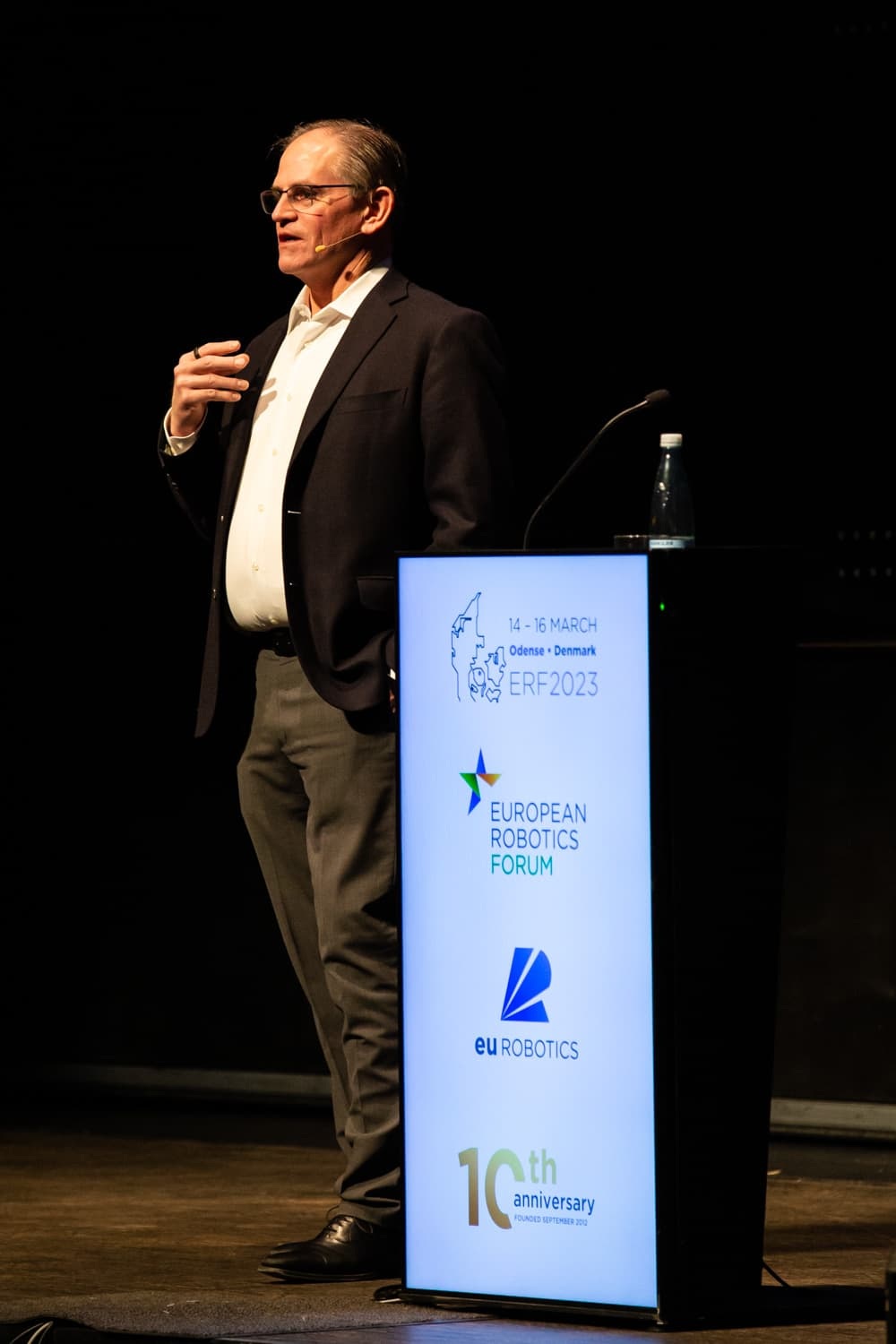
At the European Robotics Forum in Odense in March 2023, he set out a broader ambition for machines working alongside people. His argument connected automation with productive capacity: repetitive tasks left unautomated could constrain what businesses and economies could achieve. He wanted the industry to turn its technical possibilities into useful installations more quickly. The ambition was expansive; the route to it ran through ordinary manufacturing tasks.
A promotion across two different clocks
Smith became Teradyne’s president in July 2022. That November, the board announced that he would succeed Mark Jagiela as CEO on February 1, 2023, joining the board on the same day. Jagiela had spent more than forty years at the company, beginning as a design engineer. The succession kept technical experience close to the top.
Chairman Paul Tufano emphasized Smith’s understanding of both the technical and commercial sides of test and automation. That combination was especially relevant to the company he was taking over. Its testing operation served a mature industry with installed equipment, established customers, and recurring technology transitions. Robotics offered a younger market whose adoption patterns were harder to predict.
Smith was still describing that difference in September 2025. Testing developed through changes in technology, shifts between semiconductor segments, and competition for share. Robotics was earlier in its development and less predictable. Running both meant making investment decisions across different kinds of uncertainty, without assuming the businesses would arrive at their opportunities together.
In July 2023, Ujjwal Kumar succeeded him as robotics group president. Smith’s responsibilities had expanded beyond the group he had run. His own career now linked the company’s two major technical traditions, while other leaders took charge of carrying each forward.
What counts as AI?
By 2025, artificial intelligence had become a practical measurement problem as well as a business opportunity. At Teradyne’s investor day, Smith explained how the company counted AI-driven robotics revenue. For products with AI features built in, the classification was straightforward. For Universal Robots, whose partners built applications on its platform, the company required identification of the particular partner and technology before counting the revenue.
That detail is revealing because the temptation runs the other way. A fashionable label becomes easier to apply as it becomes more valuable. Smith described a rule that made the label harder to earn. The distinction also reflected the business model: Teradyne could supply a robot while somebody else supplied much of the intelligence and application expertise around it.
In April 2024, he had offered an example of what the technology could change. An NVIDIA-based visual inspection demonstration had come together in less than two weeks. He connected AI with the ability to handle variation in parts and their positions, and with making automated solutions more resilient. Development speed mattered, but so did survival in an untidy factory.
“People don’t want to put fragile things into production.”
Greg Smith, discussing robotics and AI, April 2024
There is a plain industrial standard inside that sentence. A system has to remain useful when the conditions become inconvenient. For a chief executive whose first jobs involved checking equipment, it is a particularly coherent way to describe the promise of AI.
Finding the defect before it gets expensive
Smith’s public explanations of semiconductor testing carry the same concern into a different setting. On LinkedIn in 2026, discussing advanced packaging, he argued for finding defects earlier in production. A failure late in assembly can consume valuable dies, memory, and substrates before exposing the underlying problem. Earlier detection protects the scarce components that would otherwise go into a failed finished device.
The phrase used in the industry is “shift left”: move the checking upstream. For Smith, the point was connected to the shortage of computing capacity as well as the cost of scrap. Every failed assembly represents hardware that cannot become working compute. A test engineer’s problem had become a constraint on a much larger industrial expansion.
The financial scale was visible in Teradyne’s second quarter of 2026. Revenue reached $1.329 billion, compared with $652 million a year earlier. Semiconductor Test accounted for $1.122 billion; Product Test contributed $107 million and Robotics $100 million. All three groups grew from the prior year. The figures describe the company’s quarter, rather than a personal scorecard, but they show the size of the operation Smith now leads.
The work continues outside the machine
His more recent responsibilities extend beyond product decisions. In September 2026, Teradyne announced a new Bengaluru office under India country manager Alpa Sood. Its remit included customer engagement, applications support, training, and partnerships. Those functions give physical form to an idea Smith had discussed with smaller robotics buyers: customers need help making the technology useful where they are.
On October 20, SEMI announced his election to its international board, following the association’s annual membership meeting on October 14. The appointment placed him alongside executives from other parts of the semiconductor supply chain. Testing depends on that wider chain; the instrument only does its job when it fits the production process around it.
There is also a public expression of what he wants the industry to make room for. In 2025, he supported the Global Semiconductor Alliance’s Women’s Leadership Initiative and its allyship program, pointing to the value of mentorship from female leaders. The statement adds a people question to a career usually described through equipment and revenue.
Across these roles, Smith keeps returning to the distance between a technology’s capability and its usefulness. Buyers need advice. Partners need workable platforms. Assemblies need earlier checks. Hard drives, meanwhile, continue to resist their retirement notices. His career has given him ample practice with the possibility that the important work is still waiting at the test station.