A financial executive has plenty of ways to count a working day. Revenue. Production. Assets. Another meeting, if the calendar is feeling competitive. Lisa Stavsky has spent decades in businesses where the numbers matter, and where somebody has to answer for them. Then she took on a question that refuses to sit neatly in a spreadsheet: what makes the people giving financial advice want to keep doing the work?
In June 2025, while leading WesBanco’s securities and insurance businesses, she successfully defended a doctoral dissertation on financial advisors’ autonomous motivation. The subject carries an academic title. Its everyday stakes are easier to recognize. An advisor can have a compensation plan, a computer and a book of clients, yet still need a reason to care about Monday morning.
That is the interesting turn in Stavsky’s career. After years of managing professionals, she made their experience an object of study. Authority had given her responsibilities. Research gave her another way to frame the questions that came with them. The question also changes the scale of the story. A business may report results in aggregate, while motivation is experienced one working day and one relationship at a time. Looking closely at that smaller scale is a reasonable undertaking for someone responsible for the larger one. The resulting portrait is of an executive whose work reaches from business plans to college scholarships, with Columbus as the place where those commitments meet.
New York beginnings, an Ohio life
Stavsky’s professional history stretches back to the New York securities business. Her registration record includes Balis & Zorn and Alex. Brown & Sons before National City. These are the early entries in a career that would eventually encompass trading, advising, sales management and executive leadership. The sequence matters because each position offers a different view of the same business: the transaction, the client, the team and the organization.
She and her husband, Seth, moved from New York City to Columbus in 1993. Ohio became home. Her education also crosses those two places: a bachelor’s degree from Brooklyn College, followed by an MBA from Capital University. The geography is simple enough to draw with one arrow. The career that followed would require rather more space.
National City and PNC account for 23 years of that career. Her roles included financial advisor, regional investment sales manager and senior vice president and territory director at PNC Investments. She later became TIAA’s wealth management director for Ohio, working from Dublin, before joining WesBanco in 2019. The progression took her from individual financial relationships to responsibility for the people and systems supporting many of them.
Two businesses, one demanding calendar
Today, Stavsky is president and CEO of WesBanco Securities and CEO of WesBanco Insurance Services. WesBanco also identifies her as executive vice president for securities and insurance. The titles describe two related businesses with their own products, personnel and operating demands. A title fits on a business card. The work tends to overflow.
Her remit includes strategy, annual plans, performance goals, product selection and staffing, alongside day-to-day operations and the profitability and growth of both businesses. That combination puts long-range decisions next to immediate ones. Which people should a business hire? Which products should it offer? How should a plan become something an advisor can actually use?
Those questions help explain why the subject of motivation belongs in this story. For someone responsible for both the plan and its execution, the experience of the people doing the work is a practical concern. A strategy has to pass through a human being before it reaches a client. That is an observation about the job, rather than a claim that any one management approach has solved it.
In August 2026, Stavsky appeared with Ameriprise Financial’s Christopher Melton on a discussion of OneWealth. The conversation addressed the effort to connect financial businesses around the client experience, including leadership alignment, operations, compensation and data. It is a revealing subject for an executive working across securities and insurance: integration has a friendly name, followed by a considerable amount of coordination.
Back to school, with a question from work
Stavsky earned her Doctor of Business Administration at Franklin University in 2025. Her dissertation, Financial Advisors’ Autonomous Motivation Needs, used interviews with 17 financial advisors and one manager. It examined the conditions that help advisors sustain motivation, against concerns about the profession’s future supply of talent.
The study’s themes included client relationships, autonomy, organizational alignment, compensation, technology, administrative demands and leadership. Its proposed EPIC model brings together emotional intelligence, purpose, individuality and coaching. The findings point toward meaningful relationships and room for professional judgment, supported by an organization whose values make sense to the people working there.
These are findings from a qualitative study, with a defined group of participants. They offer a way to think about leadership and further questions to test. They do not establish that a new model will produce a particular revenue result. Keeping that distinction intact makes the work more useful: a thoughtful question can travel further than a promise made too quickly.
There is also something engaging about the timing. An established executive returned to formal study in a field she already knew through practice. Experience and education can have a productive argument. One supplies examples; the other asks whether an example is enough. For a leader, taking the student’s seat creates room for both.
The colleagues who remember the earlier chapters
One glimpse of Stavsky away from a formal biography comes from a BISA gathering. In a LinkedIn post, she wrote, “Great to see old friends at #BISA.” The responses supplied the backstory. Former colleagues recognized a National City reunion. Others recalled relationships and lessons that had lasted more than 20 years.
That small exchange gives the long career a social dimension. Employer names can make a résumé look like a sequence of departures. Former colleagues meeting again show how much can continue between those entries. A company name changes; a conversation picks up where it left off. Occasionally, the reunion photograph does a better job than the organizational chart.
In 2026, Stavsky joined the Bank Insurance & Securities Association’s board for its 2026-2027 term, after serving on its Impact and Vision committee. She has identified developing future financial professionals and broadening the industry’s talent as priorities. Her new role gives those interests a forum beyond her own employer.
“My goal is to help provide a voice to those who serve this powerful channel.”
Lisa Stavsky, on joining the BISA board
The connection to her research is clear enough to be interesting without pretending the two are interchangeable. One concerns the working experience of advisors. The other concerns the profession they belong to. Both put attention on the people expected to carry financial services into its next chapter.
A different kind of investment conversation
Stavsky joined the Ohio Foundation of Independent Colleges’ board of trustees in 2023. The foundation connects donors and employers with students through scholarships, internships and career opportunities. It is an education commitment with a practical bridge to employment, a subject that fits comfortably beside her interest in developing professionals.
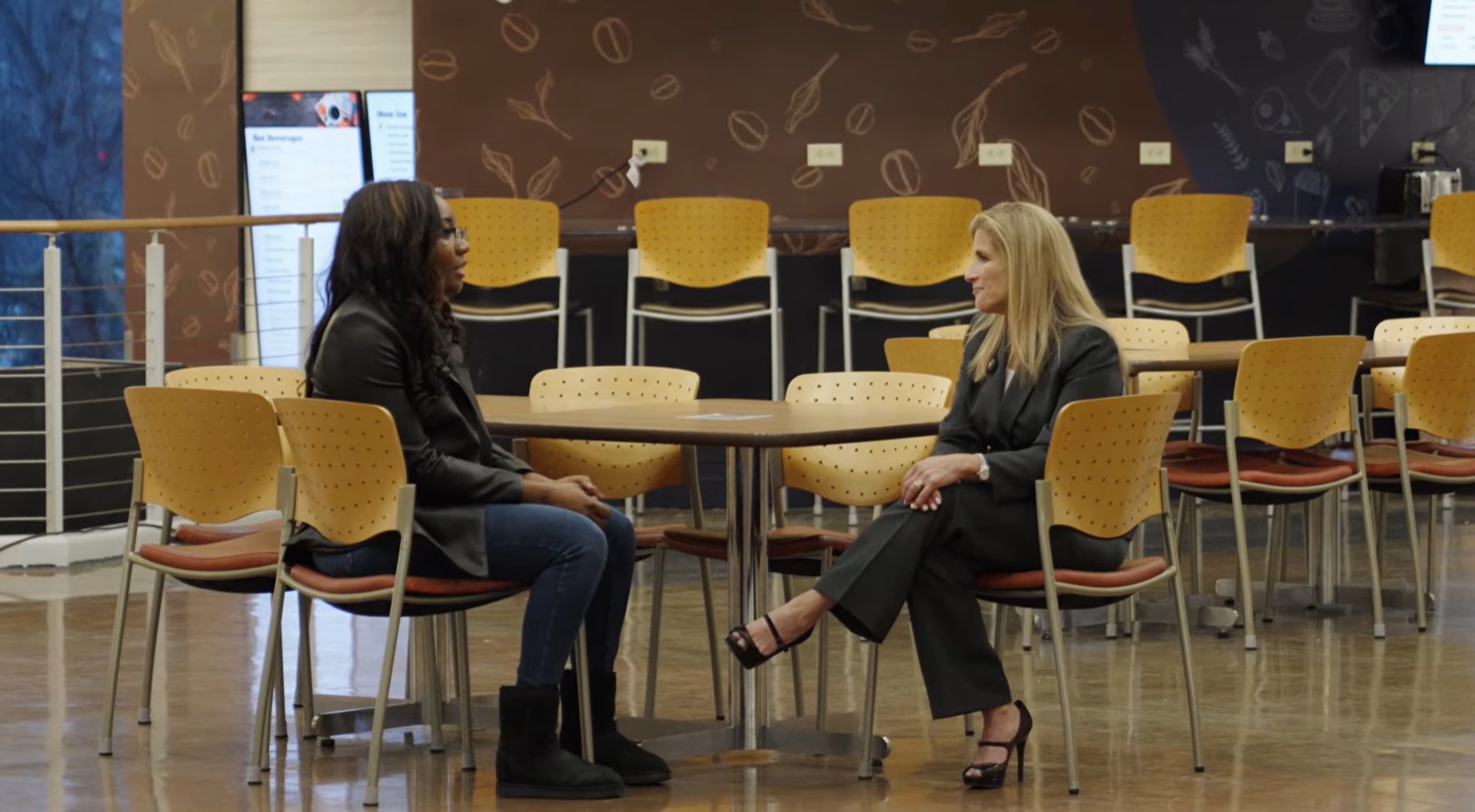
In a scholarship feature, she appears with Jalesha Goss, an Ohio Dominican University business administration student supported by a WesBanco scholarship. The image brings an institutional relationship down to the scale of two people at a table. It is an apt companion to a career spent working with financial relationships: here, the subject is a student’s opportunity to finish an education.
Her community commitments also include the Columbus Jewish Historical Society’s board of trustees and the board of Families Flourish. These organizations sit in different parts of civic life. Their presence in her public work gives the Columbus chapter a depth that a location line alone cannot convey. A city becomes home partly through the institutions people choose to help sustain.
The next question is about people
Across these chapters, education keeps returning: her own studies, the students connected to scholarships, the financial professionals she wants to help develop. It would be too tidy to turn every position into evidence of one lifelong plan. Careers rarely arrive with such obliging punctuation. What the record does show is an accumulation of responsibilities, followed by continued curiosity about the people inside them.
Stavsky’s current work brings several timescales together. There are operating decisions to make now, professionals whose careers will unfold over years, and students preparing to enter a working world of their own. Her doctorate adds another timescale: the patient work of asking a question, listening to answers and deciding what those answers can support.
The sales chart remains part of the job. So do the business plan and the next meeting. Alongside them is a question that reaches beyond any single reporting period: what helps someone keep bringing judgment, care and purpose to work? Lisa Stavsky has made that question part of her professional life. It is a good reason to keep following what she does next.