A financial advisor can have a remarkably ordinary conversation that creates a remarkably complicated record. “Can we talk next week?” might arrive by text. A retirement question might appear under a LinkedIn post. To the client, these are the natural rhythms of a relationship. To a financial institution, they can be communications to supervise, archive and retrieve. Hearsay Systems built a business in that narrow, crowded passage between human ease and institutional obligation.
- Hearsay gives distributed advisors and agents managed tools for social posts, texts, voice and client outreach.
- Financial firms buy the software so local professionals can communicate within corporate and regulatory controls.
- Yext announced a $125 million cash acquisition in 2024 and completed it on August 1.
The company began in 2009, when “social selling” still sounded like a phrase invented to trouble a chief compliance officer. Clara Shih and Steve Garrity saw a simple mismatch. Large companies had local people with real relationships, but the new social networks made it hard for headquarters to know what those people were saying in public. Hearsay’s early software let a firm distribute approved material, manage local profiles and watch the resulting activity. Its first audience was the army of branch employees, insurance agents and financial advisors who could reach people more persuasively than a corporate account ever could.
The post was only the beginning
A social post is a useful opening. It is rarely the whole conversation. Someone sees an advisor discuss college savings, asks a question and then wants a private reply. The more Hearsay learned about that route, the more its product moved beyond publishing. Hearsay Sites brought advisor webpages into the picture in 2015. In 2017 the company acquired technology from Mast Mobile to improve work numbers and mobile messaging. Hearsay Relate, its texting product, followed. A channel that used to live on an advisor’s personal phone could now be part of a firm’s supervised workflow.
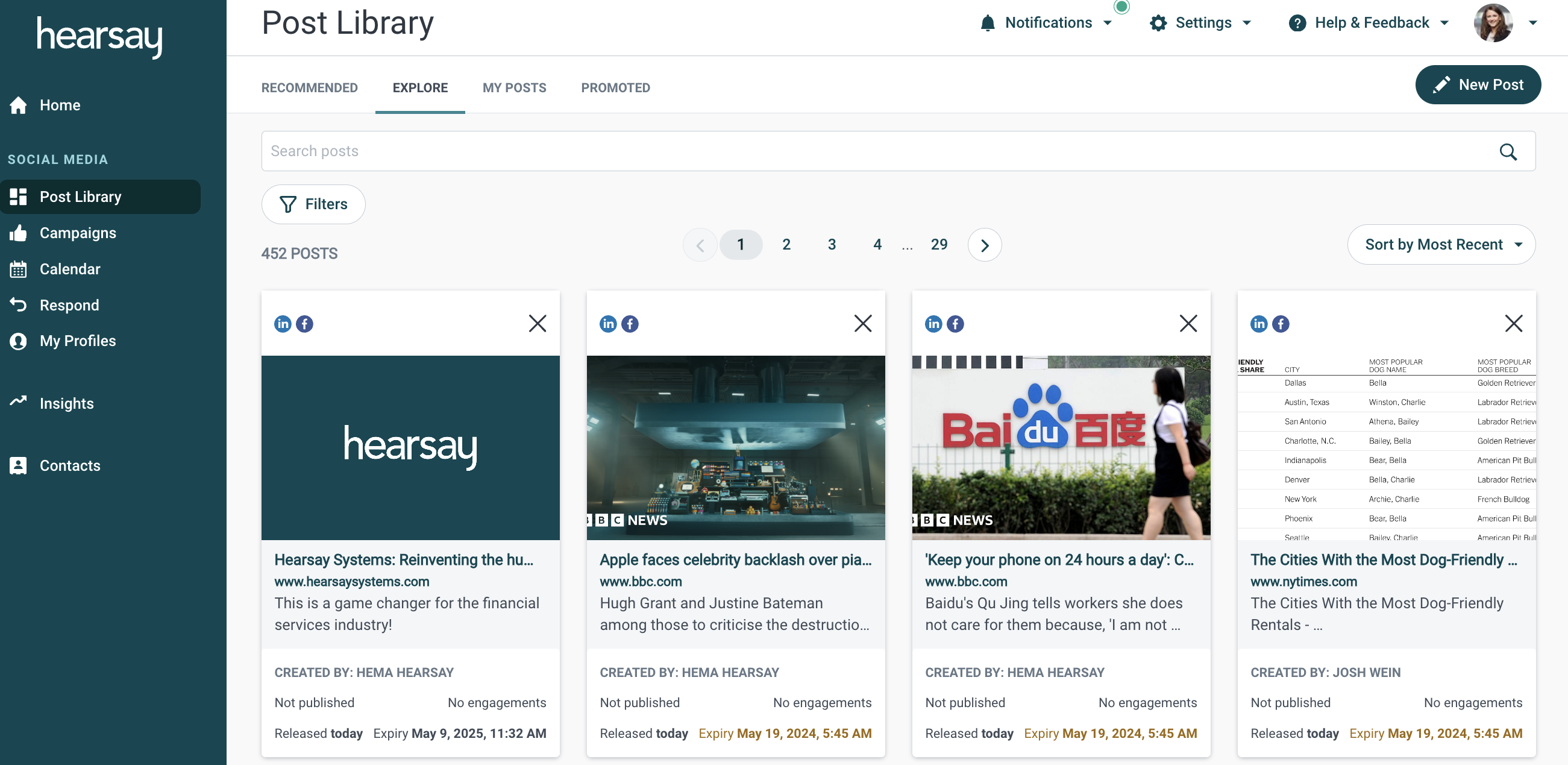
The result is easier to understand as a sequence than as a list of features. A firm supplies content and policy. An advisor chooses or adapts a post, or sends a client a text from an approved number. Hearsay records the interaction, applies the firm’s supervision rules and can sync activity with customer relationship software. Compliance staff see the items that need attention; managers see whether their distributed teams are actually using the tools. The consumer sees an advisor who remembers to reply.
One conversation / four desks
That is Hearsay’s real distinction from a general social media scheduler. A scheduler can publish a post. An archive can preserve one. Hearsay’s pitch is to connect the field worker’s daily actions to central content, review and client records. It is a specialised enterprise product for firms whose thousands of representatives cannot simply be told to stay off the internet. In that market it overlaps with social management platforms, archiving vendors and compliant messaging services, but its center of gravity is the working advisor.
“The next decade for Hearsay requires a different leader than the last.”Clara Shih, announcing Mike Boese as CEO in 2020
What failed first: the queue
Scale has a way of making a neat policy look untidy. Hearsay’s own 2024 compliance study examined more than 36 million activities across social media, texts and websites. Some 8 million items were routed for review by 1,371 compliance administrators. The striking observation was not simply that reviewers had too much to do. Turnaround times were improving while low-urgency work accumulated. If a team clears urgent items faster and leaves other material untouched, its average speed can flatter the underlying process.
This is the kind of problem that makes a product more than a convenient interface. Hearsay proposed differentiated review: apply policy according to a communication’s context and risk, then spend human attention where it does the most good. Its study found that some keywords tied to investment advertising were more useful at surfacing problems than routine LinkedIn connection language. The lesson is quite portable. Counting reviews is not the same as finding risk. A firm copying Hearsay’s approach would map its channels, classify the messages that actually matter, and keep testing whether its flags find anything worth a person’s time.
The client’s language, the firm’s memory
Hearsay sold this combination to banks, insurers, wealth managers and asset managers. Publicly named customers include BlackRock, Charles Schwab, New York Life, Morgan Stanley, Allstate, Ameriprise and Prudential. These are not businesses short of software. They are businesses with large field organisations, expensive client relationships and very little appetite for an unrecorded sales promise. Hearsay’s enterprise subscription model puts the institution in charge of providing accounts and controls to its agents and advisors; even its mobile app requires an account from the user’s organisation.

A 2020 alliance with Salesforce sharpened the idea. If a firm’s CRM already holds client history, the advisor’s text or call should not become a separate, invisible diary. Salesforce Ventures made a minority investment and the companies built integrations to move contacts and activity between systems. The ambition was not to automate friendship. It was to remove the tedious copying that makes the official record fall behind the actual conversation.
By June 2024, when Yext announced its deal for Hearsay, the company said its tools supported about 260,000 advisors and agents. The announced cash price was $125 million, with additional contingent and employee-related terms. Yext later reported $180.4 million in acquisition-date accounting consideration. Those numbers describe different parts of the transaction, so the clean headline price tells only part of the story. Yext completed the purchase on August 1, 2024.
Why Yext wanted the last mile
Yext was already in the business of helping brands manage digital presence: listings, pages, search and reviews. Hearsay supplied what happens after someone finds an advisor - the social presence, the message, the call and the governed follow-up. The combination is an understandable one. A correct local listing is useful. A reply from an actual human is what turns discovery into a relationship. Yext now offers Hearsay Social within its social products and Hearsay Relate as a compliant texting and voice service. In February 2026 it added a workflow for advisor review responses through Hearsay Compliance.
There is a boundary to the model. It makes the most sense when a company has many local representatives, substantial oversight duties and enough conversation volume to justify central tools. A small practice with one person and a modest message load has different economics. A business with little regulatory supervision may not need this much machinery. And software cannot make a poor reply wise or a generic post interesting. It can, however, make the ordinary good reply possible within an organisation that must remember it.
That is the copyable idea in Hearsay’s history. Start with the conversation the customer already wants to have. Put the controls in the path of that conversation, where they are easier to use than to dodge. Then measure the work that reaches the reviewer, not merely the volume the system processes. In a field that often treats compliance as the end of a conversation, Hearsay made it part of the way one begins.