At summer camp outside Yosemite, a newly arrived teenager found an old language waiting for her. Chess required no small talk, no polished American idiom, no knack for fitting in. A boy challenged Kira Makagon to a game. She beat him. Then she beat his friend. Soon the awkward opening days of camp had turned into friendship, one square at a time.
It is almost too tidy an origin story for a technology executive, except that Makagon has been telling versions of it for years. Competitive chess, she says, taught her to think ahead, prepare moves well before making them and keep an interruption from ruining her focus. Her career reads like a long demonstration of the lesson. She has moved through database software, customer relationship management, advertising data, cloud communications and artificial intelligence. The pieces changed. The discipline held.
Today Makagon is president and chief operating officer of RingCentral. The remit is broad enough to make a tidy organization chart blush: product and technology, direct and channel sales, customer success, marketing and operations. She took the role in February 2025 after more than a decade inside the company, having helped take it from the years before its public listing to more than $2.4 billion in annual recurring revenue.
An education in belonging
Makagon was born in Odesa, then part of the Soviet Union, the only child of Ukrainian Jewish parents. The family landed in San Francisco when she was a teenager. Her parents supplied a useful gift: they treated ability as more important than gender. They gave her Legos, chess and logic problems. Piano practice lasted two hours a day. Sport was not prescribed by convention. She liked speed skating, then ice hockey, so that was what she played.
When somebody said she skated fast “for a girl,” she replied that she skated faster than all the boys. The answer is funny because it is so exact. A lazy qualifier had been offered; she returned a measurement.
That confidence travelled well. At the University of California, Berkeley, she studied computer science at a time when few women did. Later, while working full time at Scopus Technology and raising a son as a single mother, she attended the Haas School of Business at night. She has recalled worrying about leaving work for a family obligation. Senior colleagues coached her through it, providing a model she would later copy as a mentor.
“I played competitive chess as a kid. It forces you to think ahead and strategize your moves well in advance.”Kira Makagon
Startups as a curriculum
Her first employer was Ingres, the database company founded by Berkeley professors. She was its youngest employee. From there came Scopus Technology, where she helped bring successive generations of customer relationship management software to market. CRM was an unusually good school for a future communications executive. It put software at the messy frontier between a company and the people it hoped to keep.
Makagon then co-founded Octane Software, serving in product and technology leadership and on its board. E.piphany acquired Octane in 2000 in a deal valued at $3.2 billion. Executive roles at Exigen Group followed, spanning ventures, alliances, marketing and business development. Then came NebuAd, an online data and media business she co-founded and ran as president and chief executive.
In 2009, she founded Red Aril, a real-time audience and media optimization company. Hearst acquired it in 2011, and Makagon spent the first half of 2012 leading products at Hearst-owned iCrossing. By August, she had joined RingCentral.
Scopus turns customer relationships into a software category.
E.piphany acquires Octane Software, which Makagon co-founded.
Hearst acquires her audience-data startup Red Aril.
She joins pre-IPO RingCentral to lead innovation.
RingCentral launches its proprietary video meeting product.
Makagon becomes president and chief operating officer.
The startup years made her fluent in more than one corporate dialect. Engineering must speak to product. Product must listen to customers. Marketing has to explain why the thing matters without smothering it in perfume. Operations must make the promise repeatable. Her later career at RingCentral would gather all of those functions under one roof, and eventually under her office.
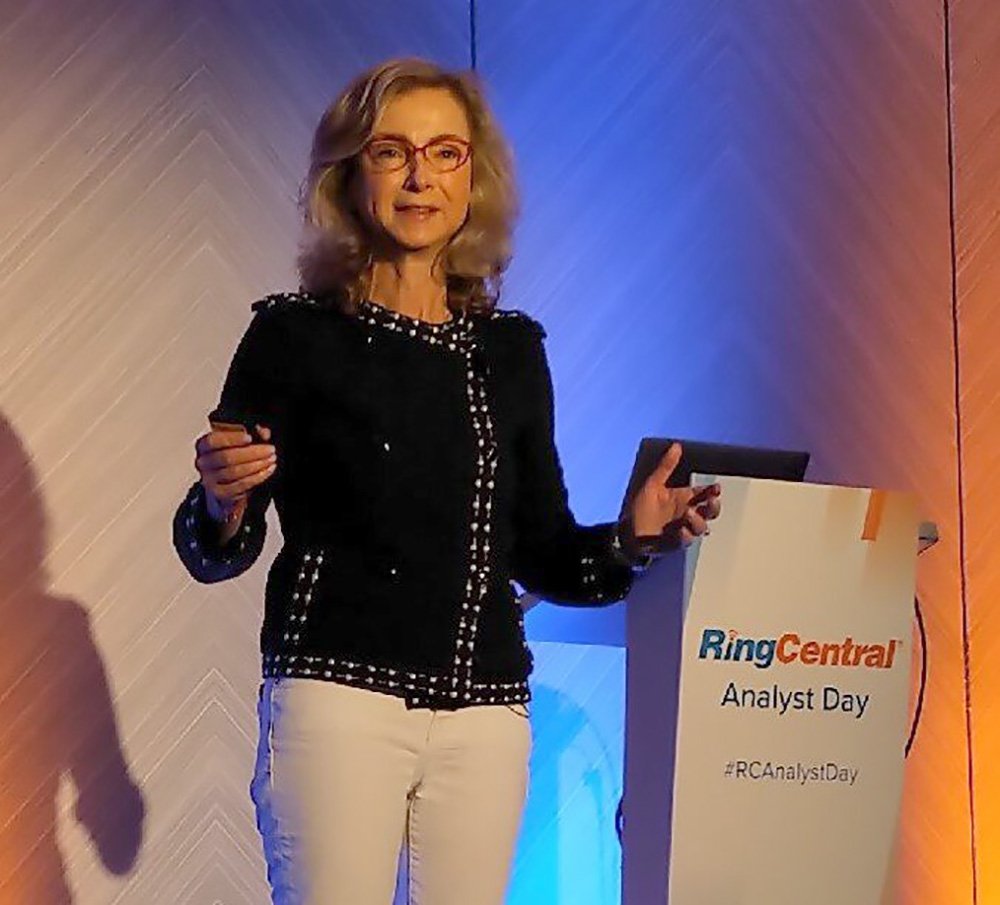
The product has to survive contact with Monday
At RingCentral, Makagon helped define a multi-product portfolio around a simple idea: business communication should travel with the worker, rather than imprison the worker beside a particular desk phone. She led its mobile-first cloud phone system, pushed an open platform that let customers fit communications into their own workflows and oversaw acquisitions that filled out messaging, video and phone.
The timing of RingCentral Video was memorable. The company's proprietary meeting service made its first release in April 2020, just as offices everywhere discovered that a video call could be both a lifeline and a peculiar form of fatigue. Makagon later declined the easy hero's share of the credit. “The credit goes to the team,” she said in a podcast interview. Her management language has the same bias. She says she tries to motivate without fear, giving people a reason to excel, focus on customers and take pride in a durable product.
That preference for usefulness over spectacle is important now. RingCentral's current pitch is built around AI agents, conversation intelligence and a large reserve of voice data. To Makagon, the business call is no longer a vanishing event. It can become a summary, a next action, a piece of customer context or a signal that helps an employee. A customer should not have to repeat a story merely because a call moved from software to a person.
The conversation should leave something useful behind
The proposition contains real tension. Human conversation is valuable precisely because it carries nuance, and any system handling it must earn trust. Makagon's place in the debate is that of an operator, not a laboratory philosopher. She talks about AI in the language of outcomes: fewer missed calls, less routine work, better-informed agents and workflows that continue after people hang up.
A larger table, with better manners
There is another line running through Makagon's career. She knows what it feels like to be treated as the exception. Once, visiting executives ignored her during a meeting until one asked her to fetch coffee, apparently assuming that the only woman in the room could not be a stakeholder. The anecdote belongs to an uglier corporate era, though not one so ancient that it can be displayed safely behind museum glass.
Her response has been structural. She speaks and writes about unconscious bias, recruits women into technical roles and mentors them inside and outside her company. She argues that women need to see a credible path from where they sit to the top. Representation, in this view, is not office decoration. It changes who gets heard, who gets promoted and what a company notices about its customers.
Makagon serves on the board of Calix, where her experience spans product, global platforms and cybersecurity, and on the board of the American Technion Society. She lectures at Berkeley and advises entrepreneurs and early-stage companies. Awards have accumulated: San Francisco Business Times recognition, a Women World Award, a Stevie for innovation and an Aragon Research award for operations. The more revealing detail is what she says she looks for in a candidate: clarity of thought and communication, energy, and honesty about skills and experience.
“It is a personal mission of mine to mentor women, both inside of my company and outside of it, as I have been mentored.”Kira Makagon
The next square
In 2026, Makagon's public writing has concentrated on agentic voice AI and the meeting point between customer experience and employee experience. The premise is that an AI system should participate in work, not merely produce a clever paragraph on demand. It should answer, route, remember, summarize and act, while leaving humans better equipped for the judgments that remain theirs.
This is a natural destination for someone who began with databases, moved through CRM, built audience-data businesses and spent years connecting phone, video and messaging. Each chapter concerned the same unruly raw material: people trying to understand one another through software.
Off the clock, Makagon swims, skis and takes long walks with her husband. The hobbies have the clean logic of her childhood pursuits: rhythm, endurance, forward motion. Her professional life has been less serene, full of acquisitions, launches and categories that changed their names just as everyone learned the old ones. Yet the strategy remains legible. Learn broadly. Get close to the customer. Give talented people room to care. Keep a few moves in reserve.
The girl at camp won the game and found her company. The executive now sits before a larger board, where voice is becoming data and software is learning to answer back. She still seems most interested in the move after the obvious one.
Continue reading