Raj Koneru has spent much of his working life helping large companies introduce new technology. His current ambition includes making some of that technology disappear from view. The menus, the forms, the procession of screens between a person and a simple request: these are the furniture he would like to rearrange. In his formulation, “no UI is the best UI.” For someone who once built a company around mobile applications, it is an intriguing next act.
The phrase describes a practical irritation. People can explain what they want in conversation, yet business software often requires them to learn its internal geography first. A request becomes a small expedition. Koneru founded Kore.ai in 2014 to bring conversational interaction into enterprise systems. The company has since moved toward AI agents that can carry out tasks across those systems. Asking is one part of the transaction. Finishing is the part that makes the transaction worthwhile.
There is an appealing tension here. Koneru wants the experience to feel simpler, while the machinery behind it grows more elaborate. Permissions, integrations, business rules and records of what happened all become more consequential when software can take action. His career makes that tension easier to understand. He has repeatedly worked at the meeting point between a new way of using computers and organizations that cannot afford to treat every day as an experiment.
“no UI is the best UI”
Raj Koneru
Before the phone, the business
Koneru received his master’s degree from the Birla Institute of Technology and Science, Pilani, in 1991. Two years later, he co-founded Intelligroup, where he served as CEO. Enterprise computing was already his territory. The business worked in IT services and consulting, and his later account of those years emphasizes SAP implementations for large organizations. It was an education in the less photogenic requirements of software: connecting systems, protecting information and getting a business to use what had been installed.
The sequence that followed includes SeraNova and the business process outsourcing company iTouchPoint. Intelligroup and SeraNova both reached Nasdaq; Intelligroup was later acquired by NTT DATA and SeraNova by Silverline. These were different businesses, but they gave Koneru repeated exposure to corporate buyers and the distance between a technical capability and a useful operation. A successful demonstration has an afternoon to impress people. An enterprise system has to turn up for work again tomorrow.
The point of this early career is more interesting than a list of exits. Koneru was learning how organizations absorb change. A new system brings its own vocabulary, but customers still need familiar assurances about responsibility, continuity and control. That experience would travel with him into mobile software. It also helps explain why his AI discussions so often return to the business around the technology, rather than the ingenuity of the technology alone.
- 1993Enterprise systemsIntelligroup co-founded
- 2007The mobile screenKony founded
- 2014The conversationKore.ai founded
Kony puts the enterprise in a pocket
In 2007, Koneru founded Kony. Smartphones were opening another route into the enterprise, and Kony supplied a platform for developing mobile applications. For a large company, reaching a customer on a phone involved more than reducing the dimensions of a website. The application still had to connect to the business behind it. Banking made the stakes especially clear: a pleasing screen was useful only if the transaction underneath it worked.
By June 2014, Kony had more than 350 customers in 45 countries, including 70 Fortune 500 companies. Those figures capture an important scale in Koneru’s story. He was building for organizations whose requirements crossed borders, devices and departments. Mobile software had to feel immediate to its user while accommodating the considerable weight of the institution providing it. The pocket was small. The enterprise remained its usual size.
Temenos acquired Kony in September 2019 for an enterprise value of $559 million. An additional $21 million earn-out formed part of the announced terms. By then, Kony’s digital banking business and application development platform had become part of a larger banking software proposition. Thomas E. Hogan was Kony’s chairman and CEO at the time of the deal. Koneru’s history there belongs to the founding and earlier leadership chapter; the acquisition was a later company milestone.
That distinction also keeps the chronology honest. Kore.ai had already begun five years before the Temenos acquisition. Koneru’s next venture was underway while Kony’s story continued. In retrospect, the two companies sit beside each other as successive attempts to improve the route between a customer and a business. The phone changed where that interaction happened. Conversation offered a different way to conduct it.
Enterprise value paid by Temenos.
Announced terms also included a $21 million earn-out.
A conversation that has somewhere to go
Kore.ai’s early work concerned automated interactions in messaging. It later expanded into voice, with enterprise connections spanning messaging services and other channels. In a 2022 discussion with Bret Kinsella, Koneru described a relationship between the Kony approach and the model he was pursuing at Kore.ai. There was another interface to serve, and another opportunity to provide the platform underneath it. Experience from mobile had found a new address.
The founding date matters. In 2014, Kore.ai was working on conversational technology years before ChatGPT brought generative AI into everyday public discussion. Its early foundations involved natural language processing and understanding. Large language models arrived later and changed what could be built on top. Reading the entire company history backward through today’s AI vocabulary would flatten a decade of work into a suspiciously tidy origin story.
In January 2024, Kore.ai announced a $150 million strategic growth investment led by FTV Capital, with NVIDIA and existing investors participating. Koneru subsequently discussed the financing on the floor of the New York Stock Exchange. It was a visible moment for a company selling something that usually does its work out of sight. The investment supported product development and expansion, as the market for enterprise AI became both more crowded and harder to predict.
Koneru’s answer has included giving customers choices about models and deployment. That is consistent with the buyers he has spent decades serving. A large organization already has systems, contracts and operating constraints. Its next software purchase has to live among them. A platform that makes room for those choices can be attractive, although flexibility also creates work: someone still has to make the pieces cooperate and account for the result.
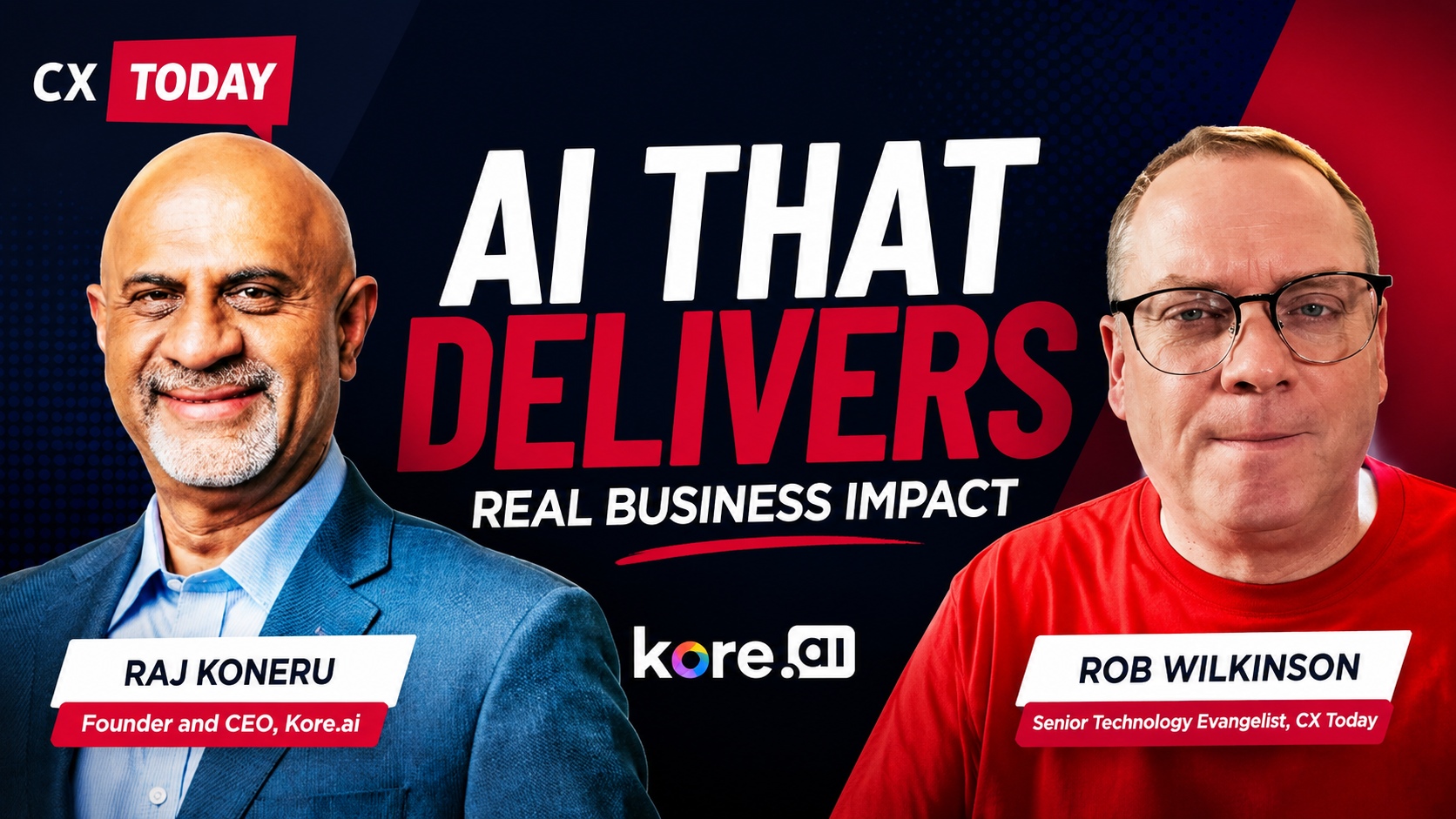 WATCH THE CONVERSATION ↗
The paperwork behind an intelligent agent
The next turn became concrete in May 2026, when Kore.ai launched the Artemis edition of its Agent Platform. The initial launch was on Microsoft Azure. Its components included Agent Blueprint Language, or ABL, for defining agents and workflows, and Arch, an AI architect for translating business objectives into those definitions. The proposition extended across building, governing and improving AI systems. The company was selling a way to manage their working lives.
Kore.ai calls another component its Dual-Brain Architecture: agentic reasoning combined with deterministic flows. Put plainly, some parts of a task benefit from flexible reasoning; other parts must follow explicit rules. The appeal is easy to see when an agent can change a business record. An imaginative answer and an authorized action require different kinds of confidence. A company needs to know what its software was allowed to do, and what it actually did.
This brings Koneru back to a familiar concern: the organization around the product. His recent argument for enterprise adoption puts ownership of outcomes near the center. Once AI is carrying out work, somebody must decide which work it owns, how its performance is reviewed and where a person intervenes. The office gains a new kind of worker and immediately acquires an old kind of management problem.
His October 2026 interview offers a small, telling story about that problem. A security executive, he recalled, discovered three separate lending agents during an audit. The teams involved did not know the others existed. It is an anecdote about software abundance becoming organizational confusion. Creating an agent can be quick; knowing what the whole company has created is a different undertaking. Koneru’s proposed balance gives teams room to build while sharing standards for access, policy and oversight.
Editorial schematic of the operating problem Koneru describes; not a product architecture diagram.
What he wants the next generation to build
Koneru’s public work also extends to the U.S.-India Strategic Partnership Forum, where he serves on the board. At the India AI Impact Summit in February 2026, he argued for developing India’s technical talent into builders of AI applications for global use. The emphasis fits his own professional geography: companies serving international enterprises, with substantial ties to India’s technology ecosystem. For him, the ambition reaches beyond adopting someone else’s software.
He has urged India to measure AI creation alongside consumption. The idea shifts attention toward what people make with the technology and whose problems they choose to solve. His examples include students, farmers and teachers, widening the imagined pool of builders beyond employees at technology companies. It is a useful extension of his interface argument. If explaining a goal becomes a workable way to create software, the identity of the person doing the creating can change too.
In a recent Coffee with a Founder conversation, he returned to questions that outlast a product cycle: choosing a clear message, concentrating effort and deciding whether going public is actually right for a company. Two Nasdaq listings give that last subject some personal weight. His career contains several different kinds of corporate ending, and he now leads a business whose products must keep changing as the underlying technology changes.
Koneru’s recurring project is making a new form of computing useful inside an existing business. The tools have moved from enterprise systems to phones to conversations and agents. Each transition offers a more direct route from intention to action, then introduces fresh questions about how to make it dependable. He wants the user to do less navigating. Behind that simpler request sits the work of a career: arranging things so that a company can safely say yes.
Continue the conversation
Interviews, writing and the companies along the way.