The most revealing moment in Netomi's history did not happen in a pitch meeting. It happened during a system upgrade at a large financial company. The support infrastructure failed. The experimental AI agent did not. It kept answering thousands of customers, quietly enough that many never noticed there was no person on the other side. For founder Puneet Mehta, the episode changed the argument. Artificial intelligence was no longer merely a cheaper way to reply. It was a way to keep the lights on.
A chatbot born before chatbots became fashionable
Netomi began in 2015 as msg.ai. Its first world was Facebook Messenger, conversational commerce and a Sony Pictures bot for the film Goosebumps. At Y Combinator's Winter 2016 demo day, the proposition sounded modest by present standards: one dashboard for managing bots across platforms, with sentiment, analytics and integrations into Zendesk and Salesforce.
The timing matters. The transformer paper had not appeared. There was no ChatGPT, no corporate scramble to appoint an AI council, and no reliable general model waiting behind an API. Mehta and his team stitched together intent detection, sentiment, retrieval and workflow models to create something that could carry context from one customer turn to the next. This was expensive in engineering hours and useful in one unexpected way: the company had to learn the unglamorous machinery around the model.
“Our goal was to orchestrate the many systems a human agent would normally juggle and do it safely at machine speed.”Puneet Mehta, founder and CEO
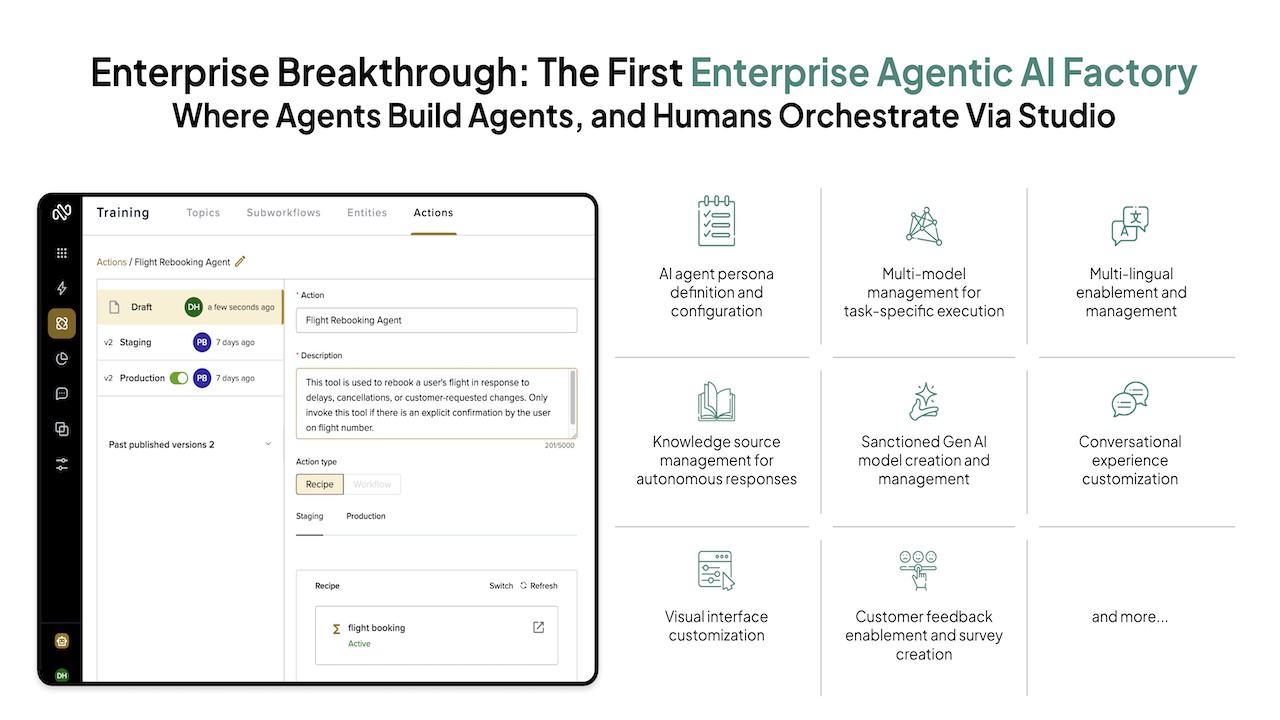
That machinery became the product. Netomi now sells an enterprise platform rather than a clever conversational widget. Autopilot handles eligible work without a person. Co-Pilot assists human agents. Agentic Studio lets business teams configure and test agents without writing the whole system from scratch. Agentic Insights monitors what happened. Underneath, Agentic OS coordinates models, knowledge, policies, tool calls and handoffs.
The answer is only the visible tip
Consider a traveler asking to move a flight. A basic bot finds an article. A useful agent may need to identify the traveler, check fare rules, read loyalty status, inspect seat inventory, calculate a price, request payment, alter the booking and explain the result. The sentence in the chat window is the smallest part of the job. Every action behind it can be stale, forbidden or costly.
Netomi's distinction is its insistence that uncertainty should reduce the model's freedom. Tool calls are checked against schemas. Brand and policy rules run inside the reasoning path. Sensitive data can be masked. If confidence drops below a threshold, the agent follows a known-safe response or sends the case to a person. In an industry enchanted by fluency, Netomi sells restraint.
Those figures come from a production account of DraftKings traffic, where a major event can turn ordinary support volume into a stampede. Similar logic applies when weather cancels flights, open enrollment jams an insurer, or a streaming service releases the weekend's irresistible show. Paramount put Netomi into chat and voice for Paramount+ in two weeks, then faced a weekend when the app climbed to number one in the US App Store. The sales demo had become a queue-management problem with millions of impatient judges.
Who pays, and what does it cost?
Netomi's named customers explain its market better than a category label: United and Delta in aviation; MetLife in insurance; DraftKings and the NBA in sports; Paramount in media; MGM Resorts and Virgin Voyages in hospitality. These are businesses with enormous support volume, multiple legacy systems, reputational risk and sudden peaks. They do not need a charming FAQ bot. They need software that can stay dull under pressure.
Netomi uses custom enterprise contracts. The real bill is likely a combination of software, interaction volume, channels, integrations, implementation and continuing governance. A no-code studio does not make a fragmented back office disappear.
The business model is enterprise SaaS with implementation wrapped around it. The 2026 financing sharpened that model. Accenture Ventures led a $110 million Series C, while Adobe Ventures, WndrCo, Silver Lake Waterman, NAVER Ventures, Metis Strategy and Fin Capital participated. Accenture also became a deployment partner. Adobe brings the digital-experience layer. The round was capital, certainly, but also distribution: two large doors into companies that prefer a familiar escort.
What failed first
The earliest failure was the category's original promise. Scripted bots were brittle. They misunderstood language, lost context and trapped customers in menus disguised as conversation. Generative models repaired the prose but created a new problem: a confident sentence could now be beautifully wrong. Netomi's response was not to trust the model more. It was to surround the model with tests, observability, policy checks and circuit breakers.
Bias forced another reconsideration. Mehta has described early systems treating some language patterns differently. The company expanded training data, added real-time monitoring and widened cross-functional review. The lesson is neither romantic nor complete. Bias does not vanish after a workshop. It becomes maintenance - a recurring cost of operating software that speaks for a brand.
The part worth copying
A company does not need Netomi's funding or client list to borrow its most practical habits. It does need discipline.
- Start with repetition. Choose high-volume, low-to-medium-risk requests with clear definitions of success.
- Connect authority. Let the agent consult the real order, policy or account system instead of composing from memory.
- Test the mess. Replay historical transcripts, incomplete data and angry phrasing before exposing a workflow to customers.
- Set retreat rules. Define confidence, cost, latency and policy thresholds that force a safe fallback or human handoff.
- Measure outcomes. Track resolved work, correction rates, repeat contacts and customer effort, not the number of generated messages.
This approach will not suit everyone. A small support desk with a few hundred monthly tickets may never recover the integration cost. A company with contradictory policies, scattered knowledge and no owner for escalation will simply automate its confusion. Highly novel, emotional or consequential cases still demand people. The platform also competes in a crowded field: Sierra and Decagon sell AI agents; Ada and Forethought automate support; Intercom, Zendesk and Salesforce increasingly bundle their own AI; Cognigy, Kore.ai and LivePerson arrive from the broader contact-center market.
Complex, high-volume enterprises that need autonomous execution, integrations, auditability and control across several channels.
Low-volume teams, weak knowledge bases, unstable policies, tiny integration budgets or work where almost every case is exceptional.
From answering to noticing
Netomi's next wager is that customer service will move upstream. Instead of waiting for a traveler to ask about a cancelled flight, an agent notices the disruption, reads the traveler's circumstances and offers the right next action. Instead of explaining a late shipment, it intervenes before disappointment becomes a ticket. This is the promised shift from reactive to proactive and eventually preemptive service.
It is also where the risk grows. An agent that answers incorrectly wastes a minute. An agent that acts incorrectly can move money, alter a booking or violate a policy. The company that began by making bots more talkative has therefore arrived at a rather Wildean conclusion: intelligence is admirable, but discretion is the better dinner guest. Netomi's future depends on proving that software can possess both.