Pehong Chen was thinking about the inconvenience of information before the internet made inconvenience available around the clock. In 1988, his Berkeley doctoral dissertation examined a problem familiar to anyone who has wrestled with a document: the difference between the instructions underneath it and the thing you actually see. He wanted those representations to cooperate. A person should be able to work with a document without spending the afternoon refereeing a dispute between its parts.
It is an unexpectedly useful beginning for a business biography. Later came multimedia tools, personalized websites, and software for colleagues trying to work together. Read backward from those products, and the dissertation looks like an early appearance of a recurring interest: how to make complicated information manageable for the person in front of the screen. His graduate research and later products approached information from several directions, through editing tools, business transactions, and the conversations that accompany everyday work.
Born in Taiwan in 1957, Chen studied computer science at National Taiwan University, earned a master’s at Indiana University, and completed his doctorate at the University of California, Berkeley. His doctoral adviser was Michael A. Harrison. The dissertation’s case study, VORTEX, joined visual editing with the underlying document language. Even the name had an engineer’s fondness for making an acronym do rather a lot of work.
Two ways to work.
The first company had pictures. The next had customers.
Chen and Harrison co-founded Gain Technology, a supplier of multimedia software tools. Sybase acquired the company in 1992, and Chen became its vice president of multimedia technology. The progression put him at the meeting point of technical research and commercial software: building ways for businesses to handle more than one kind of information. Before online shopping entered his biography, there was already a company, a product, and an acquisition.
In 1993 he founded BroadVision. The business went public in 1996. Its early proposition was personalized commerce: software that could respond to the person using a website. At a time when many businesses were learning how to put a shop online, Chen was interested in what happened after a visitor arrived. A digital shopkeeper ought to have some idea of whom it was serving. Otherwise, the celebrated new medium risked becoming a catalogue with a power cable.
The thinking drew on the one-to-one marketing work of Don Peppers and Martha Rogers. Personalization required knowing something useful about the visitor and having permission to use it. BroadVision’s later writing on trusted online relationships returned to the tension between those requirements. Enough information could improve an experience; collecting it could also strain the trust that made the relationship possible. The practical difficulty was present long before the vocabulary became fashionable.
Commerce with an organizational chart
Chen’s idea of an online business extended beyond a checkout button. In a March 2000 interview, he described customers, employees, suppliers, distributors, and dealers as different groups with different needs. Some needed knowledge; others needed access to a transaction. Personalization supplied a common approach. The interview’s language wore the period’s enthusiastic collection of electronic prefixes, but the business problem underneath was quite ordinary: give people what they need without asking them to navigate the whole company.
He also argued for implementations delivered in bounded cycles, suggesting roughly 100 days so a company could learn and improve. That advice had a refreshing lack of ceremony. Buying software did not confer experience. Using it did. The enterprise might require an overall strategy, but an actual piece of working software would tell it something a committee could discuss indefinitely.
BroadVision’s rise coincided with the dot-com boom. The subsequent contraction became part of its history, too. By 2010, the company was pursuing a new emphasis in enterprise social networking. A founder’s biography is easily flattened into the date of an initial public offering; Chen’s continued through the less photogenic business of changing direction. A stock-market entrance takes a day. Operating a company through changing markets occupies the calendar much more thoroughly.
The conversation was becoming the product
Clearvale gave businesses a platform for their own social networks. Discussing it in 2010, Chen described a project that had begun as an internal experimental effort in China. He emphasized easy setup, with the aim of letting a department begin without an elaborate installation exercise. The people expected to use a collaboration tool already had work to do. Making them undertake a second profession in software administration was an awkward opening offer.
In a 2012 interview before a talk in Moscow, Chen explained his interest in applying the thinking behind social networks to business. He also spoke about the conditions that help innovation: strong universities, talented people, financing, and the professional infrastructure around a company. The list was broader than technology alone. Software could connect participants, but an entrepreneurial environment also needed people willing and equipped to help one another.
By 2015, Vmoso brought five activities into one application: email, instant messaging, content sharing, workflow, and social networking. At a London event, Chen linked communication and collaboration with what he called Big Knowledge. “This has been a passionate focus throughout my academic and professional career,” he said. The attraction is recognizable to anyone who has found the right message after the decision it might have improved. A conversation becomes more valuable when its context remains attached.
“The only way to gain experience in e-business is to learn from actually doing it.”Pehong Chen, on implementing business software, 2000
Two brothers, rather different homework
Alongside the software career runs a family story about physics. Chen’s older brother, Pisin, went to study in the United States and sent physics problems back to him in Taiwan. Pehong ultimately chose computer science. The attempted recruitment did, however, leave an affection for fundamental research. “He was very inspirational when I was growing up,” Chen recalled. An older sibling can apparently set homework across an ocean and still receive a generous review years later.
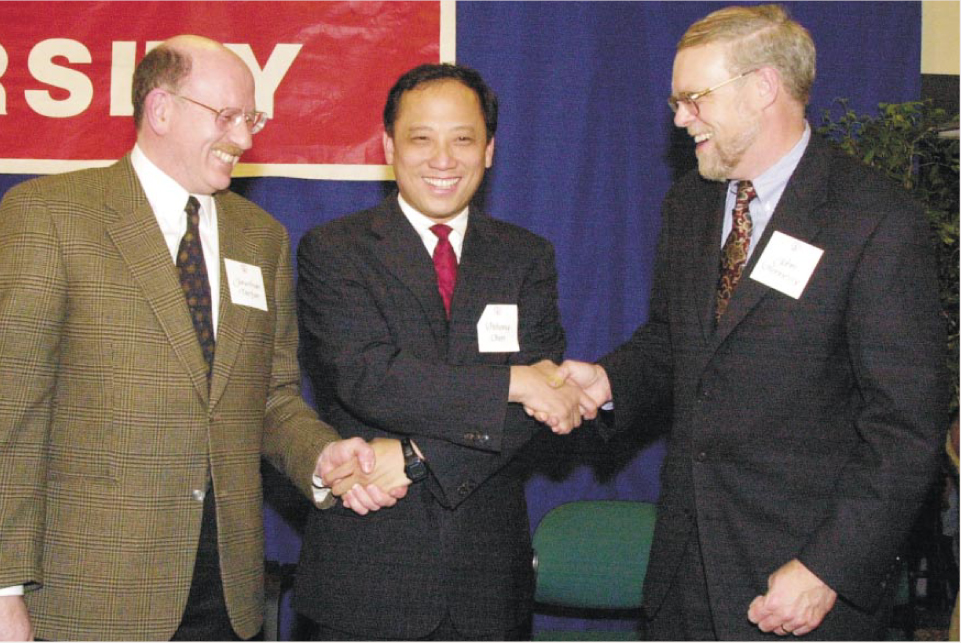
In 2001, Pehong and his wife, Adele, pledged $15 million toward a Stanford institute joining particle physics, astrophysics, and cosmology. The announcement photograph shows him between SLAC director Jonathan Dorfan and Stanford president John Hennessy, managing a handshake in each direction. For someone whose professional interests included connecting people, it is an agreeably literal image.
The plan changed after the technology downturn affected the original gift. In 2003, Fred Kavli’s support helped establish the Kavli Institute for Particle Astrophysics and Cosmology; the Chens’ pledge went toward naming and endowing its directorship. Roger Blandford became its first holder. The distinction gives the story its proper shape. An early announcement was followed by revised arrangements, additional backing, and a particular academic role that carried the Chens’ names.
A university is part of the machinery
At Berkeley, the Chens supported the proposed Center for Information Technology Research in the Interest of Society, or CITRIS. The university recorded their $20 million gift among major contributions associated with the initiative. Chen singled out the proposal’s interdisciplinary character. Researchers would have opportunities to cross the boundaries that academic departments, like corporate departments, can otherwise make rather comfortable.
“I am particularly impressed by the strong interdisciplinary nature of this initiative,” he said in December 2000. That attraction sits neatly beside his commercial work, although a university research program and a software product have very different obligations. Each depends on making useful encounters possible. A campus offers a version of the same persistent challenge: how do people with different expertise discover what they could do together?
Chen’s involvement with institutions also extends beyond a donation announcement. He served as vice chairman of the Committee of 100 from 2006 to 2010. His career includes advisory work for Berkeley’s College of Engineering, alongside company board service. These are separate forms of participation, with different purposes. Together they make his professional life harder to fit into the familiar portrait of a founder perpetually standing next to his own product.
The Chens’ gift recorded by Berkeley for CITRIS.University gift listing, 2001
After BroadVision, a broader brief
Aurea completed its acquisition of BroadVision in May 2020. The buyer emphasized document creation, management, and collaboration, bringing the account back to territory that would have been familiar to the young researcher working on documents at Berkeley. Chen’s leadership of BroadVision, Inc. ran from 1993 to 2020. His present title belongs to BroadVision Group, where he is founder and chairman.
The group funds, incubates, and operates technology ventures, including businesses in artificial intelligence, cloud technology, financial technology, and clean technology. Chen also remains an independent director of Weibo, a role he has held since January 2016 after serving on SINA’s board from 1999 to 2015. The work now takes several forms: capital, governance, and the practical experience accumulated from running companies.
His longer record of backing other founders includes Siebel Systems, NetIQ, UpWork, and C3.ai. It is a useful reminder that a company founder can participate in enterprises without putting his name above every door. The 2026 conference program in Taiwan listed him for a talk titled The Top Five AI Commandments. The subject had moved with the industry; the willingness to address an audience had plainly survived the move.
Across these chapters, Chen keeps appearing where information has to become usable: on a document, in a storefront, between colleagues, or among researchers with different tools. The products and institutions each deserve their own accounting. Together, they offer a portrait of a computer scientist whose work repeatedly brought him back to people. Technology can supply an impressive number of connections. Making those connections useful remains a perfectly demanding occupation.