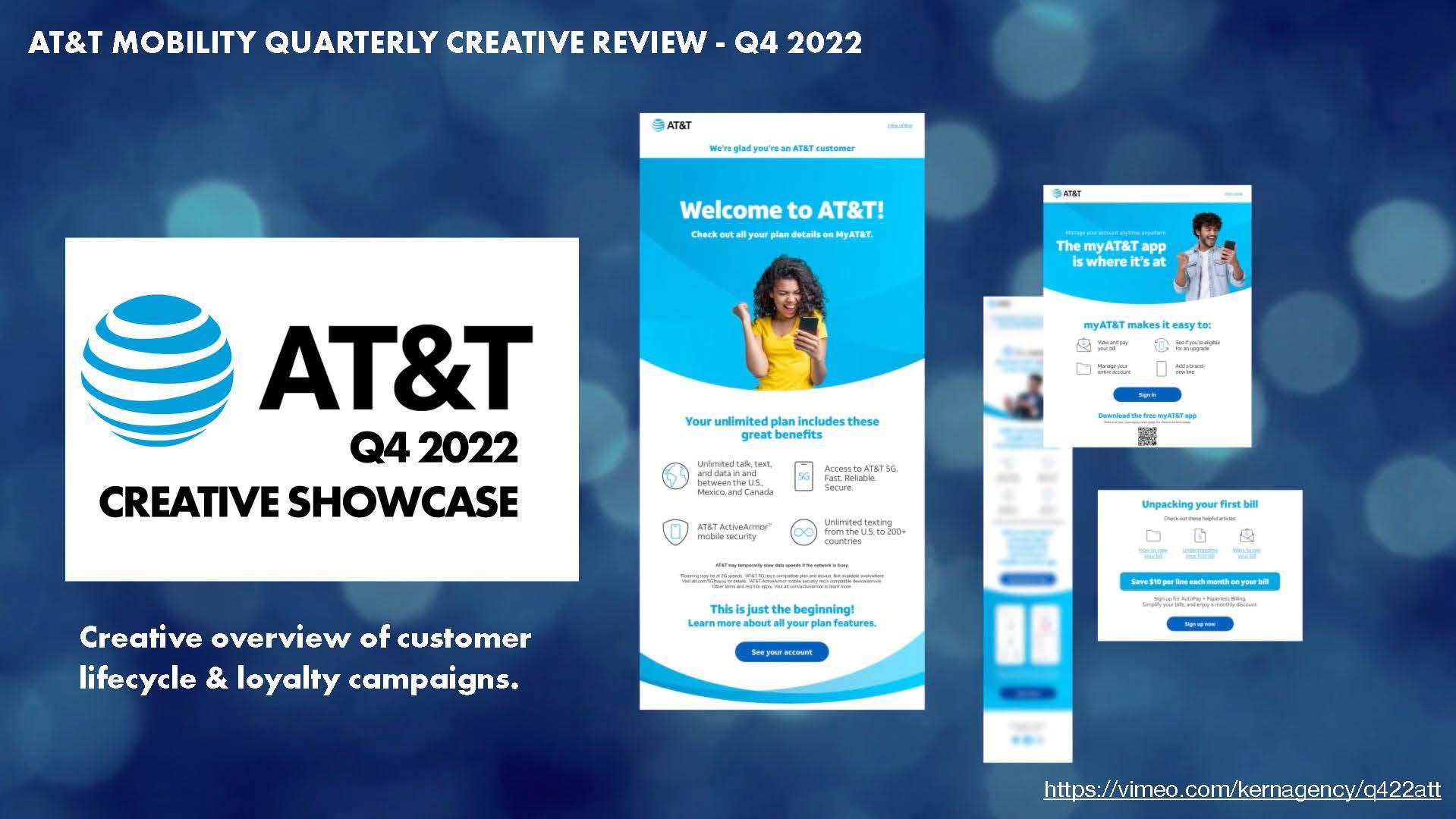
The interesting thing about an AT&T welcome email is how little it resembles an advertisement. There is a greeting, a guide to the account, perhaps an explanation of the first bill. Nothing to stop traffic. Yet this is precisely where KERN’s story becomes interesting: after somebody has already said yes. The Los Angeles agency built much of its business around what a company should say next.
- KERN connected customer data, creative work and delivery across email, direct mail and digital experiences.
- Its work included AT&T customer journeys, healthcare acquisition and enterprise lead nurturing.
- KERN’s LinkedIn now identifies the agency as part of RAPP; its old website redirects there.
A customer is not a finished sale
Consider the assignment that followed AT&T’s acquisition of DIRECTV. KERN’s account describes an expansion of nearly 20 million customers and a need to reconstruct the journey across the combined brands. Getting bigger had created a communications problem. Different relationships now had to make sense inside one ecosystem.
KERN analyzed customer records and millions of interactions, added contextual consumer data, and formed audiences that could be acted upon. It looked for moments when a message might create value or when a relationship was vulnerable. Then it built a flexible design system and used marketing automation to deliver variations. The agency reported improvements in engagement, recommendation scores and incremental revenue.
The useful detail is the sequence. Analysis came before the message; the design system made repeated delivery possible. A customer journey, in this account, was something the agency could build and operate. The welcome email was one visible piece of a much larger machine.
The direct-mail habit that survived the envelope
KERN described its approach as “Continuous Revenue Marketing,” giving CRM an unusually commercial expansion. Acquisition, experience and loyalty belonged in one conversation. Its agency presentation paired neuroscience and consumer insight with tracking, testing and revision. The appealing part is less the terminology than the refusal to treat the first conversion as the end of the job.
Its services covered strategy, creative development, content production, experience design, direct mail, performance marketing, automation and analytics. This was an agency selling expertise and execution to businesses. Clients needed people to connect systems, audiences and messages, then keep improving the work.
The portfolio shows the range: Citi tips videos and a headquarters retail experience; Discover student loans; AT&T loyalty. KERN occupied the space between a brand agency’s promise and the operational work of customer communications. An in-house CRM team or another direct marketing agency could address the same brief. KERN’s pitch was to keep those disciplines together.
- 01UnderstandData + human context
- 02DesignAudience + next action
- 03DeliverCreative + automation
- 04ReviseTrack + test + learn
Editorial synthesis of the agency’s published method.
A 2018 CRM conference biography makes the complexity easier to picture. Camilla Grozian-Lorentzen, then senior vice president of client services, was managing integrated direct and digital campaigns for 18 DIRECTV divisions. Her work included personalized email and direct mail across acquisition and retention. Eighteen divisions means many chances for a customer to receive an awkwardly timed message. It also helps explain why the agency cared about coordination. Writing a persuasive sentence was one task; making it arrive as part of a coherent relationship was another.
Seventeen percent, delivered by mail
Healthcare made that combination especially concrete. KERN Health worked with organizations including Humana, Kaiser Permanente, Merck and Dignity Health, with a particular focus on Medicare member acquisition. Chief Marketer’s 2020 directory reported that a Tufts Health Plan direct mail campaign, including branding and creative development, increased qualified leads by 17 percent.
Qualified leads for Tufts Health Plan.
Reported campaign result, Chief Marketer 200, 2020.
Qualified matters. A larger pile of inquiries is useful only if those people can become customers. The number captures KERN’s preference for a measurable response. It is one campaign’s reported outcome, rather than a forecast for the next client.
In B2B, patience mattered too. A 2015 industry listing described KERN building an educational microsite and lead nurturing operation for Merck’s weight loss offering to healthcare professionals. The work went live within four months of approval. Education, follow-up and measurement were part of the assignment.
The founder needed a system, too
Russell Kern’s early financing was wonderfully unglamorous. In a 2006 interview, he recalled starting an agency with his former high school principal, an office, two computers and a secretary. He put the initial $5,000 to $10,000 on credit cards. The founders initially took no salary. Early openings with Microsoft, Lotus and First Interstate Bank helped establish the business.
By then, Kern was describing the operation in manufacturing terms: procedures, benchmarks and continuous improvement. That language fits a business where a good idea must survive many versions, approvals and deliveries. Omnicom’s Diversified Agency Services acquired the organization in February 2008, placing it under Rapp Collins Worldwide.

Years later, on the Human Side Up podcast, Kern explained the difficulty behind the expansion. At roughly 50 to 75 people, he said, growth kept stalling. A former competitor offered mentorship. Over five years, Kern learned operating procedures, human resources practices and leadership skills he had previously lacked.
“I didn’t know what standard operating procedures were.”Russell Kern, Human Side Up, November 2025
He credits that coaching with helping him learn to scale. Selling work and creating work had taken him a considerable distance. Managing an organization required another education. That admission makes the process language more interesting: it was learned through a bottleneck.
Start with one useful next step
The practical lesson is to choose a relationship worth improving before choosing another channel. For a marketer borrowing this approach, that might mean making a first bill understandable, helping a prospect evaluate an unfamiliar product, or timing a message around an existing customer’s needs. Define the desired response, connect it to an audience, and test the communication.
This approach depends on usable customer data, coordinated delivery and an outcome that can be measured. More message variants cannot compensate for a confused offer. KERN’s current public identity points to RAPP, but its documented work leaves a useful question for any marketing team: once you have the customer’s attention, have you earned the next conversation?