The borrower had filled out the form. The advertising platform counted a conversion. Somewhere, a dashboard had another reason to look healthy. But for Kiavi, a lender to real estate investors, one detail could make that inquiry unsuitable for the product being advertised: the borrower owned fewer than five properties.
Kiavi’s Portfolio Loan required five or more. Most inquiries fell short. Here was the peculiar problem: a campaign could improve at producing the very thing the business needed less of. Level Agency’s work with Kiavi offers a useful entrance into a company whose real subject is the distance between a marketing number and a business result.
- Level combines media, creative, analytics, search, and customer relationship marketing.
- Its sweet spot is the complicated purchase: education, finance, B2B, and other considered decisions.
- The useful lesson: tell advertising systems which outcomes deserve more weight.
A checkbox changes the assignment
Level and Kiavi traced the path from advertising click to inquiry. The platforms were learning from total submissions, treating investors with one to four properties as successes alongside eligible portfolio borrowers. Those smaller investors could suit other Kiavi products. The campaign’s reward system simply failed to reflect this product’s requirements.
The teams made the five-property threshold a separate conversion event, gave qualifying submissions greater value, and adjusted messages toward experienced investors. Level reports that qualified lead volume rose more than 950% while cost per qualified lead fell 90%. By June in the reported campaign period, nearly 77% of leads met the threshold, compared with 15% previously.
The expense had been several thousand dollars per qualified lead; afterward, Level describes hundreds. These are acquisition costs, not a price list for hiring the agency. The distinction matters. Better qualification can improve spending efficiency without telling us anything about the agency’s fee or whether a client’s total budget changed.
Built for the purchase that takes a while
Level’s market makes this problem especially relevant. A person choosing a career school, a company evaluating software, or an investor arranging financing rarely travels straight from advertisement to purchase. There are questions, delays, comparisons, and conversations. An inexpensive inquiry may be a poor guide to what happens at the end.
The agency sells the expertise to manage that journey: media planning and buying, content and creative, websites, search optimization, analytics, and automated follow-up. Its nurturing practice builds messaging around the customer’s stage in the decision, then uses platforms such as Salesforce and HubSpot to deliver it. The offering is an ongoing working relationship with a client’s team, supported by tools.
That places Level among integrated performance marketing agencies, competing for work that could also go to an internal team or several specialist shops. Its argument for keeping the work together is practical: the people writing the advertisement should understand what the people analyzing customer quality have learned. Coordination becomes part of the service.
Applications beat applause
Aviation Institute of Maintenance presented a related challenge across its 15-campus network. Google Ads generated leads, but application conversion varied with intent and quality. Level’s response used its proprietary Signal V2 model, trained on historical enrollment data, to estimate which prospects were likely to apply.
Those estimates became conversion values inside Google Ads. The teams validated the approach across the application funnel before scaling it. Level’s case study reports a 40% increase in the lead-to-application conversion rate, 26% more applications, and a 26% reduction in cost per application.
“We are now prioritizing the prospects most likely to become successful students.”
Joanna Lawner
Director of Performance Marketing, AIM
The change in thinking is straightforward: a form submission and an application carry different information. The agency’s job included bringing that information back into the buying decision. The percentages are client-case results reported by Level, useful for understanding the mechanism rather than predicting every school’s return.
Three deals, a longer customer journey
Level’s own development follows a similar widening of perspective. Thomas Donohoe founded the agency in 2010. Patrick Patterson joined in 2012, then bought the business with Patrick Van Gorder in 2021. Private equity firm Dubin Clark dates its investment to September 2022. Acquisitions followed.
Becker Media added higher education expertise. WebMechanix expanded search, creative, and website capabilities. Montreal-based BAM Strategy brought creative, CRM, and loyalty experience. The October 2025 BAM announcement described a combined organization of 250 people serving more than 150 clients. Those figures capture the deal’s scale at announcement, rather than a live headcount.

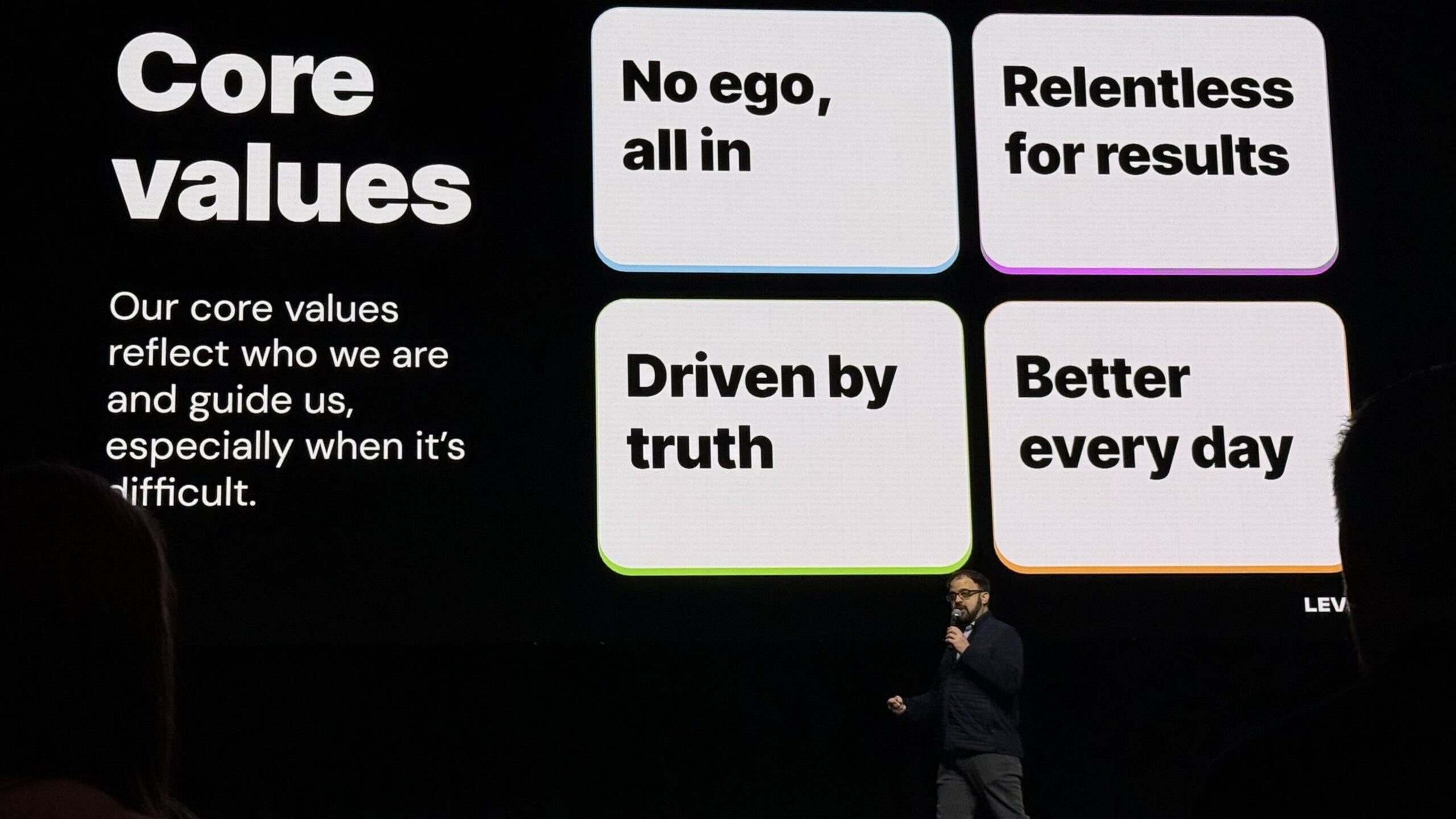
The sequence reveals the business ambition. Finding a new customer is one part of growth; keeping that customer creates another set of creative and technical demands. BAM extends Level’s reach into those later moments. Level’s account of its All In Summit describes workshops intended to give the newly combined teams shared context.
Steal the question
Level calls its current operating sequence Interrogate, Ideate, Implement, Iterate. The verbs describe a loop: investigate the problem, propose a response, put it into the market, and use the evidence to decide what happens next. Its longer-standing “Test. Learn. Grow.” language makes the same commitment to revision.
The agency also describes an Intelligence Suite: Pathfinder for audience opportunities, Signal for valuable conversions, Prism for creative performance, Pulse for connected performance insights, and Foundry for web experiences. These tools support the service relationship. Their names matter less than the decisions they are meant to improve.
The part a reader can copy is smaller than an agency reorganization. Choose one outcome with a clear economic meaning. Check whether the advertising platform can distinguish it from easier, less valuable actions. Validate the change before expanding it. Kiavi’s property threshold shows how concrete that first distinction can be.
This approach depends on usable outcome data, a meaningful definition of quality, and enough feedback to test the decision. A score trained on unreliable records can give a bad assumption more authority. For a team considering Level, the most revealing opening conversation may therefore concern the existing scoreboard: which number would you trust enough to spend tomorrow’s budget on it?