In April 2007, Kai Huang was upstairs on a double-decker bus in central London. Downstairs were the furnishings of a make-believe rock tour: a mini bar, cushions, bunk beds. Upstairs were consoles and guitar controllers. The bus was parked outside the Hard Rock Café. A business that had begun by renting video games now came with somewhere for imaginary rock stars to sleep.
Huang, RedOctane’s co-founder and president, had reason to enjoy the absurdity. Guitar Hero had made the company’s guitar-shaped controllers familiar objects. Activision had acquired the business the previous year. Here was a promotional vehicle with beds, representing a product that let people play at a profession famous for getting very little sleep.
The bus makes a tempting opening to a success story. The more revealing place to begin, though, is with a customer asking for something the company did not sell.
A business plan with room for a dance pad
Huang was born in Taiwan and moved to the United States as a child. His family spent part of his childhood in North Tarrytown, New York, before moving to the Bay Area. His parents ran businesses. He and his brother Charles helped out. Owning a company was an idea he encountered at home, long before anyone invited him to explain one on a promotional bus.
At UC Berkeley, he found himself drawn to computer science. A consulting job at Accenture followed. He had imagined getting an MBA; the internet boom offered a reason to try starting a company sooner. Adux Software, which he co-founded before RedOctane, worked on software for server appliances. It was sold in 1999.
The next venture was an online game rental service. Kai and Charles founded RedOctane in 1999, entering a business that already had customers and spending, while trying to make the transaction more convenient. The ambition was understandable. So was the temptation to keep a tidy definition of what the company did.
People renting Dance Dance Revolution complicated that definition. They needed dance pads. Could RedOctane supply those too? For a time, the answer was no. When the internet market collapsed and revenue became more urgent, accessories became a possibility worth pursuing. A customer’s inconvenient follow-up question had acquired commercial significance.
- 1999Rent the gameOnline video game rentals
- ThenSupply the controllerDance pads and accessories
- 2005Publish the gameGuitar Hero with Harmonix
Selling hardware also put the company close to complaints, returns, and suggestions. Players could explain what broke or what they wished a controller could do. Those conversations gave the brothers information that a neat rental-only strategy would have left untouched.
A guitar-shaped invitation
The brothers had spent time observing music games in Asia. Huang saw an opening for the category in North America and Europe, provided the music made sense to the intended audience. Rock suggested a guitar. Their experience making accessories supplied a practical way to think about putting that idea into someone’s hands.
There is a pleasing lack of mysticism in the reasoning. Start with an audience. Consider the music. Choose the instrument. The result looks obvious once it exists, which is one of the rewards successful products offer everybody who did not have to persuade a partner to make them.
RedOctane worked with Harmonix, the studio that developed the first two Guitar Hero games. The distinction matters to Huang’s story. His company brought publishing and hardware experience; its development partner brought the software. Credit belongs to a collaboration, with different people responsible for different parts of the object in the box.
“Very easy to pick up but very difficult to master.”
Kai Huang on Guitar Hero, 2007
That was Huang’s explanation for the game’s appeal. A recognizable instrument could invite somebody into play before a long explanation became necessary. His account included watching families encounter the game in shops. A controller that looked like a guitar gave people a familiar starting point, even when their fingers had some catching up to do.
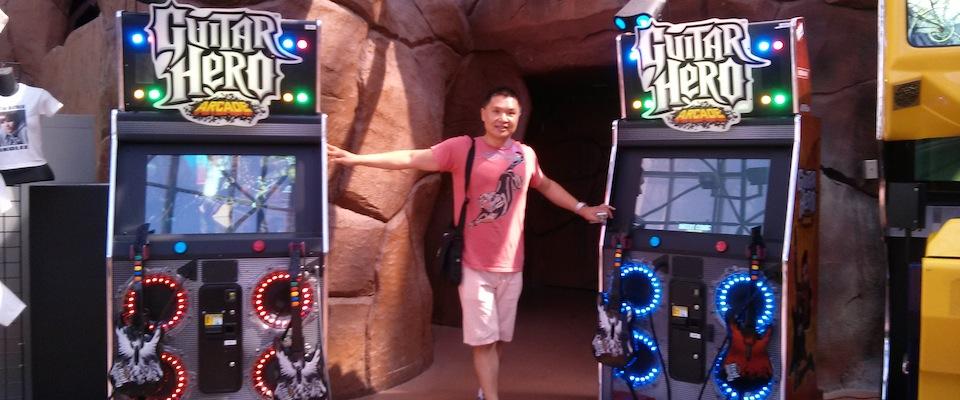
The box has to reach the shelf
Guitar Hero launched in 2005. Before success could become a cultural observation, it was an inventory problem. Retailers needed boxes. Boxes needed controllers. RedOctane needed enough money to get everything made and delivered. The company was selling a physical bundle, with all the unromantic dependencies that implies.
Charles later recalled that the brothers borrowed against their homes to help finance the launch after investors declined. The gamble involved more than a persuasive pitch. Manufacturing hardware commits money before the customer has offered an opinion. A warehouse cannot be paid with confidence in the soundtrack.
The early shortages showed how awkward even a welcome answer could be. Demand exceeded the supply available around the 2005 holiday season. More buyers meant the company had to produce and move more goods. A hit can make a small business’s immediate problems larger before it makes them easier.
Activision’s reported accounting purchase price for RedOctane, including transaction costs.
Activision announced its agreement to acquire RedOctane in May 2006 and completed the purchase that June. Its annual report recorded a mix of cash and stock. The buyer gained a position in music games; RedOctane gained access to a publisher with international distribution. The deal changed the resources available to a company whose product was finding an audience beyond its original scale.
When the bands start calling back
For Huang, the expanding franchise meant work across music licensing, instrument companies, marketing, and production. By 2007, he described his role as mainly management, with some involvement in development and creative decisions. Running a game company could mean spending much of the day on everything surrounding the game.
He later described coordinating hardware and software so the finished products arrived together. It is a detail worth keeping in the story. A plastic guitar and a disc have to agree on a release date, however different the processes that produce them. Rock-and-roll fantasy becomes a supply-chain appointment.
The music relationships changed too. Early on, persuading artists and instrument manufacturers to participate had been difficult. Once Guitar Hero had an audience, the conversations became easier. The game offered musicians another way to reach listeners, including people too young to have encountered the records when they first appeared.
Huang’s own preferences included pop-rock and Guns N’ Roses. The wider franchise required room for plenty of other tastes. By 2008, discussions with Aerosmith had grown from including music to building a game around the band. Huang explained that Joe Perry’s children were already playing Guitar Hero. The audience had reached the artist’s house before the business conversation arrived.
A band-specific game also made a different kind of presentation possible: a career could become something players moved through. Huang talked about including other musicians connected with Aerosmith. There was a story to organize around the songs, alongside the familiar task of playing them.
In 2009, Activision appointed former Yahoo executive Dan Rosensweig to lead the Guitar Hero business. Huang continued at RedOctane, reporting to him. The appointment is a reminder that an acquisition keeps unfolding after the announcement. A founder can stay with a company while its reporting lines and responsibilities change around him. The organization making the later games was growing beyond the partnership that had started it.
Giving someone else the stage
After RedOctane, Huang continued building companies. Blue Goji was founded with Charles and Coleman Fung in 2011 and publicly introduced in July 2013, with Kai as CEO. Once again, the business combined software, hardware, and games. Flash Bike also became part of his company-building career.
He began sharing the less photogenic parts of entrepreneurship with other people. In 2018, speaking to students at the Harker School, he discussed changing his major, expanding RedOctane’s activities, and the financial difficulties involved in keeping a young company running. The story available to students included the uncertainty before the acquisition.
“I rarely go all in.”
Kai Huang on making business decisions
His preferred analogy for decisions is a stove with several pans. Some move forward; others stay on a back burner. The image allows for focus without requiring every possibility to be extinguished. It also suits a career in which the activity at the edge of one business repeatedly became worth examining more closely.
At 886 Studios, where he is co-founder and managing partner, the work includes helping founders in Taiwan build businesses for international markets. He has described wanting a startup ecosystem that sustains itself through successful founders returning knowledge and support to the community. Company building becomes something that can continue through other people.
When considering founders, Huang looks for intelligence, the ability to learn and adapt, and a willingness to hear feedback. He also values storytelling. These are useful qualities for somebody who will need to explain a company repeatedly, to customers as well as investors. His own history gives the emphasis on adaptability a concrete setting: RedOctane’s original service could hardly have predicted the contents of its later boxes.
An encore, from a different seat
In August 2025, the RedOctane name returned with a new studio, RedOctane Games. Kai and Charles joined a special advisory board. Simon Ebejer led the studio. The arrangement placed the brothers alongside a team taking responsibility for its own rhythm game.
That project became Stage Tour, announced in 2026. The studio’s September update pointed toward a planned December 10 launch. Huang’s connection is an advisory one, a useful distinction in a career whose most familiar achievement is so often compressed into the name of a single game.
The guitar remains the object people recognize. Behind it sits a succession of jobs: renting, listening, manufacturing, publishing, negotiating, advising. On that London bus, the imaginary musicians had bunk beds waiting downstairs. Huang’s working life has continued well beyond the tour, helping other people decide what they ought to put in the box.
Keep exploring
- 886 Studios / Kai’s professional biography
- LinkedIn / Kai Huang
- Watch / Harbinger Asia conversation, 2025
- Listen / Rock the Boat, 2020
- Interview / Guitar Hero on the London rock bus
- Interview / Making Guitar Hero
- Interview / Financing the first Guitar Hero
- Stage Tour / The December 2026 release plan
- Blue Goji / Company website
- RedOctane Games / The current studio