An onion is an awkward thing to build a startup around. It grows in soil, arrives with leaves attached and refuses to become software. Someone must lift it, trim it and collect it. Among the winners of the DANA-Bhau Idea Hackathon reported in 2026 was a machine designed to do precisely that. Its roller mechanism cuts the wet leaves and gathers the bulbs. Here was entrepreneurship with dirt on it.
That machine offers a useful introduction to COEP’s Bhau Institute of Innovation, Entrepreneurship and Leadership. Located at Pune’s COEP Technological University, this nonprofit technology business incubator helps people turn inventions into businesses. Its work includes mentoring, shared facilities, business advice and access to funding programs. The interesting question is what happens between those nouns.
- Bring the next problem. Bhau supports idea validation, prototyping and commercialization.
- Read the terms. Applying is free; services and investment have separate conditions.
- Choose your route. A fellowship, a prototype grant and seed investment serve different needs.
01 Two friends, one missing older brother
The institutional story begins before the company’s incorporation. In 2009, YourStory reported that Narendra Kale and Sanjay Inamdar, described as schoolfriends, had committed ₹1 crore apiece to the proposed institute. COEP had introduced an entrepreneurship elective in 2007. The response helped prompt a larger undertaking, encouraged by F. C. Kohli, then chairman of COEP’s board of governors.
Inamdar explained the motivation plainly: “When Kale and I started our companies, there was no one to guide us.” Bhau means elder brother in Marathi. The name made a promise about the relationship: experienced people would help a younger founder find a way forward. In 2017, the institute was incorporated as a Section 8 nonprofit company.
“When Kale and I started our companies, there was no one to guide us.”
SANJAY INAMDAR / CO-FOUNDER / 2009
Today, Bhau identifies the Department of Science and Technology and Maharashtra State Innovation Society as supporters. That puts it at an intersection of public programs, an engineering university and private industry. Its users include students, individual innovators and early-stage companies. The general incubation FAQ also welcomes mid-career professionals. A COEP student identity is not the admission ticket.
02 A business plan meets a bench drill
Consider the equipment list. Bhau publishes details of grinders, drills, a hydraulic bench press and electronic test instruments. Its Pratham 5.0 3D printer has a listed build volume of 50 centimetres in each dimension. Users submit an STL file, receive a quotation based on material weight and pay before printing. The published procedure specifies PLA and reserves the machine for prototyping.
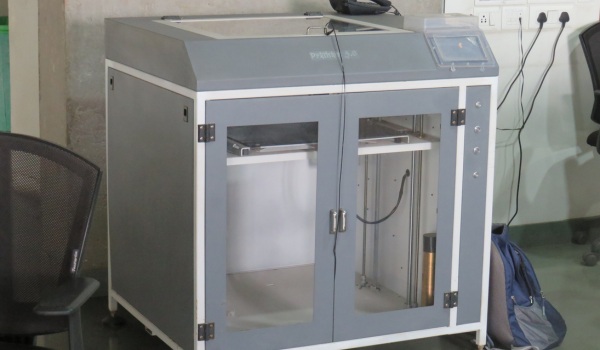
Those instructions make the service tangible. A founder can test a shape without first buying a printer. Alongside technical resources, Bhau offers access to advice on intellectual property, accounting, legal matters, marketing and finance. The combination matters because a working device still needs a customer, a price and a defensible business.
The portfolio reflects that mix. Thermistance, listed under Bhau’s NIDHI seed-support portfolio, develops thermal-management technology using miniaturized loop heat pipes. Other teams work on healthcare, cybersecurity, mobility and agriculture. Bhau’s proposition is particularly relevant when technical development and business formation must happen together. Its workshop access and public-program connections give founders concrete reasons to consider it alongside other campus incubators.
03 Time, then a prototype, then capital
A founder’s first shortage may be household income. The SARTHI-Bhau and AMRUT-Bhau programs advertise fellowships of ₹25,000 a month for twelve months, subject to their respective eligibility rules and progress requirements. Both require full-time commitment and no parallel income. The money addresses a practical problem: finding time to build before a business can pay a salary.
Separate routes, not an automatic funding ladder. Selection and eligibility apply at every stage.
For the object itself, Bhau’s published NIDHI PRAYAS offer provides selected innovators with prototyping grants up to ₹10 lakh. Its stated exclusions include software-development projects and pure academic research. That is a consequential boundary for an applicant with a software-only idea, even though Bhau’s wider activities include digital technologies.
Later finance has another rulebook. The institute’s NIDHI seed-support page describes investment up to ₹50 lakh, with due diligence, valuation and legal agreements. It requires a relationship with Bhau of at least three months and physical incubation before investment. Equity participation is part of the published terms. The general FAQ’s statement that founders retain their intellectual property should be read alongside these separate investment conditions.
Bhau therefore operates through a mixture of institutional support, government programs, corporate relationships and some paid services. Its FAQ mentions a nominal fee for Incubation Lite. Free application is a useful starting point; founders still need to establish the cost and commitments of the particular service they choose.
04 Support has to reach the workbench
The April-June 2026 newsletter reports 403 startups supported, 113 funded and more than 1,500 jobs generated. These are institute-reported totals. They describe activity and reach; they do not establish what would have happened to the same founders elsewhere.
Smaller details show how the system operates. The same newsletter describes a DANA hackathon with 61 applications, six finalists and three winners receiving a grant and a year of incubation. Beside the onion machine were ideas for automated milk-quality assessment and tractor-mounted harvesting. Corporate involvement was attached to identifiable problems and a defined next period of support.
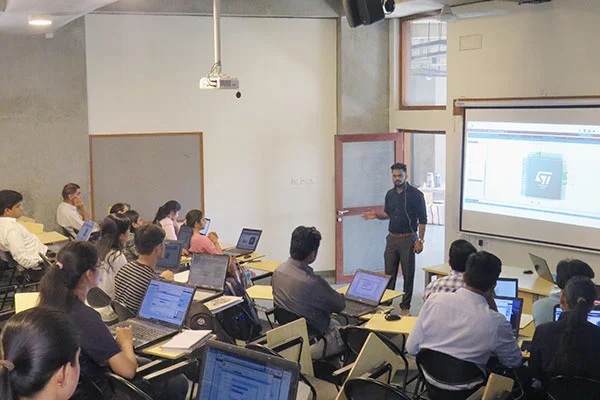
Bhau also lists AWS Activate, MathWorks, Ansys, Zoho and SolidWorks among its technology partners. A founder evaluating that network should ask which benefits apply to the particular company, for how long and under what conditions. Access to a partner network becomes useful when it removes a specific expense or gives a team expertise it can use immediately.
Founders can copy the sequence: identify the next test, find the equipment or expertise it needs, then seek finance suited to that stage. Participation also requires showing up. Bhau’s virtual-incubation FAQ expects detailed visits every two months, plus specified events and training. For someone far from Pune, that belongs in the budget.
The onion machine brings the story back to earth. An incubator earns its place when a founder can run a useful test that previously lay out of reach. Bhau has assembled several ways to make that happen. The founder’s task is to choose the right one, build something and discover what the next onion refuses to do.
Follow the work
Explore Bhau’s programs, people and public updates.