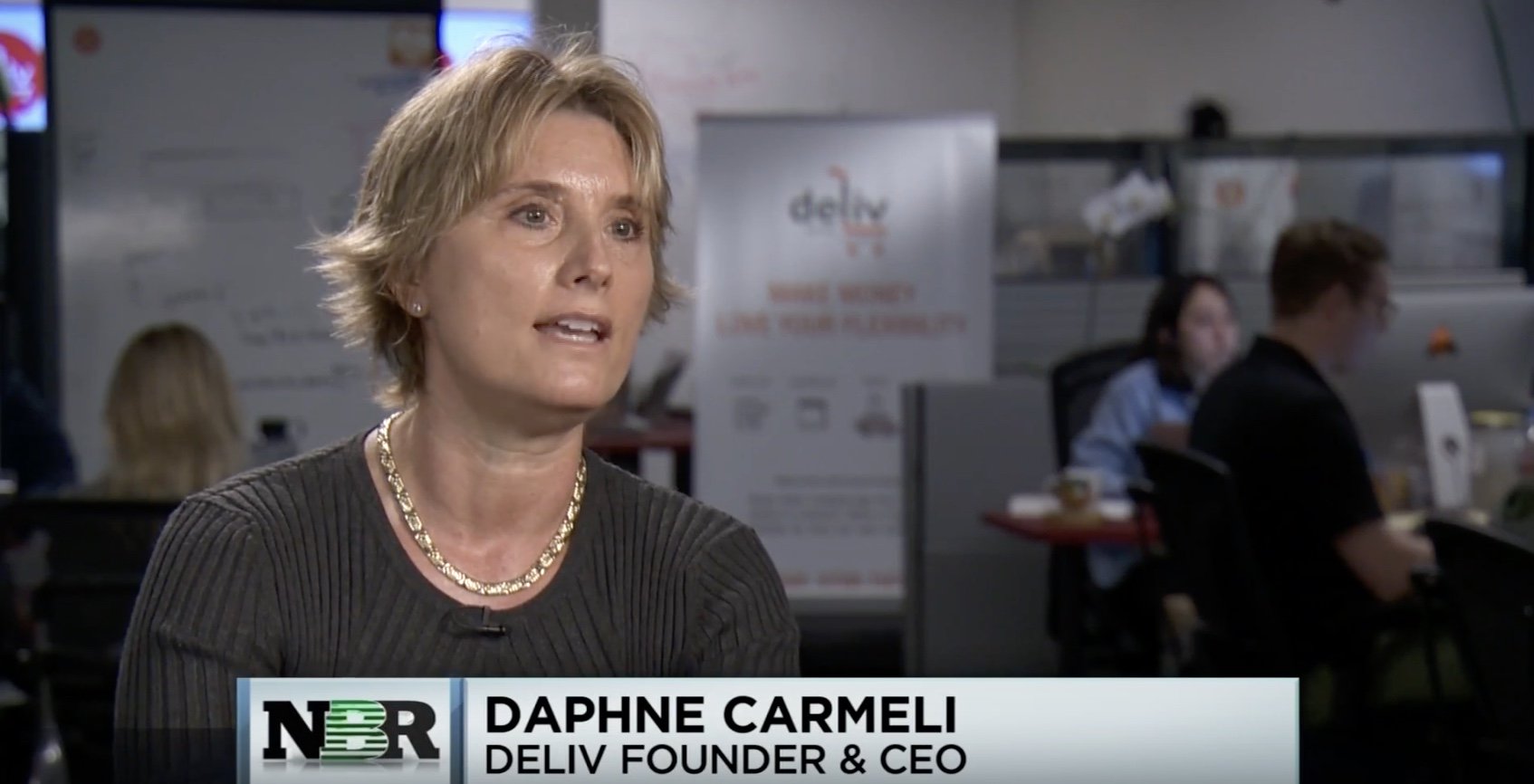
Daphne Carmeli had already sold a software company. She had two teenagers at home. Running another startup was not the obvious way to enjoy what she called “semi-retirement.” Then she became interested in crowdsourcing, and retirement acquired an inconvenient complication: a business idea.
The idea became Deliv, founded in 2012. Its task sounded simple enough: collect something a customer had bought and get it to that customer the same day. The difficulty lay in making the journey affordable, repeatable and worth doing again tomorrow. Anyone can deliver a parcel quickly if someone else is paying extravagantly for the privilege.
Carmeli approached the problem through the shop rather than the shopper. Retailers already had customers, merchandise and buildings close to where people lived. She wanted to connect those pieces to drivers. The familiar store, apparently disadvantaged by the internet, could become the starting point for an online order’s short trip home.
A second act with a very small button
Before Deliv, Carmeli had worked at Silicon Graphics and held a marketing leadership role at Netscape. She then led Metreo, a pricing optimization software company, from its beginnings in 2000 through its acquisition by Symphony Technology Group in 2006. These were businesses concerned with what technology could make possible, and what customers might actually pay for.
Her education included Brandeis University and Carnegie Mellon’s business school, where she completed the MSIA in 1991. By the time she entered delivery, she had spent years around software companies and their buyers. Deliv brought that experience into a business with an unusually physical final step. Somewhere, a person still had to carry the bag.
Her interest in crowdsourcing grew through advising companies using the model. One lesson particularly interested her: building supply and demand simultaneously makes a startup’s job harder. She and her co-founder looked for an industry where demand already existed and could be connected to a new supply network. Retail provided a promising answer.
In an early explanation, she described Deliv as a button at checkout. After a customer finished buying from a retailer, the delivery information would go to Deliv. A substantial operation could sit behind that modest interface. Carmeli was proposing to become useful at precisely the moment someone else had completed a sale.
The shop down the road had a head start
Amazon gave Carmeli an argument retailers could understand without a lengthy tutorial. Its delivery services were changing expectations. A store could have the right product, at the right price, and still lose a customer who wanted it brought home. The competition extended beyond the shelf and into the hours after checkout.
She saw proximity as an underused advantage. Existing stores already held stock near their customers. Turning them into local dispatch points required an accurate view of inventory and a way to move orders. Retail property owners had a stake in that transition, too: more useful tenants made their shopping centres more useful.
General Growth Properties, Macerich, Simon and Westfield became backers. At malls, Deliv also offered a practical variation on the idea: shoppers could leave purchases at a central collection point and arrange delivery home. The shopping trip could continue without every purchase becoming another thing to carry. Commerce has produced grander visions than freeing someone’s hands; few are as immediately comprehensible.
Carmeli’s pitch gave familiar buildings another purpose. A store could welcome a customer through its front door while fulfilling another customer’s internet purchase from the same inventory. The local branch became part of the delivery network, with the distance to the doorstep doing some of the competitive work.
Useful, without taking over
There was a commercial boundary she returned to repeatedly. Deliv moved goods for retailers; it did not operate a competing shopping marketplace. Customers could buy through the retailer’s existing site, and the retailer could maintain its connection with them. Delivery was the service Carmeli wanted to sell.
That boundary mattered as companies weighed the convenience of outside platforms against control of their own transactions. A partner that also wanted to own the shopping experience presented a different proposition. Carmeli could offer a narrower bargain: let us handle the journey after the sale. She made restraint part of the sales pitch.
In 2017, Deliv Fresh extended the approach to grocery and other perishable orders, working with businesses including Eataly Chicago and Plum Market. The categories changed, but the distinction remained. A retailer could offer delivery through its own checkout rather than send shoppers to another marketplace to place the order.
Her public writing that year also addressed the retailer’s arithmetic. In one example she discussed, a free same-day delivery threshold encouraged customers to build larger baskets. Her argument was that the delivery fee needed to be considered alongside the transaction it helped secure. A parcel’s journey and a shop’s margin belonged in the same conversation.
An airport shuttle, with shopping bags
Carmeli had a useful analogy for pooling deliveries: the airport shuttle. A vehicle carrying several passengers shares its costs across several fares. A driver taking several nearby orders can do something similar. The comparison made an algorithmic business legible to anyone who had ever waited while a shuttle collected another passenger.
The analogy also explained why the clock mattered. With enough visibility into upcoming orders, routes could contain more stops. Distance between those stops mattered, too. The business depended on arranging the work, rather than simply announcing that a car and a smartphone were now a delivery company.
Deliv expanded in part through acquisitions, including Chicago’s WeDeliver and New York’s Zipments in 2015. In New York, joining an existing driver network and customer base offered a way to strengthen a dense delivery market. Density was a commercial consideration as much as a geographical description.
In February 2016, Deliv announced a $28 million funding round that included the UPS Strategic Enterprise Fund. The company reported serving 17 markets and more than 4,000 businesses. A delivery incumbent was now investing in a younger operation built around a different arrangement of drivers, stores and software.
The unfashionable pleasure of a reliable appointment
By 2018, Deliv was operating in 35 US markets. Another $40 million funding round included Google and existing investors. Expansion brought more retailers into the network and gave Carmeli a larger operation on which to test her proposition. Funding bought room to build; the economics still had to work.
At GroceryShop in Las Vegas in September 2019, she compressed her thinking into three words: “Predictability trumps speed.” In a business routinely described through ever-shorter delivery promises, she was asking the audience to consider the value of a dependable appointment. The customer has a timetable as well as a shopping basket.
She identified four connected costs: volume, distance, the service promise and unpredictability. More orders collected together could help. Extra miles could hurt. A delivery commitment shaped what a route could accommodate. Delays consumed time, and time consumed money. The glamour of instant gratification eventually encounters somebody’s working hour.
Those practical concerns gave her delivery philosophy its human dimension. A customer who knows when an order will arrive can arrange the rest of the day. A business with a realistic promise can plan the work needed to keep it. The appeal of speed becomes more useful when it comes with a calendar.
“Predictability trumps speed.”
Daphne Carmeli · GroceryShop, 2019
A company closes; the routes continue
Deliv’s independent story ended in 2020. The company wound down its operations, while Target acquired its proprietary batching and routing technology and brought Carmeli and some members of the team into the retailer. Target did not take over Deliv’s existing customer relationships. An asset sale and an operating company’s closure happened alongside one another.
The distinction belongs in any account of Carmeli’s career. The software had a buyer and a further use, even as Deliv’s service was ending. Target’s interest centred on a familiar problem: how to combine local orders and move them efficiently. The modest checkout button had left behind a considerable amount of machinery.
In May 2020, Target explained that it had tested the route optimization technology before purchasing it. The retailer saw an opportunity to increase fulfillment capacity and reduce the expense of the final delivery. Members of Deliv’s team would help integrate the technology into existing systems and processes.
A year later, Target described applying Deliv technology to optimize sortation, alongside technology from Grand Junction and delivery capacity from Shipt. Carmeli’s work had entered a larger system of stores, packages and neighbourhood routes. The original business no longer operated independently, but its central problem was very much still being worked on.
The founder behind somebody else’s checkout
Carmeli’s subsequent public profile includes investing, advising and board work. Her Platform biography describes helping startups secure funding, recruit teams, shape products and acquire customers. Those interests fit the work behind Deliv: establishing what a company should provide, finding people to provide it, and checking whether the arrangement earns its keep.
There is a particular kind of ambition in choosing to supply the infrastructure behind another business’s promise. The retailer gets the purchase. The customer gets the package. Much of the work connecting them is meant to pass without incident. A successful arrival rarely demands an explanation of its routing software.
Carmeli built a company around that largely uncelebrated interval. Her story contains a return from semi-retirement, investors from both technology and retail property, a national delivery operation, and a complicated ending. Running through it is a remarkably everyday concern: someone has bought something, someone has promised a time, and the doorbell ought to ring when expected.
Continue the conversation
Interviews, ideas and public profiles.