The driver had reached the store. The groceries had not reached the driver. In February 2019, Reuters reported that drivers working on Deliv’s Walmart grocery pilot frequently waited 40 minutes or more to collect orders. Consider the peculiar arithmetic: a company selling speed could spend much of an hour standing still.
- Deliv let merchants keep the sale while outsourcing the journey.
- Fast delivery depended on stores having orders ready and nearby demand to combine.
- The service closed in 2020; Target bought technology that helped organize its fulfillment network.
That small, awkward interval at the pickup point is a useful entrance to Deliv’s story. The company had an appealing proposition for physical retailers: your stores are already close to your customers. Use them. Add local drivers, connect the checkout to delivery software, and a familiar disadvantage becomes an advantage. A shop can be a miniature distribution center, provided somebody has remembered to prepare the parcel.
A shopping mall with an exit strategy
Daphne Carmeli founded Deliv in 2012. Its early world included shopping malls, where the merchandise and the shopper were already together. In the service described at its 2014 Seattle launch, shoppers could leave purchases at a kiosk and have them delivered home later that day. It was an agreeable answer to the less glamorous part of retail therapy: carrying everything.
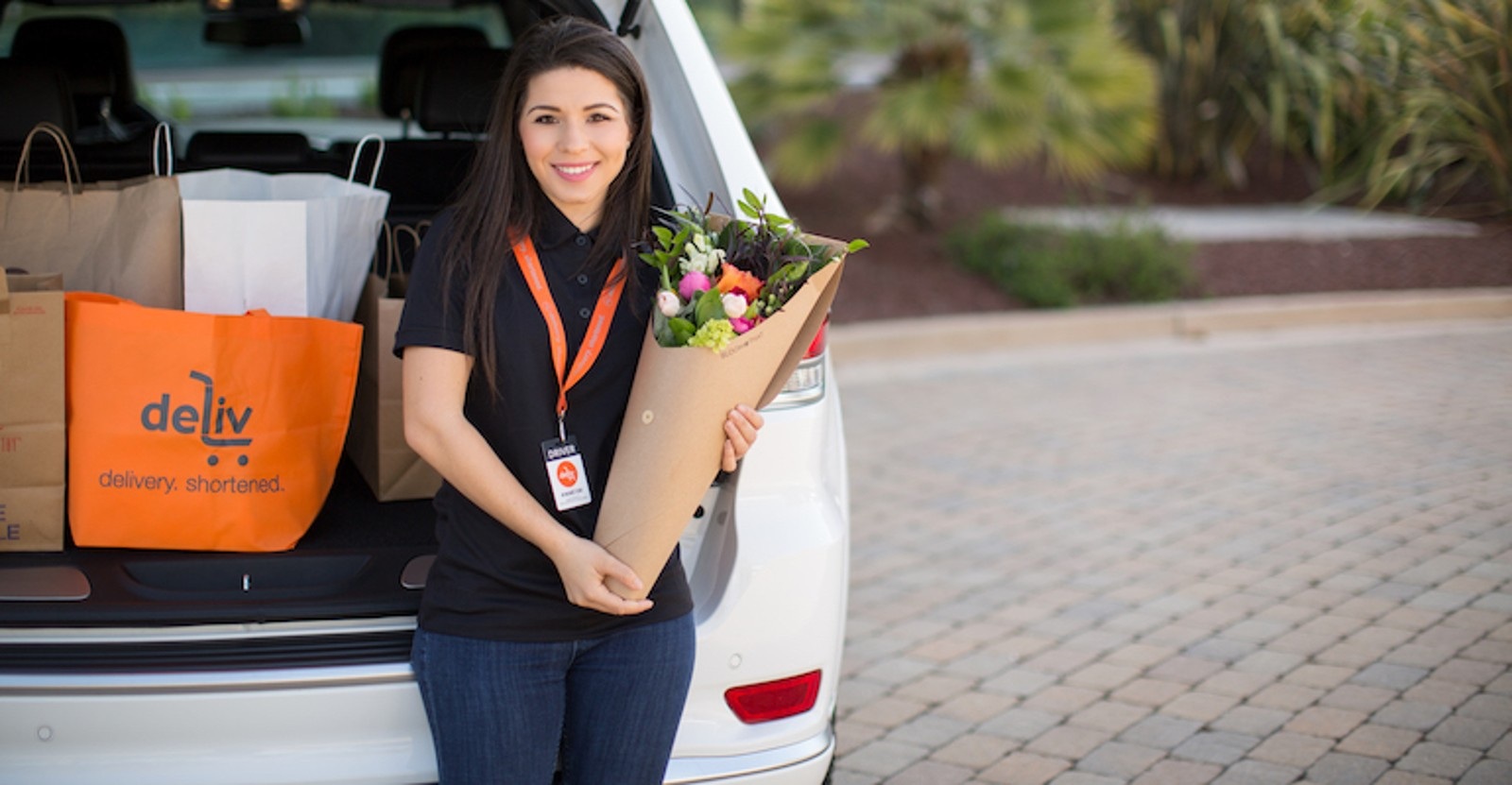
The larger opportunity sat online. A merchant could add same-day delivery to its existing ordering experience and dispatch goods from a nearby store. Independent contractors used their own vehicles to make the trip. Deliv coordinated the movement. It did not need to purchase the merchandise or persuade the shopper to abandon a favourite retailer for another shopping destination.
“We’re selling the picks and shovels.”Daphne Carmeli · 2016 interview
That phrase explained the market position neatly. Amazon was building a shopping empire with delivery attached. Deliv offered the delivery component to other merchants. Retailers kept their checkout, brand and customer relationship. The distinction mattered to businesses understandably reluctant to invite a potential rival between themselves and their customers.
The price of a short journey
In Seattle launch coverage, Deliv charged retailers $5 or more for deliveries of unlimited items to one address. That was a historical starting price, not a universal tariff. It also reveals the wager: the economics would improve if orders could travel together and local drivers could spend their working time moving goods rather than finding them.
The customers ranged from department stores to local businesses. Macy’s, Bloomingdale’s, Best Buy and Kohl’s appeared in the company’s retail roster. Small merchants could use the same network for cupcakes, documents or urgent parts. What united them was an existing order and a need to transport it. Deliv’s expertise lay in dispatch, local movement and coordinating delivery with the merchant’s workflow.
checkout02Order
ready03Batch
and route04Local
delivery
New services applied that idea to particular kinds of goods. Deliv Fresh, introduced in 2017, handled perishables for businesses including specialty food merchants and meal providers. Deliv Rx followed in 2018, bringing prescription delivery through participating pharmacies’ websites or apps. Walgreens began using the service in the Dallas area. Tracking and screened drivers were part of the pharmacy offering.
The map expanded, too. In 2017, coverage grew from 19 to 33 markets and 1,400 cities. Such numbers are pleasing on a slide. For an operator, their value depends on what happens within those boundaries: how many orders exist, when they are ready, and whether their destinations belong on the same route.
Forty minutes nobody ordered
Deliv attracted investors with rather different reasons to care about that question. UPS participated in a $28 million Series B announced in 2016. A $40 million Series C announced in October 2018 included Google and Enterprise Holdings’ venture arm alongside existing backers. Shopping mall investors also had a stake in making physical stores useful in an increasingly digital transaction.
Pickup waits reported in the Walmart pilot. A delivery clock can run before a wheel turns.
Yet investment could not remove every operational dependency. Reuters’ account of the Walmart pilot described slow handoffs, weak volume in some markets and long delivery distances. Walmart disputed the concern about volume. The partnership ended in January 2019. Its spokesperson described Deliv as a good delivery option that did not fit the programme at that time.
This episode should not be stretched into a complete explanation of Deliv’s later closure. It does expose a constraint in the model. A routing engine can organize ready orders; it cannot, by itself, turn an unfinished grocery basket into a parcel. The first visible trouble in this pilot appeared at the store handoff, before the much-discussed last mile.
For the merchant choosing a delivery partner, this changes the purchasing question. Ask how the service handles late preparation, uneven demand and orders spread across a wide area. A cheap quoted trip can become expensive when collection takes too long. The useful comparison includes the entire handoff, from a paid order to a parcel that can actually leave.
The route continued inside Target
In May 2020, Deliv’s wind-down became public. Target purchased technology assets and hired members of the team. Existing retail relationships were not transferred. Target’s interest followed encouraging tests of local route optimization: a practical reason to buy a capability even as the business supplying it disappeared.
The technology found a different setting. Target opened a Minneapolis sortation pilot in 2020, collecting packed store orders for sorting and onward delivery. In 2022, Target said technology acquired and further developed through Deliv and Grand Junction helped optimize routes. Its 2023 announcement of a $100 million sortation expansion belonged to Target’s broader network, not to a revived Deliv service.
For a retailer, the part worth copying is modest and demanding. Measure pickup readiness. Group destinations where practical. Test whether local order volume supports the promised service before expanding the map. Sparse orders, long distances and unpredictable preparation make that approach harder. Deliv’s history suggests that proximity is an opportunity requiring organisation. The customer may be nearby. The order still has to get out of the shop.
Follow the delivery trail
Historical company website · LinkedIn · Twitter / X · Facebook
Carmeli on the original business
The 2020 technology sale
Target’s sortation network