The flower business has always contained a tiny logistical absurdity. The buyer is often in one city, the recipient in another, and the product begins dying as soon as it is cut. Add a birthday, a funeral service or a guilty apology, and the delivery window becomes less a preference than the entire point. In 1910, a group of American florists found an elegant answer: stop trying to move the flowers so far. Move the order.
They used the telegraph to ask a trusted florist near the recipient to make and deliver the arrangement. Florists’ Telegraph Delivery - later Florists’ Transworld Delivery, and now simply FTD - was a network business before anyone called it one. Its commodity was not the rose. It was coordination: a message, a payment and enough common standards for a stranger’s promise to arrive in a vase.
That basic mechanism survives inside FTD’s modern checkout. The company sells bouquets, plants, gift baskets and other occasion gifts through FTD.com and sister brand ProFlowers. Many hand-delivered orders flow to a local florist who interprets a design, works with available stems and drives the finished piece across town. Shipped products take a more conventional route through parcel carriers. The customer sees a catalog; behind it sits a mix of marketplace, software, wholesale supply and last-mile operations.
01 / The hidden productA marketplace wrapped in tissue paper
FTD serves two customers whose interests overlap but do not perfectly match. Consumers want choice, confidence and a delivery date they can trust. Independent florists want profitable orders, useful technology and enough control to protect the reputation printed on their own awning. FTD sits between them. Demand from the national storefront makes the network valuable to shops; local inventory and skill make the storefront’s same-day promise possible.
For shoppers, the problems are familiar: what should I send, what is appropriate, and can it get there today? Occasion-led navigation turns an emotional question into a manageable catalog. The network handles distance. A satisfaction policy reduces the anxiety of buying a handmade object the purchaser may never see. FTD says eligible same-day orders generally need to arrive before its local cutoff and remain subject to location and availability - the necessary fine print in a business governed by traffic, weather and what bloomed this week.
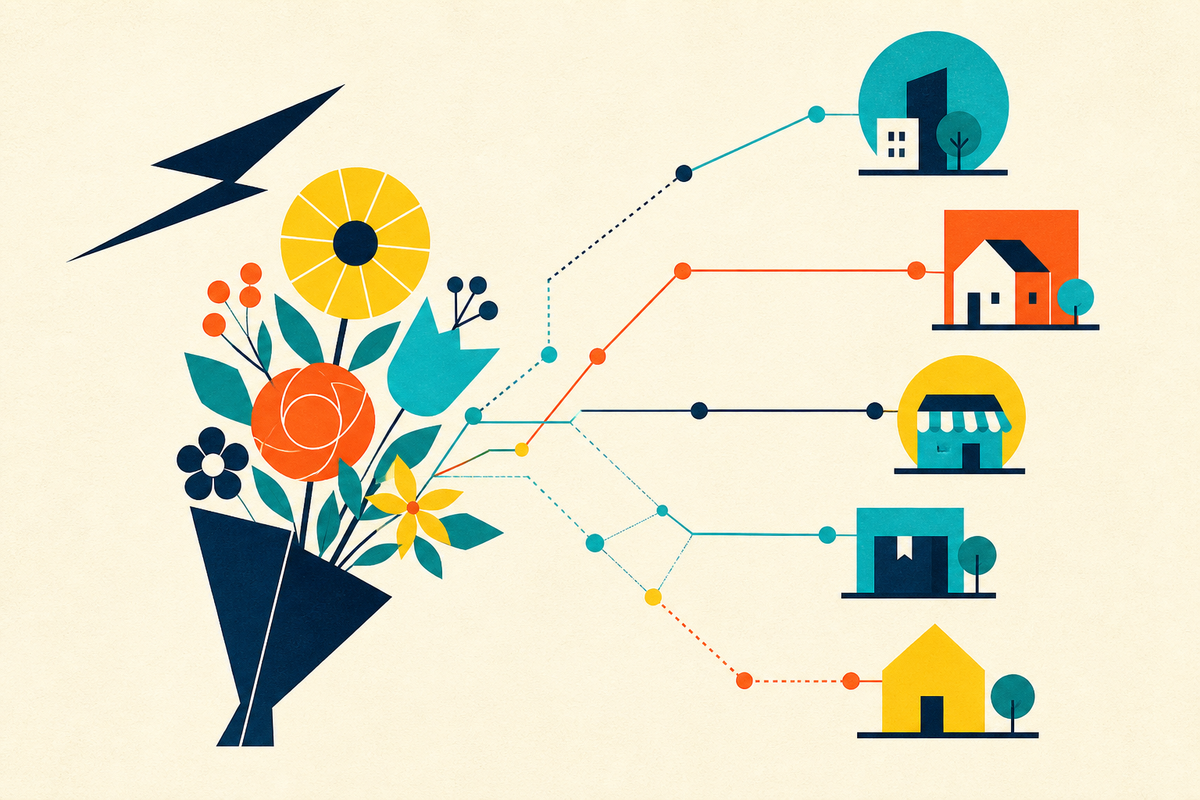
How one hand-delivered order moves
For florists, FTD’s pitch is broader than a stream of orders. Mercury HQ is marketed as a cloud system for receiving and managing business from multiple devices. FTD Florists Online offers Shopify-powered websites and digital support. The Marketplace and Flower Exchange supply stems, containers, equipment and hardgoods. Add education, marketing and operational services, and FTD begins to resemble a vertical operating system for a highly specific small business.
“At FTD, our goal is to give you an all-in-one solution for running a successful flower shop.”FTD’s florist-facing website
This is where FTD differs from a pure direct-to-consumer bouquet company. A box of stems shipped from a farm can offer consistency and a clean supply chain, but the recipient may need to trim and arrange them. A florist-delivered bouquet arrives composed and can often be produced close to the destination. The tradeoff is variation: flowers are agricultural products, local inventories differ and substitutions happen. FTD’s model turns human discretion into both an advantage and a quality-control challenge.
Local florist delivery
Designed near the recipient, often available the same day and presented ready to enjoy. The outcome depends on local inventory, interpretation and execution.
Farm or warehouse shipping
More centralized packing and product control, with carrier delivery across a broad footprint. The recipient may assemble the flowers and timing follows parcel logistics.
02 / Scale and stakesThirty thousand workshops, one deadline
FTD has described its florist network as more than 30,000 shops in over 125 countries. Its consumer site says its delivery options extend to nearly all of the United States and Canada and more than 150 countries internationally. Those figures measure slightly different things, but together they explain the company’s market position: a familiar consumer brand attached to a broad, distributed base of floral production.
Scale matters most when demand becomes lumpy. Valentine’s Day and Mother’s Day do not politely spread themselves across a quarter. Sympathy work is unpredictable and unforgiving. A national promotion can create orders far from available stems or drivers. FTD’s expertise lives in absorbing those spikes: merchandising designs that shops can reproduce, transmitting instructions, allowing substitutions, handling customer service and keeping money moving among the parties.
The company’s history makes the difficulty plain. FTD acquired ProFlowers and related gifting businesses in 2014, a bet on expanding its ecommerce reach. Debt and operating pressure later contributed to a 2019 Chapter 11 process. A Nexus Capital affiliate bought the North American and Latin American consumer and florist assets, including FTD and ProFlowers, for a reported $95 million in cash, subject to adjustments. The old public company disappeared; the brands and network continued as a private business.
The architecture outlived every interface
Conceptual timeline, not a measure of revenue or order share. FTD introduced its Mercury electronic network in 1979, 1-800-SEND-FTD in 1985 and FTD.com in 1994.
In May 2023, FTD merged with From You Flowers. Founder Michael Chapin became chief executive of the combined companies. The stated logic was unusually direct: From You Flowers brought a large ecommerce operation and customer relationships; FTD brought its distribution network and florist services. Management said the combination would nearly double the number of orders flowing into the florist network and create savings to reinvest in member technology. The portfolio also gathered FTD, ProFlowers, From You Flowers, SendFlowers, H.Bloom and gifting sites under a wider platform.
“The merger will enable From You Flowers’ best-in-class ecommerce operation to accelerate the growth of FTD’s already impressive floral distribution network.”Michael Chapin, CEO, May 2023
03 / The durable edgeTrust is the part that cannot be boxed
FTD competes in a crowded middle. 1-800-Flowers.com combines floral delivery with a broad food-and-gift portfolio. Teleflora also routes designs through local shops. The Bouqs Co. and UrbanStems made farm shipping, cleaner branding and subscription-friendly merchandising feel contemporary. Supermarkets and a florist’s own website can be cheaper or more personal. Search engines make every local shop visible, while delivery marketplaces train consumers to expect instant tracking.
FTD’s defense is not novelty. It is accumulated network density, name recognition and a stack built for florists. The Mercury Man, introduced in 1914, is almost comically literal: the winged Roman messenger stands for speed and communication. Yet it neatly explains the product. FTD makes a distant intention legible to someone nearby who can act on it. Its modern tools - order software, ecommerce sites, standardized recipes and wholesale access - are elaborate descendants of the telegram.
The business model earns from both motion and enablement. Consumers pay for products, delivery and associated charges. Florist fulfillment creates network economics, while software, websites, marketing, wholesale flowers and shop supplies deepen the business relationship. FTD does not disclose a current segment breakdown, and its private ownership makes clean financial comparison difficult. That opacity matters: a marketplace is only healthy if orders work economically for the platform and the local operator doing the physical work.
Customers can use FTD for the obvious moments - birthdays, anniversaries, sympathy, holidays - and for the less scripted gesture that its current “Give with Meaning” platform encourages. Florists can use the company as a demand channel or adopt a much larger portion of its operating stack. The tension is productive. A shop wants national reach without becoming interchangeable; FTD wants reliable local execution without owning every cooler and delivery van.
That makes the local florist more than a supplier. The florist is a small factory, creative director and last-mile depot in one. Roses arrive imperfectly uniform. A funeral spray must read properly from across a room. A substitute must preserve the feeling of the design, not merely its color count. These judgments are difficult to centralize, which is precisely why a network of skilled local operators remains useful.
04 / What enduredThe order travels farther than the flower
FTD turned 115 in 2025. Along the way it introduced a 45-foot Rose Parade float, recruited Elizabeth Taylor and Rosemary Clooney as endorsers, launched a memorable toll-free number and became an early web retailer. Those are charming artifacts. The consequential invention is quieter: separate the message from the perishable object, send the message quickly, and manufacture the experience near its destination.
Software founders might recognize the pattern. FTD standardized a request across independent providers, created a trusted mark, aggregated demand and supplied tools that made providers more capable. Logistics founders might notice what it refused to centralize. Retailers might notice that an emotionally specific purchase behaves differently from an ordinary package. The recipient is not the customer, the delivery date is part of the product, and a reasonable substitution can be better than an exact bouquet that arrives tomorrow.
The company’s future depends on improving the unglamorous seams: accurate availability, transparent pricing, sensible substitutions, useful tracking and economics that keep talented florists participating. Its 2023 merger gives the combined operation more demand and brands to route through the system. It also raises the standard. More orders only strengthen a network when shops can fill them well and customers believe the next bouquet will match the promise.
So the old telegraph idea remains surprisingly current. The interface went from Morse code to a mobile cart. The wire became a cloud service. The florist still clips the stems, chooses the angle and knocks on the door. For all the technology between them, FTD’s product arrives as evidence that somebody, somewhere, remembered in time.