A bouquet that never arrives is an unusually personal kind of product failure. On March 8, 2014, an early test of Flowwow produced about 50 orders. Shops failed to fulfill roughly half of them, co-founder Andrey Makeev later recalled. Some sellers had forgotten their arrangements with the fledgling platform. Others had more pressing customers. The website could generate demand. It could not yet make a florist care.
That awkward distinction explains much of Flowwow’s subsequent development. The company sells access to flowers, cakes and other gifts from local businesses, with ordering and delivery arranged through a website and apps.
By 2024, Flowwow reported 17.29 billion rubles in annual turnover. In 2026, the story acquired a corporate fork: its international operation relaunched as Udora, while the Russian business continued separately. Flowwow grew by getting involved in the messy interval between “buy” and the doorbell.
unfulfilled
01A birthday abroad, a business at home
Slava Bogdan’s origin story begins with an ordinary frustration: trying to arrange a birthday gift for his mother while he was in Greece. Finding a present, paying for it and checking its progress became a logistical nuisance. He and Makeev had already tried other businesses, including a tour-voucher aggregator that failed. Aggregation still looked promising. Flowers supplied a more concrete problem.
Bogdan, Makeev and programmer Artem Gambitsky founded Flowwow in 2014. Their backgrounds were an unlikely bouquet: two university friends with history degrees and experience in sales and advertising, plus a technical co-founder. The first version resembled a directory handing customers to shops. What followed showed why a transaction could not simply disappear into a seller’s private messages.
The fixes were practical: order reminders, seller and customer apps, status changes and photographs before delivery. Makeev described repeat purchasing rising from no more than 15 percent in the early period to around 50-60 percent after the service improved. Those are retrospective founder figures, rather than a controlled experiment. Still, the sequence matters: make the order work before buying another customer.
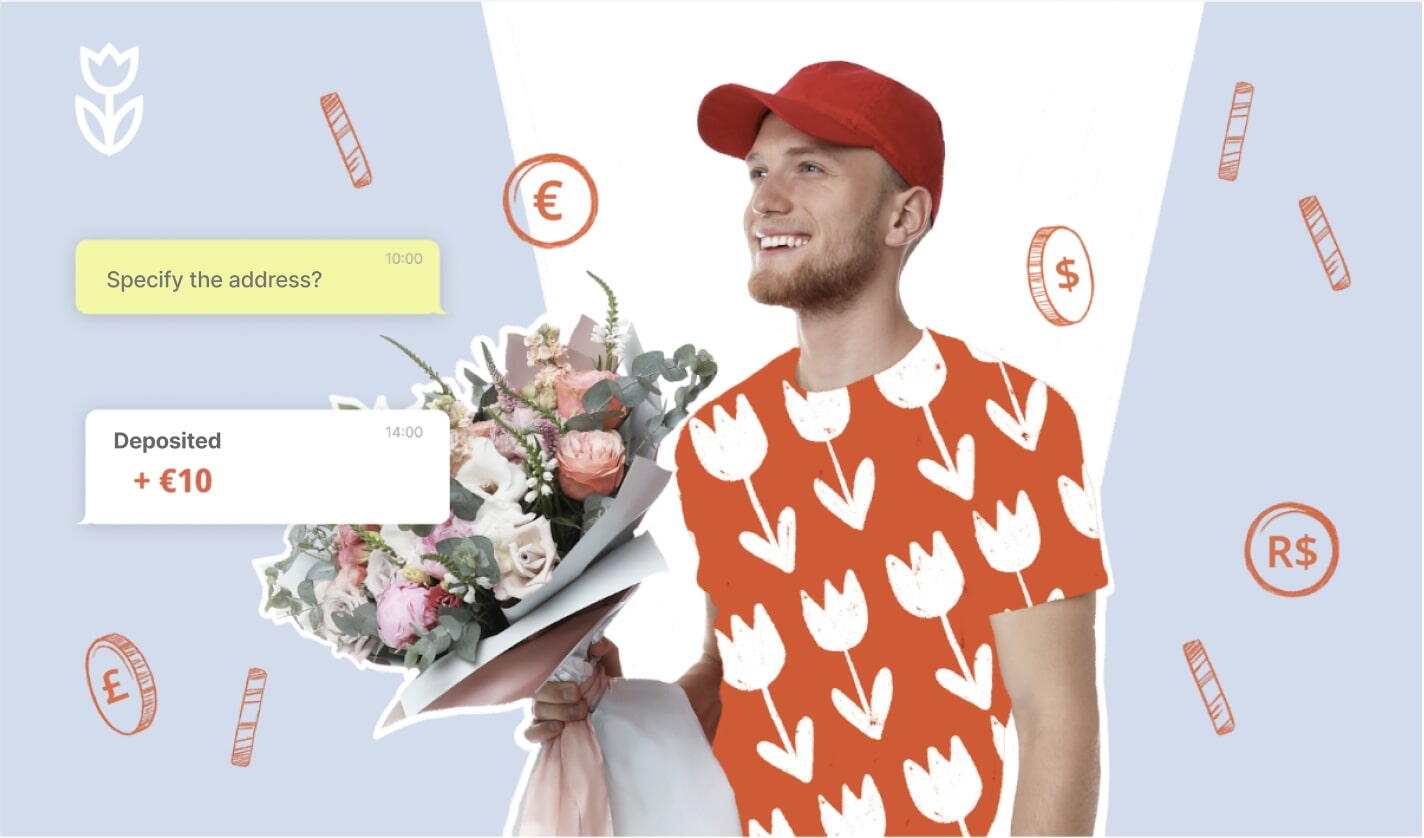
02The flowers travel locally. The thought can travel farther.
For a shopper, the starting point is the recipient’s location. Available products come from shops that serve that destination. The catalogue includes bouquets and living plants, but also confectionery, balloons, jewellery, decor and other gifts. Customers choose a product and delivery arrangement, pay online and follow the order. Same-day options depend on the seller, stock and destination.
Photographs of prepared orders give the buyer something more useful than a promotional image: a look at the actual gift before it leaves. Bogdan’s January 2026 description of the product also included a calendar for important dates and curated selections. These features address the small anxieties of giving remotely. Is it the right thing? Will it arrive? Have I remembered the occasion?
The model’s appeal is particularly clear when sender and recipient live apart. A local shop makes or selects the gift near its destination; the sender need not personally organize a parcel shipment. In editorial terms, Flowwow sits between a neighbourhood florist’s individual website and a broad shopping marketplace. Its organizing idea is the occasion, with local fulfilment doing much of the practical work.
- 01The senderChooses, pays, follows progress
- 02The local shopPrepares the gift near its destination
- 03The recipientReceives the order at the agreed location
03What the florist pays for the introduction
The other customer is the merchant. Flowwow Seller provides a storefront and tools for handling orders, products and performance. Registration opens a route to platform demand without asking a small bakery to build its own shopping app. Sellers set product prices. Flowwow deducts fees from completed orders; the applicable charges depend on category, location and participation in marketing programs.
A dated example makes the trade-off concrete. From May 20, 2025, Flowwow raised the fixed commission for certain St Petersburg categories, including flowers, from 16 to 19 percent without WowPass, and from 20 to 23 percent with it. On a hypothetical 4,000-ruble product, 19 percent is 760 rubles. That illustrates one fee component, not the seller’s final proceeds or today’s universal tariff.
There is a revealing exception. Orders placed through a merchant’s direct shop link can carry zero fixed commission. That does not mean every associated charge disappears. The distinction is commercially sensible: a shop bringing its own audience is doing the acquisition work. Sellers can share that link with existing customers while using marketplace discovery to meet new ones. Before joining, they need to price ingredients, labour, delivery and all applicable fees together.
04Growth has a cash register attached
The early experiments were expensive relative to the company’s means. Bogdan told SETTERS that the founders sold 15 percent of the business for 4.5 million rubles in 2014, then spent the money on advertising that converted poorly. T-Business’s later account put unsuccessful experiments over five years at 4 million rubles. These are separate descriptions of early spending, not amounts to add together.
Management eventually assigned explicit responsibility for finances and tied spending to ordinary monthly earnings, saving some holiday proceeds for quieter periods. A seasonal sales spike is a poor basis for permanent commitments when payroll and advertising bills return every month.
Scale also needs careful labels. Flowwow’s 2024 announcement reported 17.29 billion rubles of turnover and approximately 4.5 billion rubles of company revenue. Turnover describes business transacted through the system; it is not money the platform keeps. The turnover total included 2.87 billion rubles from the FMART by flowwow flower-studio franchise. Treating the entire number as software revenue would produce a very flattering fiction.
For 2025, Kommersant reported 5.7 billion rubles in revenue for the Russian legal entity, citing corporate records. That figure has a different scope from the earlier company-wide announcement. A reader can recognize a substantial business without pretending every number belongs on the same uninterrupted chart.
The big number is not the take-home.
05A cake is another reason to open the app
Flowers got Flowwow started; gifts gave it more occasions to serve. Bogdan has described 2019 as a turning point in recognizing that the platform could accommodate more categories. During spring 2020, it opened more than ten new categories in two months as small businesses needed online sales and contactless ordering. The pandemic accelerated a direction already taking shape.
The expansion changed its competitive neighbourhood. A February 2025 Vedomosti interview reported that non-flower categories represented 20 percent of 2024 revenue. Flowwow was increasingly contesting gift purchases that could go to general marketplaces such as Ozon and Wildberries. Flowwow’s case rests on combining choice from local creators with delivery suited to an occasion.
Corporate gifting adds another buying pattern. Its business service offers shared accounts for up to ten employees, a deposit payment system, electronic documents and help from an account manager. An office manager ordering treats and an HR team arranging employee gifts need administration as much as inspiration. The company is selling relief from paperwork alongside the cake.

06The back office needs attention, too
The promise also depends on people customers never see. An August 2025 HRlink case study described more than 500 Flowwow employees, most working remotely. An earlier attempt to digitize personnel paperwork had proved inconvenient; the company subsequently adopted HRlink. Supporting a distributed company had become an operational project of its own.
Bogdan’s public reflections on growth are refreshingly recognizable to anyone with a crowded calendar: more people meant more Slack threads, more meetings and more chances for information to vanish. He advocated shorter meetings, written updates and trust in departmental leaders. Flowwow also described a five-day staff camp bringing remote colleagues together for talks, workshops and social activities.
There is little mystery in the expertise this requires. Payments must work, shops must notice incoming orders, support must understand what happened and merchants must learn the tools. Flowwow’s seller offering includes education and partner benefits, including banking offers. Its GitHub organization publishes software such as a CloudPayments PHP client. Behind the gift photography sits a recognizable commerce operation.
“Early on, I tried to manage everything myself, which led to burnout and slowed progress.”
SLAVA BOGDAN / TECHROUND / JANUARY 2026
07Two names, and an offer left on the table
International expansion was not a straight line. A 2019 United States test ended with an underprepared product, expensive advertising and insufficient funds, Bogdan recalled. Later, the team tested the cost of attracting both merchants and buyers in potential markets. The useful question was not simply whether people wanted flowers. It was whether the platform could afford to assemble both sides of a functioning local marketplace.
In April 2026, the international business adopted the Udora name. Its announcement said seller accounts, catalogues and order histories would carry over. Coverage of the separation identified Dubai as Udora’s headquarters and described it as independent of the Russian operation. The international company also announced a private funding round reported as $10 million. That financing belongs to Udora’s next chapter.
Back in Russia, the expected sale to Yandex did not happen. Kommersant reported in May 2026 that negotiations had stopped because Flowwow did not accept the proposed financial terms. The company remained open to other investors. Rebranding abroad and declining an offer at home were distinct decisions; neither supports describing the whole original business as acquired or uniformly renamed.
Continues separately
New name, private funding
08The next order is the test
The lesson a founder can borrow is specific: fix the point where responsibility becomes unclear. Flowwow’s initial sellers already had flowers and customers already had reasons to buy. The missing piece was dependable execution. Reminders, visible order progress and a photograph of the finished product helped turn separate shops into a service customers could use again.
A merchant can borrow something smaller: use an existing platform for ordering, then bring repeat buyers through its direct-link option where the terms make sense. A shopper can compare local makers, check recent reviews and choose a delivery window before committing.
The conditions matter. Thin local supply limits selection; delivery costs can consume a modest order’s margin; perishable products punish delays. A marketplace also depends on outside payment and delivery services holding up during holiday demand. Software can make responsibility visible, but somebody still has to assemble the bouquet and answer the door. Flowwow’s business keeps returning to that wonderfully inconvenient fact.