A birthday bouquet has a deadline that a pair of socks does not. Arrive tomorrow and the flowers may still be fresh, but the gesture has changed. Floward built a business around that awkward distinction: people buy the arrangement on a screen, yet judge the purchase at somebody else’s front door. The ribbon is visible. The coordination behind it is the harder thing to sell.
Founded in Kuwait in 2017 and now headquartered in Riyadh, Floward sells flowers and gifts through its website and app. Its ambitions have grown beyond the vase. A fragrance acquisition, automated flower machines and prepaid payment cards tell the story of a retailer trying to capture more of the occasions that make people spend on one another.
01 / ORIGINA flower-shop investment needed rescuing
The beginning was less tidy than a startup pitch. A London Business School case traces Floward’s roots to a troubled 2016 investment in Q8 Flowers. Abdulaziz Al Loughani and his partners rebuilt the operating model and relaunched under a new name. They took responsibility for sourcing, preparation and the final delivery, turning a flower business into an online retailer with substantial physical operations.
Al Loughani had previously led food-ordering company Talabat. He brought experience in running an online business to a category where the merchandise needs water and a careful pair of hands. Co-founder Mohamed Al Arifi, now chief operating officer, helped build the regional operation. The name itself makes the geography legible: an English flower reference meets the Arabic ward.
In a 2020 interview, Al Loughani explained why controlling fulfilment mattered. A sender might never see the delivered flowers. If the arrangement disappoints the recipient, the shop has failed two people in different ways. His answer was to keep preparation and delivery close enough to manage.

02 / OPERATIONSThe cold chain behind the warm gesture
Floward’s operating literature reads like a travel itinerary with temperature checks. Its logistics newsletter describes sourcing from farms in countries including Colombia, the Netherlands, South Africa and Thailand, with a stated journey of no more than 72 hours from farm to warehouse. Local teams then prepare the flowers for arrangements.
The same account describes direct flights, country-specific logistics, refrigerated vehicles, vacuum cooling and summer measures including thermal packs and dry ice. A driver app supplies tracking and operational data. Ahead of busy periods, teams coordinate supply with farms and logistics partners. These are company descriptions of the system, but they reveal where the work sits: well before the customer taps a delivery slot.
- 01GrowGlobal farms
- 02ArrangeLocal florists
- 03DeliverManaged fleet
- 04ReceiveThe occasion
The customer sees a bouquet. Floward manages the handoffs.
That control is a meaningful distinction within the market. Bleems, another regional gifting option, lets shoppers browse products from numerous named shops. An independent florist offers yet another route, often with a direct local relationship. Floward’s core flower proposition centres on its own preparation and delivery operation, alongside gifts from outside brands.
The trade-off is straightforward. Managing more of the journey gives a retailer more ways to intervene when something goes wrong. It also makes facilities, staffing and delivery capacity its problem. A polished app cannot take a temperature reading or arrange a rose.
03 / THE CUSTOMERBuying for someone who is not at checkout
For a customer, the attraction is practical: choose flowers and an accompanying gift without arranging separate purchases and deliveries. The catalogue includes chocolates, cakes, perfume and jewellery. Birthdays, anniversaries, congratulations and get-well wishes provide the shopping context. The purchase starts with a person or an occasion as often as it starts with a product.
Floward’s app materials also describe subscriptions, an occasions calendar and personal video cards. A feature allowing the sender to provide a recipient’s name and phone number addresses a familiar gifting nuisance: knowing someone well enough to buy a present without knowing their delivery address. Product availability and delivery options vary by market.
There is an office version of the same problem. Floward Business markets arrangements and gifts for client appreciation, employee recognition and events. Buyers submit requirements, receive proposals and confirm an order. A company sending gifts to staff needs coordination and consistency, while an individual may mainly want to avoid spending a lunch break finding flowers.
The business earns through retail orders and related gifting services, including recurring flower deliveries and corporate work. Its expertise combines merchandising, floristry and logistics. The National reported more than one million users in April 2023, a historical indication of reach rather than a count of today’s active buyers.
04 / THE MONEYThe capital behind the catalogue
Floward’s expansion attracted progressively larger cheques. A $2.75 million investment round was reported in 2020. In June 2021, it announced a $27.5 million Series B led by STV, with Impact46 participating. The company said pandemic-driven online shopping had accelerated growth and its move into London.
Selected rounds, not a complete funding history. Cumulative funding announced by February 2023: $190.2 million.
February 2023 brought a $156 million Series C led by Aljazira Capital, Rainwater Partners and STV. Floward put previous funding at $34.2 million, taking the announced cumulative amount to $190.2 million. It earmarked the new money for gifting categories, acquisitions and greater use of artificial intelligence and machine learning in the customer experience.
These figures describe capital raised. They do not measure the cost of building each warehouse or the profit on a bouquet. The distinction matters for anyone tempted to copy the company: a financing round can support expansion while leaving the commercial discipline of each order just as demanding.
05 / THE EXPANSIONFirst sell the perfume. Then buy the business.
Floward’s November 2022 acquisition of Mubkhar makes its broader strategy unusually concrete. The Kuwait-born fragrance brand had already sold through Floward and, according to the acquisition announcement, become a strong seller across the Gulf. Floward could observe the relationship through actual purchases before taking it further.
The announcement said Mubkhar’s management would continue running day-to-day operations while Floward invested in products and points of sale. The commercial logic is easy to follow: a fragrance extends the gifting basket and gives a flower customer another reason to return. It also introduces the responsibilities of owning a separate brand.
In February 2024, Floward gave this direction a name: a “house of brands”. New packaging, a redesigned digital experience and a knot-like emblem of intertwined Fs accompanied plans for exclusive partner collections and its own gift lines. The change in wrapping had a business argument behind it. Floward wanted a larger share of the gift, across more kinds of occasion.
“But more importantly, we wanted to do it to control the customer experience.”
Abdulaziz Al Loughani
On the operating model, October 2020
06 / NEW WAYS TO GIVEA bouquet, a robot and a bank card
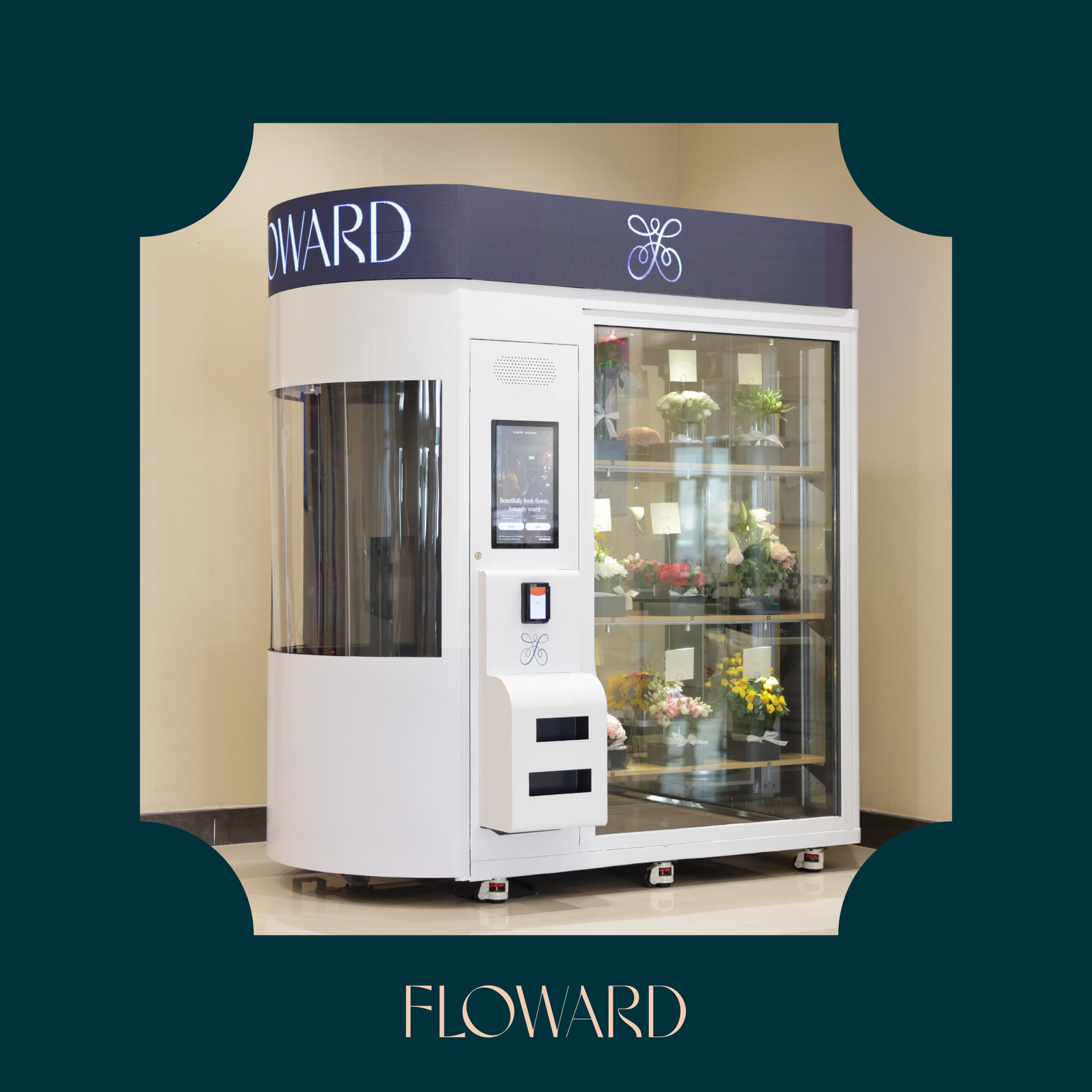
By May 2025, the online retailer was selling flowers through robotic vending machines in Saudi Arabia, the UAE, Qatar and Kuwait. The machines offered screen-based selection, automated fulfilment, printed message cards and a water-spraying system. Even a vending machine, apparently, needs to remember the flowers are alive.
In January 2026, Floward announced another extension: prepaid payment cards packaged with flowers. The Jordan launch involved GateToPay and Mastercard. The Kuwait collaboration with Boubyan Bank and Visa followed, with ordering scheduled to begin in February. The Kuwait announcement described a card usable online and at merchants accepting Visa.
These products solve different problems. A vending machine serves the person already passing a physical location. A prepaid card lets the recipient choose what to buy after the flowers arrive. Both keep Floward near the act of giving while changing what it must coordinate. A financial partner now sits beside the florist in the chain of organisations making the gift work.
07 / THE PEOPLEThe people carrying the promise
Floward’s ESG report published in 2025 described a workforce of more than 1,200. Its careers materials now talk about more than 50 nationalities and list ten markets, including Malaysia. The team spans the visible craft of floristry and less visible jobs in sourcing, product development and operations.
The company’s culture newsletter describes twice-yearly employee satisfaction surveys and meetings between new joiners and the CEO. These are its own accounts of working life. They fit a business whose service depends on people across several functions completing the same order.
Community activity also follows the calendar. For Ramadan 2026, Floward announced Omnia, a free-to-view Shasha programme giving children with disabilities a chance to experience their dream roles. In March, it announced Al Loughani’s appointment to Endeavor Saudi Arabia’s board, extending his involvement in the region’s founder network.
08 / THE TAKEAWAYWhat another retailer can borrow
The most useful lesson is a sequence of decisions. Find the moment customers judge the purchase. Decide which parts of the operation need direct control to make that moment dependable. Test related products through sales before committing to ownership. Floward’s own early city-launch formula emphasised workshop space close to customers and local hiring - physical requirements with consequences for delivery.
This model asks a lot of the market around it. As a matter of operating economics, thin order density makes facilities and dedicated delivery harder to support. Price-sensitive shoppers may not pay enough for elaborate preparation. Disrupted transport or overloaded holiday capacity can undermine the promise. An operator considering the model needs to examine those conditions before copying the catalogue.
Floward’s advantage depends on making all that coordination feel ordinary. The recipient should be able to enjoy the flowers without thinking about air freight, a warehouse or a payment partner. The company has added more ways to give. Each one adds another promise to keep when somebody opens the door.