Benjamin Smith had a particularly awkward announcement to make. He had spent more than four years building Disco, persuaded people to invest in it, and watched customers sign up for its products. In November 2023, he publicly said goodbye. The company had filed for Chapter 7 bankruptcy. A founder whose job had involved explaining why people should believe now had to explain what had gone wrong.
He chose to do that in public. His account acknowledged the people left behind: investors, employees, subscribers and vendors. It also considered decisions about positioning, products and customer acquisition. The specificity mattered. “Entrepreneurship is hard” would have been an easier post to write. It would have told the next founder considerably less.
By March 2026, Smith was making a different announcement. Mars Men, the company he co-founded with Zach Stuck, had raised $27.5 million in a Series A led by L Catterton. Between those two announcements sits the interesting part of his career: how a person keeps the appetite to build while becoming more exacting about the business he is building.
A change of address, with no reconnaissance
There is an earlier decision that helps explain the appetite. After university, Smith weighed New York, Miami and Los Angeles, then settled on Austin after some internet research. He moved without having visited or knowing anyone there. For someone who would later spend so much time discussing customer research, his research into his own relocation was agreeably brief.
His attachment to other places runs deeper. Born in England and raised from toddlerhood around Washington, D.C., he is a fifth-generation Aston Villa supporter. He also follows Formula One and Lewis Hamilton. Football allegiance is one form of inherited commitment that a new address rarely disturbs. A startup can change its name, colors and audience. Persuading a Villa family to change clubs would be another fundraising challenge entirely.
At Wake Forest University, Smith was already trying business ownership. He launched two boutique gyms while still a student, raised outside money and later sold the businesses. He graduated in 2015. That gave him an early encounter with customers who return, memberships that recur and the everyday work that follows an opening day.
The move from a local operation to an internet brand would preserve the attraction of a continuing customer relationship. It would also introduce a different dependence: people could discover the business through platforms whose rules Smith did not control. A physical address has a rent bill. An online storefront has its own landlords, even when their names never appear on the lease.
The bathroom counter as a business proposition
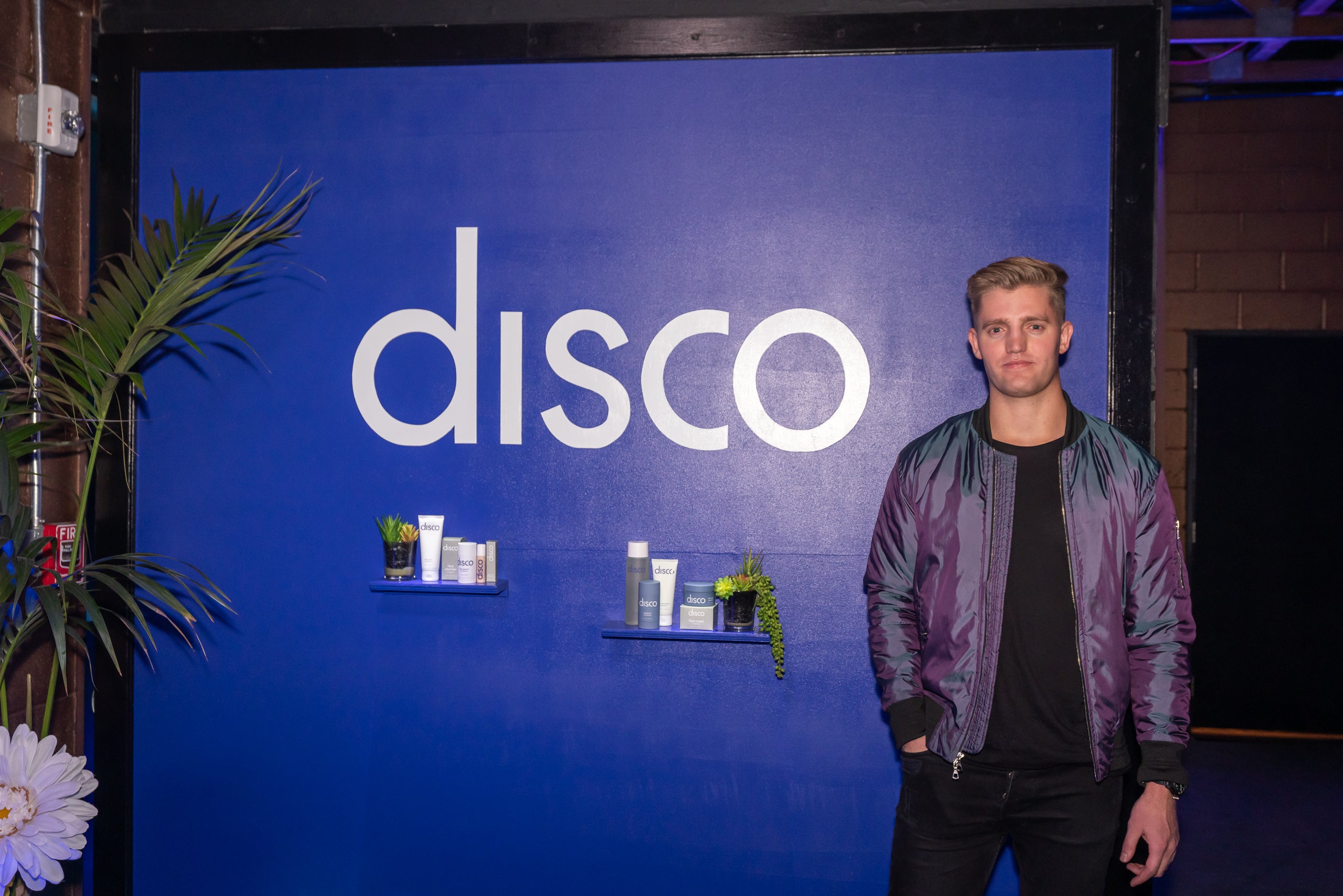
Disco launched in October 2019. Smith’s opening proposition was about convenience as much as branding: buying everyday grooming products should involve fewer separate shopping trips. A single brand, a coordinated range and a membership service could simplify replenishment. Replacing a depleted bottle was hardly an occasion customers were hoping to turn into a hobby.
He wanted the company to have a sense of humor. In an early account of the brand, he favored something playful and sophisticated over the familiar dark packaging and macho language. Working with Brooklyn agency High Tide, he developed an identity that customers might actually want visible on a bathroom counter. The object would do some of the talking before an advertisement ever appeared.
His job, meanwhile, had little of the simplicity he wanted to sell. Product development, supply chains, marketing and fundraising all landed on his desk. He also made time for Instagram messages and customer requests. Those small exchanges offered something a pitch deck could not: the language people used when they were buying, puzzled or dissatisfied.
Money was tight. Smith described maxing out credit cards on several occasions while trying to establish the business. Previous experience owning gyms helped his confidence, but it did not automatically persuade people to finance a consumer brand. He had to make a new case to a new audience, with bills arriving while the case was still being heard.
“In the beginning, persuading investors to trust me was difficult.”
Benjamin Smith, 2020
The customer he imagined, and the customer who bought
One of Smith’s more useful admissions concerned his own assumptions. He had expected a strong brand and well-developed products to carry more of the load. Building a company around people like yourself feels like research when you are the person in question. The checkout page eventually offers a less accommodating opinion.
When he examined customers more closely, he found an audience older than the team had expected. Surveys and Instagram analytics prompted changes in messaging, models and landing pages. The aim was continuity: the person attracted by an advertisement should recognize the same proposition when arriving at the website. Good design could help that encounter; it could not decide whom the encounter was for.
Smith was willing to describe this as something he had learned late. His advice to another founder became more practical: understand demand before committing to an elaborate brand, and have customer acquisition expertise involved early. That expertise might belong to the founder, a colleague or a co-founder. Someone needed to understand the route from interest to an actual order.
In a separate discussion, he reduced brand building to confidence, visual identity and consistent communication. He also warned against spending too much attention on the newest website apps. The attraction of another tool is understandable. Installing one offers a satisfying little finish line. Understanding why a customer does not buy is less obliging.
Who is actually buying?
Smith’s account of customer research at Disco, expressed as a sequence rather than a growth promise.
When the platform changes the arithmetic
In 2021, the route became considerably more expensive. Smith said Disco’s acquisition cost rose 300% after Apple’s iOS 14.5 changes. At roughly the same time, the company put a leading product on Amazon. He then saw Amazon bidding on Google keywords that Disco used to bring people to its own store.
He pulled the business off Amazon. His account was that the website’s conversion rate subsequently doubled and Facebook acquisition costs fell. For a founder interested in subscriptions and the direct customer relationship, the distribution decision had become a question about where value accumulated. More places to buy could also mean more ways to lose control of the sale.
By 2022, he was discussing a fresh bridge round, reduced operating expenses and lower marketing spending. The language had shifted from reaching more people to protecting room to operate. These are decisions that rarely make an exciting launch photograph, although they can occupy far more of a founder’s working day.
There were visible signs of momentum too. Creator Griffin Johnson joined Disco as an investor, adviser and brand ambassador in 2022. Smith’s career contained the introductions, partnerships and public recognition that often populate a company’s success story. Their presence makes the eventual closure more instructive: those markers and a durable business are separate achievements.
A public goodbye with people in it
Disco filed for Chapter 7 in November 2023 after its debt provider had foreclosed during the summer. Smith described attempts to raise money, three unsuccessful acquisition processes and an exploration of restructuring. The team had reduced spending and worked on its economics. None of those efforts produced a rescue.
His explanation resisted the convenience of a single villain. Digital advertising had become harder, but he also discussed brand positioning and dependence on a leading product. That combination gave the account its weight. External changes can expose decisions that looked tolerable under better conditions. A useful reckoning has to consider both.
He acknowledged that shareholders were left with nothing and that employees, subscribers and vendors bore consequences. There is a temptation to make business failure sound like a seminar purchased exclusively for the founder’s benefit. Smith’s public account kept other people in the frame. Their losses belonged in the story alongside whatever he learned.
Disco launches in October.
Smith publicly addresses its November bankruptcy.
Mars Men announces its $27.5 million Series A.
Another company, and a co-founder
Mars Men brings Smith together with Stuck, its co-founder and chief marketing officer. The partnership is an interesting development beside Smith’s earlier advice about involving acquisition expertise from the beginning. The resemblance is visible; it does not require inventing a private conversation in which the two drew up a list of everything Disco would have done differently.
At its March 2026 financing announcement, Mars Men reported a $100 million annual revenue run rate and more than 400,000 customers. A run rate describes the pace of sales at a point in time, so it should be read with that precision. The company also said it had reached that stage profitably, before taking outside capital. L Catterton’s investment accompanied plans for a larger team, partnerships, distribution and product expansion.
For Smith, the financing creates another set of obligations along with opportunities. He is again responsible for what happens after the announcement: hiring people, serving customers and making decisions when circumstances change. His earlier interviews suggest he knows how easily a founder can become busy enough to stop examining the assumptions underneath the work.
The continuity in his career is his interest in the customer who returns. The change is the amount of experience he brings to earning that return. The younger founder wanted to make something people would be pleased to display. The current CEO has also had to explain what happens when a business cannot keep going. Both experiences belong to Benjamin Smith. His next decisions will be made with both on the desk.