Justin Guilbert knows a perfectly serviceable origin story when he sees one. Two friends walk along a beach. A coconut falls. Inspiration strikes, preferably somewhere near a camera. Harmless Harvest could have had that story. Its co-founder has cheerfully explained that it did not. He and Douglas Riboud began with an argument about how business ought to work, then went looking for something to sell. The coconut arrived after the philosophy. This is a less convenient sequence for a marketing department, which may be part of its charm.
Guilbert had worked inside one of the places where consumer stories are professionally assembled: L’Oréal. His subsequent career has kept circling the relationship between the promise on a package and the arrangements behind it. First came a beverage company. Later came BRAVO SIERRA, developed with military service members and veterans. The objects changed. His interest in who makes them, who uses them and who benefits remained conspicuous.
A very short stay on Wall Street
He grew up in Paris, with an American mother and a French father. His grandfather, John Becker, offered a particularly concrete version of American enterprise. A World War II Navy veteran, Becker founded Eurpac Service, which distributed brands to the military, and served as chairman of the USO. For Guilbert, he became a reference point for thinking about a business’s purpose as well as its proceeds.
The grandson initially took a more conventional route. He joined Goldman Sachs in New York as an analyst and left after a few months. In a later conversation with Michael Chernow, that brief stay was described as 90 days. It is an admirably compact banking chapter. The same interview covered childhood in France, cultural differences between his parents and the usefulness of failure. His résumé acquired its departures early.
At L’Oréal, Guilbert worked on marketing for Maybelline and Garnier. He came away questioning the relationship between research and advertising: in his account, manufacturing was being asked to serve a narrative that marketing had already written. His eventual departure in 2008 opened up a different problem. If he wanted to build something around the making, he would have to decide what to make.
The company came before the coconut
Riboud, a business-school friend, supplied the other half of the conversation. The pair founded Harmless Harvest in 2009. They wanted a company whose commercial activity could benefit the people and places involved in producing its goods. Food offered a way to put that intention into practice. Soil, crops, growers, processing and a finished drink made the relationships tangible. An abstract position would eventually have to pass a taste test.
The early project was less tidy than the familiar coconut-water bottle suggests. In 2010, the founders were talking about wild-harvested ingredients and a fruit blend called Mato. Coconut water’s reception surprised them. They had been travelling, considering unfamiliar fruits and looking for commercial uses for crops that received little attention in the industrial food system. Their first proposition contained several possible businesses. The one shoppers remember emerged from that exploration.
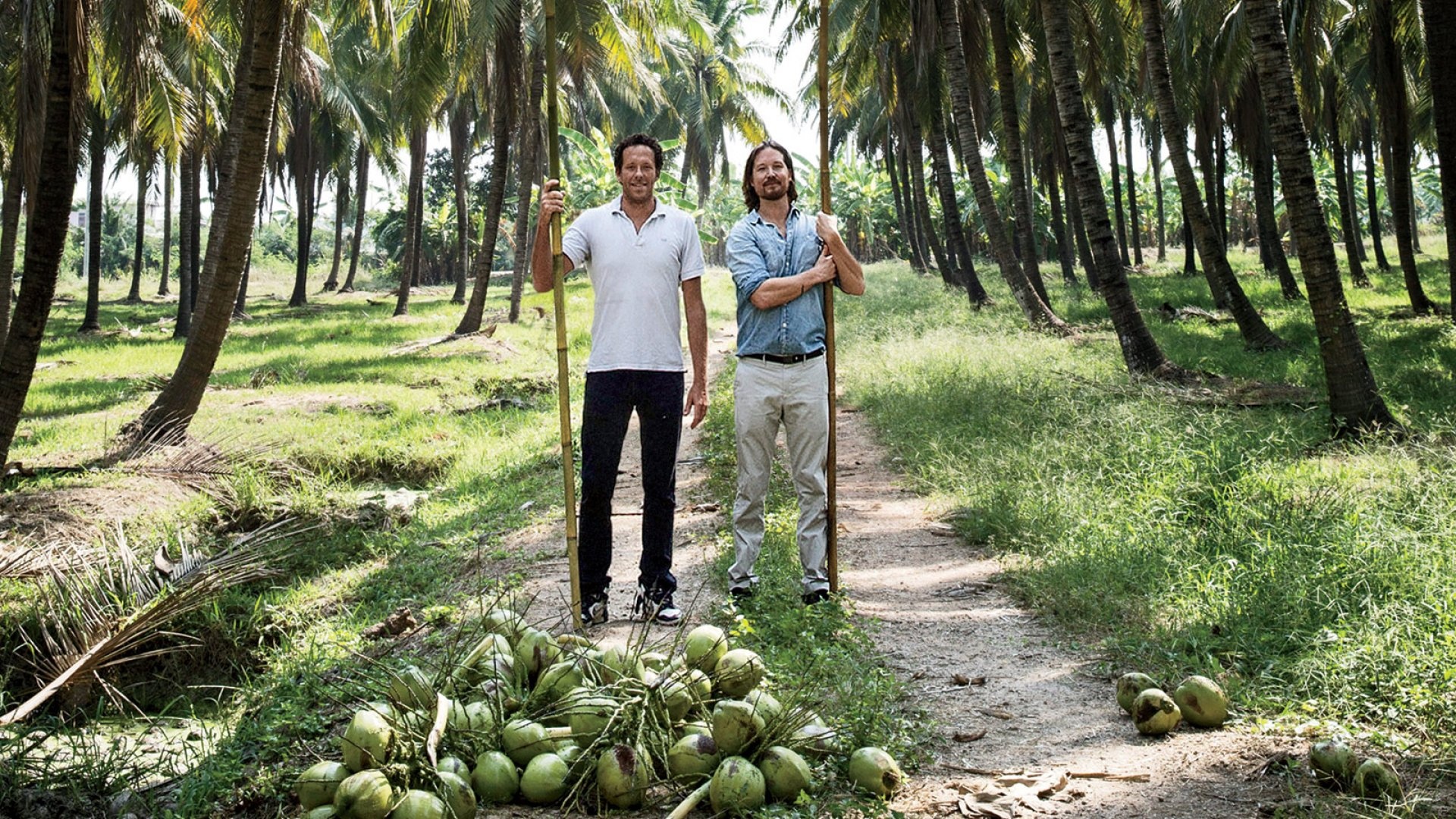
By the commercial launch in 2011, coconut water had become the defining product. The work behind it included finding a suitable coconut and developing a way to preserve its taste. Later accounts described a Thai variety, Nam Hom, and a factory close to the farmland. Those choices gave the founders a practical version of the company they had first discussed: the sourcing and production decisions belonged inside the proposition.
In 2012, the production rhythm could be described in unusually concrete terms. Only three to six minutes separated opening a coconut from bottling its water. Guilbert described working with small-scale Thai farmers. For a customer, the encounter lasted a few seconds at a refrigerated shelf. Behind that encounter was an arrangement of people, geography and timing that the founders wanted the business to support.
What the bottle could not explain
Guilbert was quite willing to defend the price. In 2015, he discussed selling a 16-ounce bottle for roughly four to five dollars, arguing that customers would pay for a difference they could experience. He resisted treating Harmless Harvest as interchangeable with the established coconut-water brands. The distinction, as he described it, ran through the product and its supply chain. His shorthand was emphatic: “product, product, product.”
That emphasis created an interesting problem for a former brand marketer. A package has limited space. A production system has rather more moving parts. In 2015, Harmless Harvest removed “100% Raw” from its labels. Guilbert explained that a description he once considered useful had become an overused category term. He wanted the brand to communicate the source of the ingredients and the relationships around them, rather than leave consumers remembering a single fashionable word.
His explanation returned to the starting material: better processing could not redeem a poor ingredient. He described a sequence beginning with soil and farming, moving through relationships with growers and ending with harvesting, bottling and processing. This was a demanding amount of biography to ask of a beverage label. It also shows why the label change mattered to him. A convenient descriptor could obscure the business he believed he was building.
“Let’s find an industry and then a product to prove this works.”
Justin Guilbert, on the thinking behind Harmless Harvest, 2016
The business continued beyond its founders’ daily management. Harmless Harvest appointed Ben Mand CEO in 2018. In 2021, Danone Manifesto Ventures took a majority stake, after first investing in 2017. The founders welcomed the expanded collaboration. There is a useful distinction here between originating a company and carrying it through every subsequent stage. Guilbert’s career had room for a company to grow under another operator while his attention moved toward a new experiment.
A second conversation, a different customer
BRAVO SIERRA grew out of conversations with Benjamin Bernet, a longtime friend who also knew L’Oréal from the inside. Guilbert recalled family visits to East Hampton, discussions about consumer culture and the American experiment, and young fathers finding a little time to talk after the children’s day was done. Their late nights could begin at eight. Entrepreneurship occasionally keeps surprisingly sensible hours.
The brand launched in 2019 with products intended for military customers and a wider civilian audience. Former Army Ranger Charles Kim helped connect the project to that community. The military connection brought a particular set of users into development: people whose daily circumstances could expose weaknesses in an otherwise plausible product. It also echoed a world Guilbert knew through his grandfather, though BRAVO SIERRA had its own collaborators and methods.
Battalion gave that participation a structure. It combined a community of testers with a digital feedback platform. The 2020 Series A announcement described more than 1,000 active-duty service members contributing to development. By the 2022 financing announcement, the stated community included 2,500 special-operations personnel, active service members and veterans. These are snapshots of a developing network, rather than a timeless head count.
A simplified view of the collaborative development approach.
The approach outgrew a single product range. Under the parent company Rhizome, the founders explored applying the feedback infrastructure to other development projects. That makes the software part of Guilbert’s story, even though the most visible results came in ordinary consumer packaging. A community could help decide what should be made, then remain involved while it was improved.
The participants also became part of the company’s continuity. In an August 2024 anniversary post, Bernet recalled the early testing work with members of the Army’s 75th Ranger Regiment, 2nd Battalion. He named the original team and described more than 2,000 Battalion testers still providing feedback. Five years after launch, he presented those relationships as part of the operating business. The community had work to do after the launch photographs were taken.
The economics reach the shelf
A product philosophy still needs somewhere to sell its products. BRAVO SIERRA began with military exchanges and expanded into civilian retail and e-commerce. Its February 2020 announcement disclosed a $12 million Series A. In August 2022 came a $17 million Series B led by The Merchant Club, alongside a Walmart rollout. Guilbert, identified then as founder and co-CEO, tied the expansion to reaching more people at affordable prices.
August 2022
community programs, as announced
The company committed five percent of sales to programs supporting the military community. Basing a contribution on sales gives it a different place in the business from a donation considered after profits are counted. It belongs in the economics of the transaction. For Guilbert, whose earlier venture had put relationships with growers inside its commercial model, that arrangement extended a recurring interest in making a company’s stated purpose operational.
Distribution also meant changing how the company found customers. In August 2021, BRAVO SIERRA stopped buying Facebook and Instagram advertising. A year later, Bernet described reallocating attention toward Amazon, community marketing and physical retail. He reported Facebook acquisition costs around $70 before the change, against consistently sub-$10 acquisition costs on Amazon. Those were his 2022 comparisons, attached to particular channels and a particular moment.
The lesson in that episode is practical rather than permanent. The founders were prepared to change a marketing arrangement when its economics became difficult to justify. Guilbert publicly applauded Bernet’s work. For someone who had questioned marketing’s hold over product development, it was another occasion to examine which part of the system was earning its place. Even a familiar channel had to answer for the money.
The philosopher in the personal-care aisle
There is a less corporate Guilbert in his interviews, too. Asked about flying, he described reading poetry and essays by Deleuze and Spinoza, then making room for romantic comedies. He preferred travelling clothes as close to pajamas as decency permitted. It is a pleasing combination: difficult philosophy, comfortable trousers, an undemanding film. Consumer taste rarely observes the categories that businesses draw for it.
His public work continues to move. His LinkedIn profile now lists hazelwood beauty with an anticipated 2027 arrival, alongside references to his earlier ventures. It is another entry in a career that has repeatedly crossed product categories. The question running through the completed chapters is already substantial: how much of a company’s story can be built into the goods themselves? Guilbert keeps taking that question back to the people who make and use them.