In 1897, John T. Dorrance confronted an oddly expensive ingredient: water. Soup contained plenty of it. Customers had plenty at home. Yet the company that would become Campbell’s was paying to package it, store it, and move it around. The chemist’s solution was to remove some before shipping and let the customer put it back. A familiar dinner became a different kind of business.
- The idea: let customers add the water.
- The business: branded meals, drinks, and snacks.
- The tension: familiar names, softer sales, another reset.
The clever part was where the work happened. The factory supplied the recipe and preservation; the household supplied the final dilution. Smaller cans made distribution cheaper. Campbell’s condensed soup sold for ten cents a can, and by 1911 it had national distribution. Convenience came from rearranging an ordinary task.
That little division of labor explains more about The Campbell’s Company than its famous label does. Its enduring territory is the gap between cooking everything yourself and buying a finished meal. Today that territory includes broth, pasta sauce, cookies, chips, crackers, and soup. The cupboard has become considerably more crowded.
01The business between scratch and supper
Joseph Campbell, a fruit and vegetable merchant, and commercial canner Abraham Anderson founded the Camden business in 1869. Dorrance joined later. That distinction matters: Campbell’s began as a preservation company before condensed soup gave it a defining product. Expansion beyond soup is an old habit.
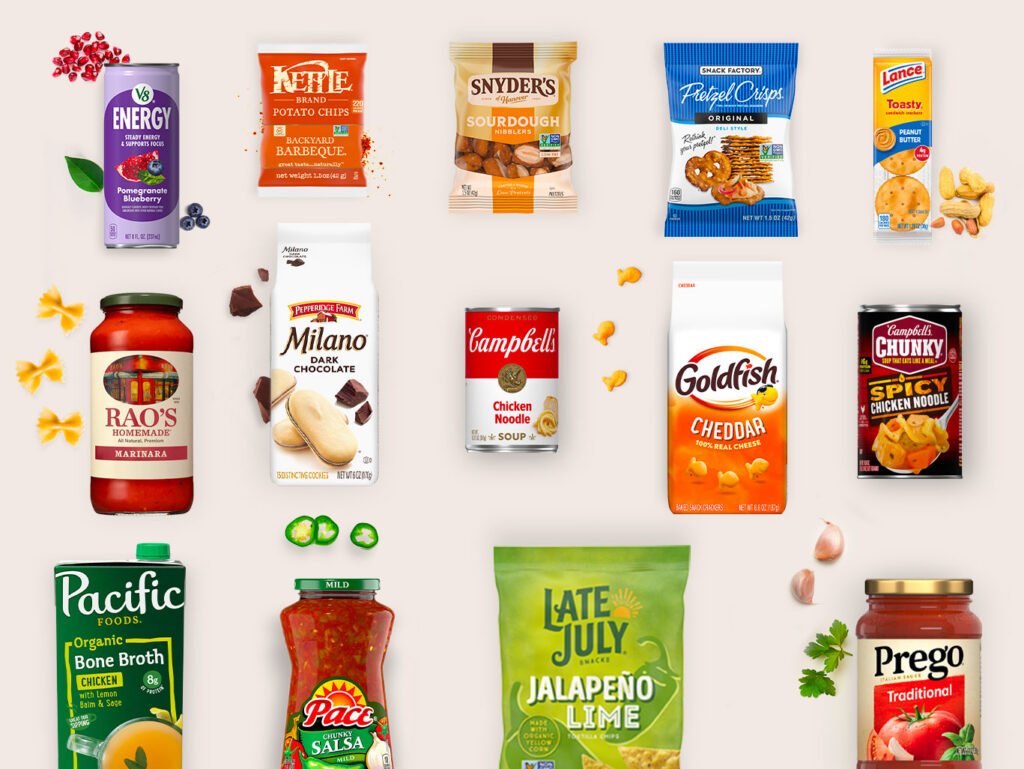
The modern operation has two divisions, Meals & Beverages and Snacks. Campbell’s and Chunky cover soup; Swanson supplies broth and stock; Prego and Rao’s handle pasta sauce; V8 supplies beverages. Pepperidge Farm, Goldfish, Snyder’s of Hanover, Cape Cod, Kettle Brand, and Late July occupy other shelves. In November 2024, shareholders approved dropping “Soup” from the corporate name. The groceries had already made the argument.
Consumers buy those products, but retailers and distributors are the company’s immediate commercial customers. Foodservice extends the business into restaurants, healthcare facilities, schools, and lodging. Campbell’s makes money by manufacturing and selling branded food through those channels. Its expertise combines recipes, food safety, packaging, procurement, manufacturing, and getting replenishment right.
The range also contains choices for particular dietary needs. In June 2026, Campbell’s announced a condensed chicken soup with Banza chickpea pasta for gluten free eaters. That is a specific product answer to a specific constraint. It does not make every soup in the portfolio interchangeable: ingredients, preparation, and dietary suitability vary by product. For a household, the practical starting point is the label and the recipe. For a foodservice buyer, it is choosing a format that fits the kitchen, the menu, and the people being served.
A shopper can turn broth into a soup base, condensed soup into a casserole ingredient, or jarred sauce into dinner. Campbell’s competes with General Mills’ Progresso in soup, PepsiCo’s Frito-Lay in salty snacks, and store brands across the basket. Its portfolio lets it serve several eating occasions and price levels. Each brand still has to earn its place against an alternative.
02The $1.55 billion trip to the refrigerator
In August 2012, Campbell bought Bolthouse Farms for $1.55 billion in cash. Carrots, refrigerated beverages, and dressings offered another route into people’s kitchens. But moving from the pantry to the refrigerator introduced a different set of operating demands.
The trouble became concrete in 2016. Bolthouse recalled 3.8 million bottles of Protein PLUS beverages because of possible spoilage. Campbell identified manufacturing equipment and processes as the primary cause. Enhanced procedures shortened a typical production run from 72 hours to 24, reducing capacity. Carrot quality and execution problems compounded the damage. The breakdown was painfully physical: equipment, crops, and throughput.
The board’s August 2018 portfolio review called for selling Campbell Fresh and the international business, concentrating on North American meals and snacks, and reducing debt. In June 2019, Bolthouse sold for $510 million. That is a $1.04 billion gap between announced purchase and sale prices, before considering intervening cash flows, investment, or accounting adjustments. It is a price comparison, not a calculation of total loss.
03A jar worth buying the company for
The next major pantry bet was Rao’s. Campbell completed its acquisition of Sovos Brands in March 2024 at an announced enterprise value of approximately $2.7 billion. The deal brought Rao’s and Michael Angelo’s, along with noosa yogurt, which Campbell subsequently sold in February 2025.
Rao’s offered premium sauce alongside the existing Prego business. By March 2026, Campbell described Rao’s as a billion-dollar portfolio spanning sauce, soup, pasta, and frozen meals. Its origins in a New York restaurant supplied a story; the grocery aisle supplied a much larger audience.
Then Campbell moved closer to production. In May 2026, it completed a 49% investment in La Regina, the maker of all Rao’s tomato-based jarred sauces. The agreed consideration was $286 million, split between closing and the following year. Here was another division of labor: the consumer-facing brand and its specialist producer becoming financially tied together.
04A full cupboard still needs repeat buyers
The latest numbers make this more interesting than a comforting heritage story. Fiscal 2026 net sales were $9.744 billion, down 5% as reported and 2% organically. The prior year contained an extra week, so those measures tell different stories. Fourth-quarter organic sales fell 6% in Snacks while Meals & Beverages grew 3%.
In September 2026, CEO Mick Beekhuizen acknowledged the shortfall. Campbell announced a new program targeting $500 million in savings by fiscal 2030 and cut its quarterly dividend from 39 cents to 25 cents to accelerate debt reduction. Those are intended remedies, with results still to come.
“Our performance is not where it needs to be.”
Mick Beekhuizen · President & CEO · September 2026

Its stated purpose, “Connecting people through food they love,” also reaches outside the supermarket. Full Futures, its school nutrition partnership with Alliance for a Healthier Generation, received a 2026 Gold Halo Award. Internally, Campbell names care, character, collaboration, competitiveness, and creativity as its values. These describe management’s expectations; they do not settle the performance question.
The useful lesson is specific: identify the costly work a customer can comfortably finish, then make the remaining work dependable. That logic weakens when refrigeration, quality controls, or supply capacity outrun operating competence. It also weakens when a familiar brand cannot justify its price. Dorrance’s can worked because the household’s contribution was easy. Every new product asks Campbell to solve that equation again.
Explore the brands, recipes, and business.