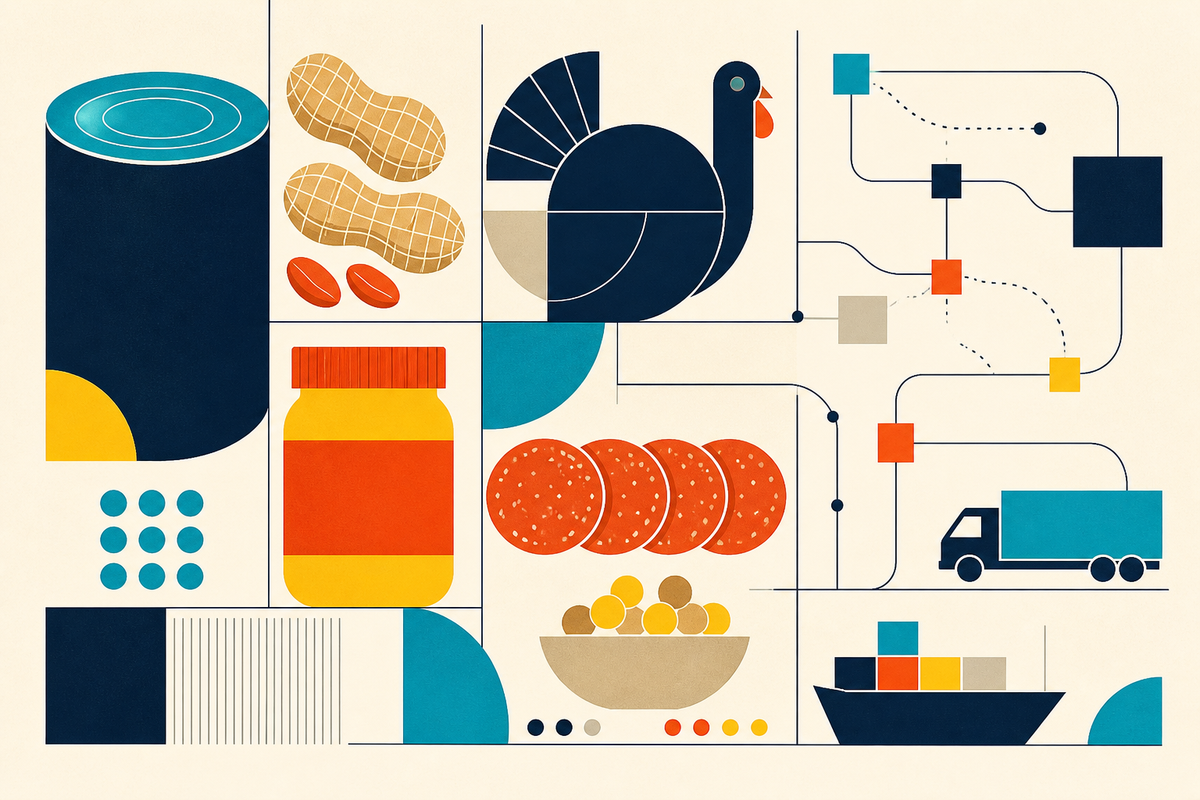
A jar of Skippy, a pouch of Applegate deli meat and a tin of Planters peanuts do not look like parts of the same machine. Add a blue can of SPAM, a Jennie-O turkey burger and the pepperoni on a delivery pizza, and the machine begins to show itself. Hormel Foods has spent 135 years assembling a portfolio that follows eating occasions rather than grocery-store departments. It appears in the pantry, refrigerator, deli, convenience store and restaurant kitchen, often without the consumer noticing the corporate name behind the label.
That invisibility is useful. Hormel can let each brand speak in its own accent while the parent company supplies factories, procurement, food science, sales relationships and distribution. In fiscal 2025, that system produced $12.106 billion in net sales. Retail accounted for $7.46 billion, foodservice for $3.94 billion and international operations for $709 million. The balance matters: a shopper choosing peanut butter and a pizzeria ordering a case of pepperoni are different customers, but both can feed the same operating network.
Convenience, wearing many packages
Hormel calls itself a protein-centered branded food company. That is accurate, but the more revealing word is convenience. SPAM makes meat shelf-stable. Hormel pepperoni removes preparation from pizza night. Dinty Moore turns stew into a heat-and-eat purchase. Skippy and Justin's package portable calories. Planters and Corn Nuts turn the same basic need into a snack. Columbus makes charcuterie ready to open, while Applegate sells prepared meat to shoppers who care about ingredient and animal-raising standards.
For households, the problem solved is usually small and recurring: what can be packed, heated, spread, served or eaten now? For restaurants and institutions, the friction is larger. Operators need consistent portions, predictable performance, food safety, labor savings and a supply chain that can deliver at scale. Hormel Foodservice sells branded pepperoni, Italian meats, smoked meats, turkey and customized prepared proteins. The operator gets a repeatable ingredient; Hormel gets volume and a view into how tastes move outside the supermarket.
“The portfolio is the menu. Distribution is the kitchen.”Hormel's business logic, in one line
Own the occasion, not one identity
The company began in 1891, when George A. Hormel opened a meat business in Austin, Minnesota. Product engineering gave it early reach: canned ham in 1926, then SPAM in 1937. Shelf life widened the distance between plant and plate. During World War II, the company shipped as many as 15 million cans of meat overseas per week. A practical product became a global object, eventually absorbed into local dishes from Hawaii to South Korea.
The modern portfolio was assembled through a mixture of invention, acquisition and partnership. Skippy arrived in 2013. Applegate followed in 2015, Justin's in 2016 and Columbus Craft Meats in 2017. The $2.79 billion Planters transaction in 2021 added a century-old snack brand and deeper access to convenience stores. MegaMex Foods, a joint venture with Herdez del Fuerte formed in 2009, gives Hormel a route into Mexican-food brands including Herdez and Wholly Guacamole.
Each deal placed another bet on an eating occasion or consumer preference. Applegate covers natural and organic prepared meat. Justin's covers premium nut-butter snacks. Planters covers the communal bowl, the gas-station rack and the workday handful. Hormel does not require these brands to look related. It needs them to share capabilities behind the scenes and earn enough space in their own categories.
Three doors into the same company
Hormel reports three segments because the route to the customer changes the job. Retail is a contest for recognition, shelf position, price and repeat purchase. Foodservice is more consultative: a direct sales force works with operators and distributors on products that fit kitchens, menus and labor constraints. International combines exports with subsidiaries, licensees and joint ventures. In China, for example, the company can manufacture and sell in country; elsewhere, SPAM and Skippy may travel through distributors.
Brands turn trust and convenience into frequent household purchases.
Products save prep, standardize output and solve operator constraints.
Exports, local operations and partners adapt the portfolio market by market.
This is where Hormel differs from a pure meat processor. Tyson Foods, Smithfield, JBS and private-label plants compete in protein; Kraft Heinz, Conagra and General Mills compete for packaged-food attention; specialists compete in every niche. Hormel's distinction is the overlap. It owns manufacturing knowledge in protein, consumer brands with long memories, and a meaningful foodservice business. One channel can expose a flavor or format before another scales it.
The system also has an unusual long-term shareholder. The Hormel Foundation, created in 1941, holds a large stake and directs grants toward Austin and surrounding communities. That structure does not remove quarterly pressure - Hormel is an NYSE-listed company - but it ties corporate endurance to a hometown institution in a way few Fortune 500 businesses can match.
The same local-to-global pattern appears in Hormel's social programs. Since 2020, the company reports donating $53.6 million in cash and products toward food security. Project SPAMMY is the more unusual expression of its expertise: a fortified, shelf-stable turkey spread developed with public-health and nonprofit partners for families in Guatemala. Hormel says it donates 2.5 million cans each year. The program is philanthropy, but it also reveals what the organization knows how to do - formulate protein for a nutritional requirement, make it safely at scale and move it through a difficult distribution environment. Corporate responsibility is most convincing when it uses capabilities that already exist inside the company.
A durable portfolio can still get stale
Scale solves distribution but creates its own frictions. Commodity prices, animal disease, freight, labor and retailer bargaining power can move margins quickly. Familiar brands must keep pace with shoppers who want more protein, less preparation, clearer ingredients or bolder flavors - sometimes all at once. A portfolio this broad can protect the whole company from one weak aisle, but it also asks management to allocate advertising, factory capacity and attention across dozens of businesses.
Fiscal 2025 captured the tension. Sales grew 1.6 percent, but reported net earnings fell to $478 million, affected by impairment charges and transformation costs. By the second quarter of fiscal 2026, the picture had improved: net sales were $2.97 billion, organic sales rose 3 percent and each segment posted both sales and segment-profit growth. Foodservice recorded its 11th consecutive quarter of organic sales growth, led by customized solutions, branded pepperoni and premium prepared proteins.
Portfolio editing is now as important as portfolio collecting. Hormel sold its whole-bird turkey business in 2026, keeping value-added Jennie-O products while reducing exposure to a more volatile commodity operation. It also completed the sale of Ceratti in Brazil. These are clues to the desired shape of the company: fewer businesses where price is set mostly by a commodity cycle, more where a brand, formulation or customer solution earns a premium.
A good can lasts for years. A good packaged-food company has to keep changing what goes inside the system.The modernization problem
The incoming chief knows both brands and plants
John Ghingo is scheduled to become chief executive on October 26, 2026, succeeding interim CEO Jeff Ettinger. His resume crosses the portfolio's fault lines. He spent more than 15 years at Mondelēz, worked with Planters before Hormel owned it, led plant-based businesses at WhiteWave and ran Hormel subsidiary Applegate. As Hormel president, he has overseen Retail, Foodservice, International, operations, supply chain, research, technology and strategy.
His assignment is less about discovering a new identity than making the existing one move faster. Hormel is investing in data and technology, introducing portable products such as refrigerated Hormel Pepperoni Snack Bites, and using foodservice collaborations to test globally inspired flavors. At the same time, it must improve factories, simplify the portfolio and protect the dependable products that fund experimentation.
The larger market position is easy to misunderstand. Hormel is neither the biggest commodity meatpacker nor the broadest global food conglomerate. It sits between them: a scaled American branded-food manufacturer with unusual depth in value-added protein, a substantial operator-facing business and a few brands that travel well across borders. Its customers do not need to admire that architecture. They only need the jar to be on the shelf, the pepperoni to cook the same way and the case to arrive before dinner service.
That is the stealable lesson. Distribution becomes more valuable when a company gives it multiple jobs. A grocery relationship can carry peanuts, peanut butter, bacon and party trays. A foodservice relationship can carry pizza toppings, smoked meats and a custom protein. A factory network and research team can support products with different names but similar technical demands. Hormel's quiet trick is to make a portfolio feel miscellaneous to shoppers and coherent to the people running it.