Consider two bread bags. One carries Wonder’s cheerful dots. The other presents Dave’s Killer Bread, with its muscular, guitar-playing mascot. They seem to have arrived from different Americas. Yet both belong to Flowers Foods. In a supermarket, difference is something this company manufactures as carefully as the bread itself. The interesting question is how those differences reach the same shelf.
- Distinct brands let Flowers sell familiarity, organic ingredients and gluten-free choice.
- Delivery and merchandising turn bakery capacity into a presence in stores.
- Expansion into snacks brings opportunity, expense and no exemption from weak demand.
A loaf with a deadline
Bread comes with an awkward business condition: the clock is always running. Producing a loaf is only one task. Getting the right quantity into a store, keeping the display stocked and removing unsold goods are equally practical concerns. A beautiful recipe has limited commercial value if the customer encounters an empty space.
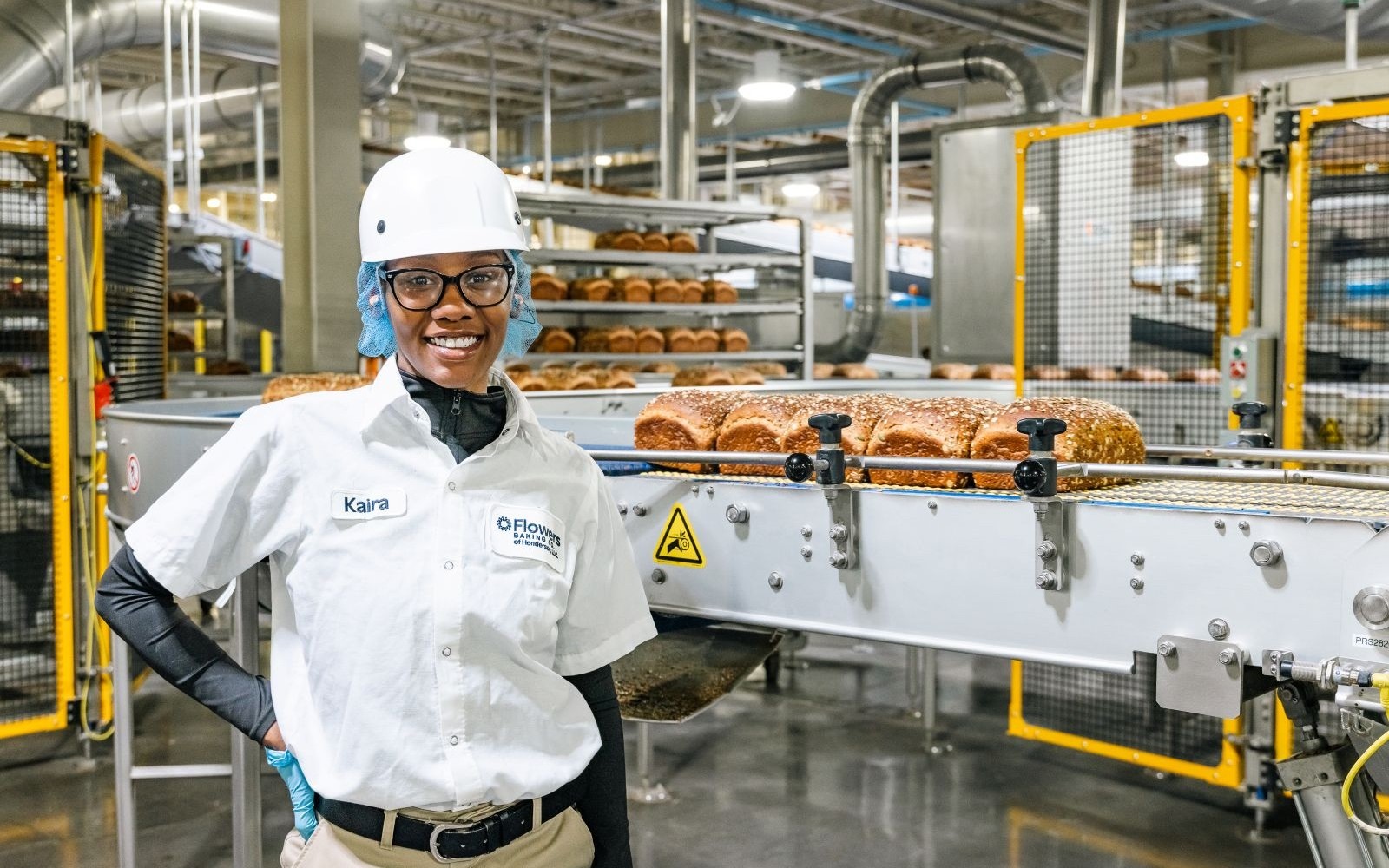
Flowers addresses that problem through direct-store delivery and warehouse delivery. Its independent distributors order, sell, stock shelves, maintain displays and remove unsold goods. Some markets use employee sales routes. Warehouse delivery takes products to customers’ warehouses. These arrangements make Flowers a manufacturer with a substantial distribution job attached.
The company describes more than 5,800 distribution territories, about 4,600 sold to independent distributor partners with exclusive rights to specified products in defined areas. That network is useful to retailers seeking dependable supply and to brands seeking wider availability. For a smaller food business, reproducing those relationships would be a considerable undertaking.
Different bags, different promises
Flowers started with a much shorter journey. Brothers William Howard and Joseph Hampton Flowers Jr. opened their Thomasville bakery in 1919 and sold 500 loaves on the first day. Its later history includes acquisitions and homegrown products: Nature’s Own debuted in 1977; Tastykake joined in 2011; Wonder arrived with former Hostess bread assets in 2013.
Each name offers a different reason to reach for the bag. Nature’s Own sells familiar everyday breads. Dave’s Killer Bread offers organic products. Canyon Bakehouse serves gluten-free needs. Tastykake supplies sweet snacks. For shoppers, the practical benefit is choice within ordinary shopping routines. Restaurants and institutional buyers also purchase bakery products through Flowers’ foodservice business.
That breadth places Flowers alongside Bimbo Bakeries USA, whose brands include Arnold, Oroweat, Thomas’ and Sara Lee, and against store brands and regional bakers. Flowers’ position rests on its particular combination of brands and routes. A consumer may compare two loaves without knowing either parent company. The retailer has to consider who can keep supplying them.
Dave’s supplies a useful example. Flowers announced its purchase for approximately $275 million in cash in 2015. Then-CEO Allen Shiver promised fidelity to what customers already liked:
“We are firmly committed to staying true to the recipes, baking process”Allen Shiver / acquisition announcement, 2015
The brand’s own history records nationwide expansion in 2016, including Canada and Mexico. Its identity also includes second-chance employment, rooted in co-founder Dave Dahl’s return to his family’s bakery after imprisonment. Distribution could expand while that story remained recognizable. The business lesson is specific: buying a brand creates value only if its appeal survives the purchase.
There are two customers in this arrangement: the person choosing lunch and the buyer deciding what the store will carry. Flowers must satisfy both. Its annual report identifies Walmart and Sam’s Club as its largest customer, accounting for 21.5% of fiscal 2025 sales. That concentration gives a concrete shape to the relationship. A national footprint still depends on individual customers continuing to make room.
The work behind that footprint is less picturesque than a bread bag. Flowers describes safety training beginning at orientation and reinforced annually, alongside internal audits and processes for reporting unsafe conditions. Its community work includes a Feeding America partnership and donations of usable products nearing the end of their selling life. These activities connect the company’s stated values to the physical realities of operating bakeries: people work around machinery, and perishable food needs a destination while it can still be eaten.
The $795 million turn toward snacks
In February 2025, Flowers completed its Simple Mills acquisition. The announced cash price was $795 million; its annual report subsequently recorded approximately $848.6 million in total consideration. Those figures describe different measures of the transaction. Simple Mills brought crackers, cookies, snack bars and baking mixes, extending Flowers further into shopping occasions beyond sandwiches.
This was an established business. At announcement, Simple Mills products were available in more than 30,000 stores, with estimated 2024 net sales of $240 million. Flowers described distribution expansion and faster innovation as opportunities. To help finance the purchase and related expenses, it priced $800 million of senior notes. Growth arrived with obligations attached.
Bigger sales, fewer loaves
The pressure was visible in fiscal 2025: sales rose 3% to about $5.256 billion, but the acquisition and an extra reporting week offset declining volume and lower price/mix. Reported growth did not mean more underlying demand. Flowers announced a comprehensive review of its brands, supply chain and financial strategy in February 2026.
By the second quarter of 2026, volume declined 5.8% and sales fell 4%. Management lowered its annual outlook and described changes in consumer purchasing and sustained competition. Its response included a Nature’s Own relaunch emphasizing simpler ingredients. The company said that initiative had not yet meaningfully contributed to results. A promising response still needed evidence.
Execution also includes the label. In October 2026, Flowers recalled specified Nature’s Own Hawaiian Bread packages distributed in five states because milk was undeclared. No related illnesses or incidents were reported at announcement. For a portfolio selling dietary choices, ingredient control and accurate labeling are everyday obligations with unusually direct consequences.
Borrow the experiment
There is a more affordable idea to copy. In 2022, Flowers introduced a website for direct purchases of trial products, collecting sales and consumer feedback before deciding on broader launches. It gave new snacks a smaller proving ground. Buyers could demonstrate interest with an order, giving the company something more concrete than enthusiasm in a meeting.
That approach travels well: test a new eating occasion, observe purchases, then expand. It depends on representative customers and reliable production. A small online audience may misrepresent supermarket demand; wider delivery cannot fix a product people stop buying. Flowers’ history makes the attraction of scale plain. Its recent results make the conditions equally plain: the shelf must keep earning the shopper’s hand.